Lee Bok-hyun, Governor of the Financial Supervisory Service (FSS), whose term ends in early June, met consecutively with the heads of financial supervisory authorities in Hong Kong and China to discuss ways to strengthen cooperation for the development of capital markets.
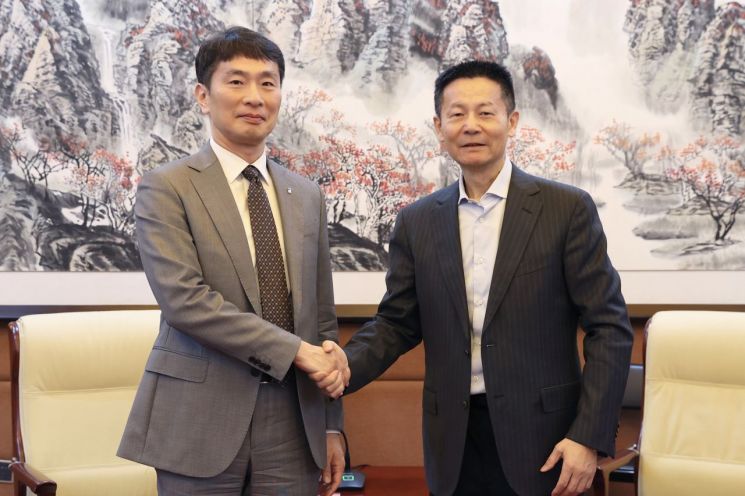 Lee Bok-hyun, Governor of the Financial Supervisory Service (left), is meeting with Wu Qing, Chairman of the China Securities Regulatory Commission (CSRC), and taking a commemorative photo on the 15th in China. Financial Supervisory Service
According to the FSS on the 17th, Governor Lee visited Hong Kong and China from the 14th to the 15th. First, on the 14th, Governor Lee met with Julia Leung, Chief Executive Officer (CEO) of the Hong Kong Securities and Futures Commission (SFC), to share issues related to capital market supervision between the two countries and to hear about the current status of Hong Kong’s virtual asset market and the regulatory experiences of the authorities.
At the meeting, CEO Leung mentioned that despite increased volatility due to external factors such as U.S.-originated reciprocal tariffs, the Hong Kong stock market is stabilizing after a temporary shock. She also expressed a good understanding of South Korea’s efforts to improve its capital market and emphasized the need for active discussions among various stakeholders such as academia, investors, and companies in a public forum to achieve this. Furthermore, regarding improvements to South Korea’s short-selling system, she stated that the SFC would actively support Hong Kong-based financial companies in fully complying with Korean regulations.
In response, Governor Lee said that short selling was resumed considering investor confidence in the Korean capital market and expressed gratitude for the SFC’s active cooperation in investigations related to global investment banks (IBs). The two leaders also discussed establishing a regulatory framework for virtual assets that comprehensively considers market participants’ investment demand, investor protection, and prevention of regulatory arbitrage with traditional financial products. They then shared recent trends in virtual asset trading and regulation in Hong Kong and agreed to closely cooperate on virtual asset supervision.
The following day, on the 15th, during a meeting with Wu Qing, Chairman of the China Securities Regulatory Commission (CSRC), they discussed the roles of the supervisory authorities of both countries in revitalizing capital market functions, including enhancing market fairness, expanding disclosure, and strengthening the supply of venture capital. Governor Lee introduced key tasks prioritized by Korean financial authorities, such as value-up and corporate governance improvement, and expressed hope for active exchanges in the future, noting many similarities in the capital market advancement policies pursued by both countries. Chairman Wu also responded by expressing a willingness to cooperate mutually for the development of capital markets.
Subsequently, in a meeting with Xiao Yuanqi, Deputy Director of the China National Financial Regulatory Administration (NFRA), Governor Lee discussed risk management measures of the financial supervisory authorities of both countries. Deputy Director Xiao expressed concerns about the unpredictable external environment, including the expansion of global trade conflicts, and explained that the Chinese government is responding to downside risks by stimulating domestic demand and expanding investment in advanced industries.
Both sides discussed potential risk factors that could impact the financial sector due to shocks in the real economy caused by intensified trade conflicts and agreed on the importance of financial authorities’ responses to prevent the transmission of such risks. They also agreed on the significant need for cooperation between the two neighboring countries to maintain regional financial stability and decided to continue their exchanges going forward.
© The Asia Business Daily(www.asiae.co.kr). All rights reserved.

















