Responding to the AI Era: Successful Demonstration of Next-Generation Virtualized Base Stations
First Case Among Domestic Mobile Carriers to Demonstrate in Both Indoor and Outdoor Environments
SK Telecom announced on the 17th that it has successfully demonstrated next-generation virtualized base stations necessary for advancing mobile communication networks in a commercial environment, in collaboration with global equipment manufacturers such as Samsung Electronics, Ericsson, and Nokia. Virtualized base stations are a core technology for realizing 'Network AI,' which combines mobile communications and artificial intelligence (AI).
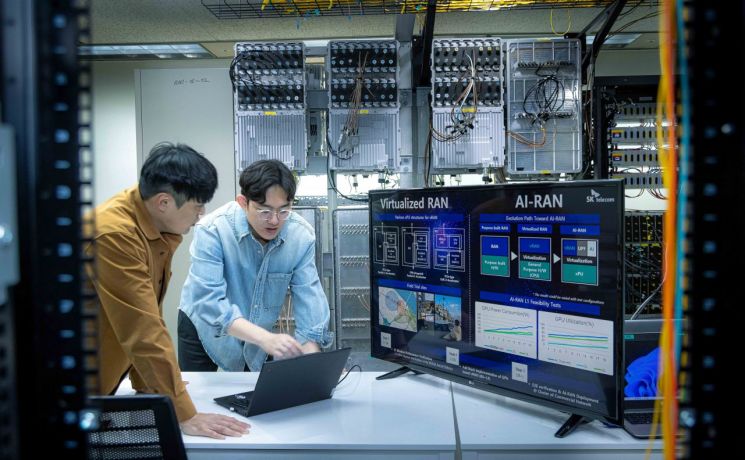
Through this demonstration, SKT built next-generation virtualized base stations in both indoor and outdoor commercial networks and comprehensively verified and confirmed improvements in key performance areas such as service quality, capacity, and power efficiency compared to existing virtualized base stations.
Notably, SKT is the first domestic mobile carrier to demonstrate next-generation virtualized base stations from global manufacturers including Samsung Electronics, Ericsson, and Nokia in actual indoor and outdoor environments.
Virtualized base stations can be implemented regardless of the manufacturer by installing only the necessary software on general-purpose servers, making them a key technology for realizing Network AI. This represents an improvement in openness and flexibility compared to the past structure, where base stations had to be composed of dedicated hardware and software from the same manufacturer.
SKT developed a next-generation virtualized base station that reduces power consumption and improves data processing efficiency through the evolution of the accelerator architecture, a core element of virtualized base stations, and utilized it in the demonstration to enhance both efficiency and cost-effectiveness.
Additionally, SKT succeeded in verifying performance by linking Samsung Electronics' next-generation virtualized base stations and wireless devices from the domestic network equipment specialist HFR (HF Radio) based on an open front-haul standard, and applying this to an actual indoor office space. The front-haul refers to the network connecting the central unit of a base station with distributed radio units.
SKT continues research and development for realizing Network AI in cooperation with global partners. It is also conducting studies on base station equipment based on various chipsets, including graphics processing units (GPUs), and virtualization resource allocation technologies to derive the optimal AI base station (AI-RAN) architecture capable of simultaneously implementing communication services and AI workloads.
Ryu Tak-gi, Head of SKT’s Infrastructure Technology Division, stated, "We plan to take the lead in implementing future networks through active research and development and collaboration with global partners."
© The Asia Business Daily(www.asiae.co.kr). All rights reserved.

















