'Big 3' Expected to Post 827.2 Billion KRW Operating Profit in Q1
High Value-Added Strategy Centered on LNG Carriers and Warships Proves Effective
Ship Retrofit Market Rapidly Rising Amid Carbon Regulations
Urgent Need for Competitiveness in Eco-Friendly and Digital Transformation
Despite the global order cliff, the domestic shipbuilding industry is expected to successfully defend its performance in the first quarter of this year. The strategy focused on high value-added ship types such as liquefied natural gas (LNG) carriers and warships is being recognized for proving its competitiveness amid the crisis. However, voices are also emerging that the portfolio should be diversified in the long term, as Chinese shipbuilders are rapidly catching up both inside and outside the industry.
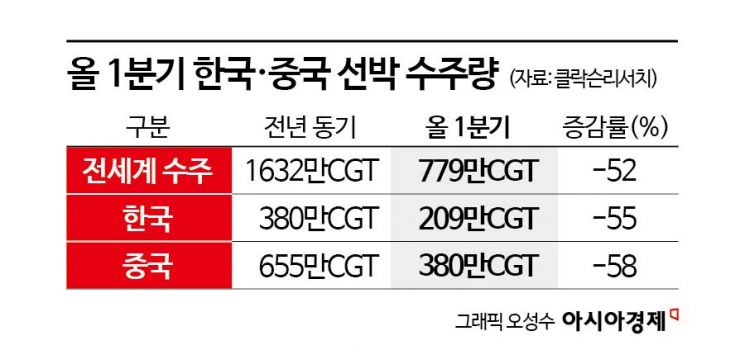
On the 17th, Clarkson Research, a UK-based shipbuilding and shipping market research firm, reported that the global ship orders in the first quarter of this year amounted to 7.79 million CGT (234 vessels), down 52% from 16.32 million CGT (710 vessels) in the same period last year. Among these, South Korea accounted for 2.09 million CGT (40 vessels, 27%), a 55% decrease compared to the same period last year. The slowdown in the economy and the reduction in shipping cargo volume have combined to significantly reduce orders for major ship types.
However, the domestic shipbuilding industry remains optimistic about orders. According to FnGuide, a financial information company, the operating profit of the domestic shipbuilding 'Big 3'?HD Hyundai Heavy Industries, Hanwha Ocean, and Samsung Heavy Industries?is estimated to reach around 827.2 billion KRW in the first quarter of this year, an increase of 184.2% compared to the same period last year. These companies recorded a combined annual operating profit exceeding 2 trillion KRW last year, marking a joint profit for the first time in 13 years.
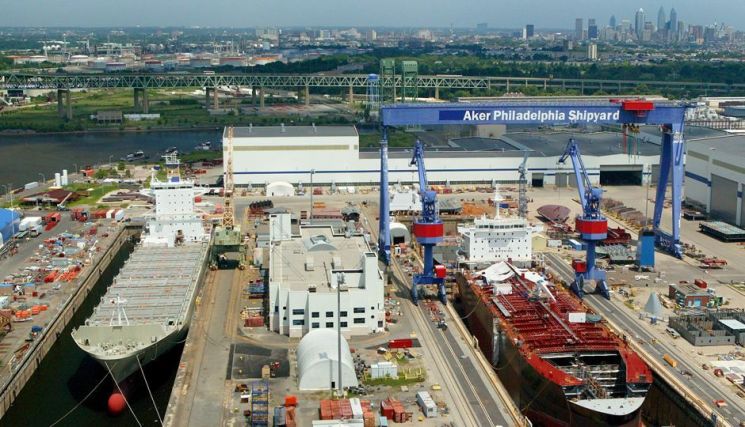
The background of the strong performance lies in the strategy centered on high value-added vessels. Korean shipbuilders have focused on technologically challenging ship types such as LNG carriers, large container ships, and warships. An industry insider said, "Maintaining a selective order policy under the judgment that securing profitability is more important than expanding order volume has been effective." In particular, Hanwha Ocean is seeking new breakthroughs in the global defense and military supply sectors. After entering the North American market last year by acquiring Hanwha Systems and the US-based Philly Shipyard, it secured the US Navy's maintenance, repair, and overhaul (MRO) projects, aiming to capture defense demand worth about 20 trillion KRW annually.
The International Maritime Organization's (IMO) strengthened carbon emission regulations also present an opportunity for the domestic shipbuilding industry. As demand for retrofitting aging vessels rapidly increases, the global ship retrofit market is expected to grow to about 4.2 billion USD (approximately 5.8 trillion KRW) by 2028. Korean shipbuilders are also shifting their focus from the traditional newbuilding-centered business model to ship retrofitting and eco-friendly upgrades.
On the other hand, the improvement in technology and enhanced price competitiveness of Chinese shipbuilders pose the greatest threat to our shipbuilding industry. Some Chinese shipyards are achieving visible results even in LNG carrier and container ship orders. Shorter shipbuilding periods and a domestic market based on demand from their own shipping companies are also strengths. In fact, last year China accounted for more than 50% of global ship orders, further widening the market share gap. Meanwhile, South Korea, while focusing on high value-added ship types, is repeatedly losing quantitative market share to China.
The industry’s strategy to overcome difficulties is to build a 'profit-oriented business portfolio.' In the short term, they plan to defend performance through orders of high value-added ship types, but in the mid to long term, they aim to expand into retrofitting, eco-friendly ships, defense, and offshore plants. In a phase where total order volume is decreasing, how much profit is retained is more important than how much is ordered. A shipbuilding industry official said, "It has become difficult to expect growth through large-scale orders as in the past," adding, "Only those who have comprehensive competitiveness such as eco-friendly technology, digital design capabilities, and integrated front-to-back capabilities can survive." He also emphasized, "To survive, domestic shipbuilders must simultaneously expand research and development (R&D) investment and secure manpower."
© The Asia Business Daily(www.asiae.co.kr). All rights reserved.


















