KCCI Holds Meeting with Director General of Trade Negotiations
Jeong Ingyo: "Establishing a One Team, One Voice Cooperation System"
More than 70% of domestic mid-sized manufacturing companies are affected by the United States' tariff policies. There are calls for urgent government support measures, such as tax credits, to help companies respond.
On the 17th, the Korea Chamber of Commerce and Industry (KCCI) held the 30th Mid-sized Enterprise Committee meeting at the KCCI Hall in Jung-gu, Seoul, inviting Jeong In-gyo, Director General of Trade Negotiations at the Ministry of Trade, Industry and Energy. The meeting was attended by about 20 representatives and executives of mid-sized companies, including Lee Jong-tae, Chairman of the Mid-sized Enterprise Committee (Chairman of Fursys), Oh Won-seok, Chairman of Korea FT, Kim Seong-yeol, Vice Chairman of Superior, Lee Jun-hwan, Vice Chairman of KCTC, and Lee Ho-jun, Executive Vice Chairman of the Korea Federation of Mid-sized Enterprises.
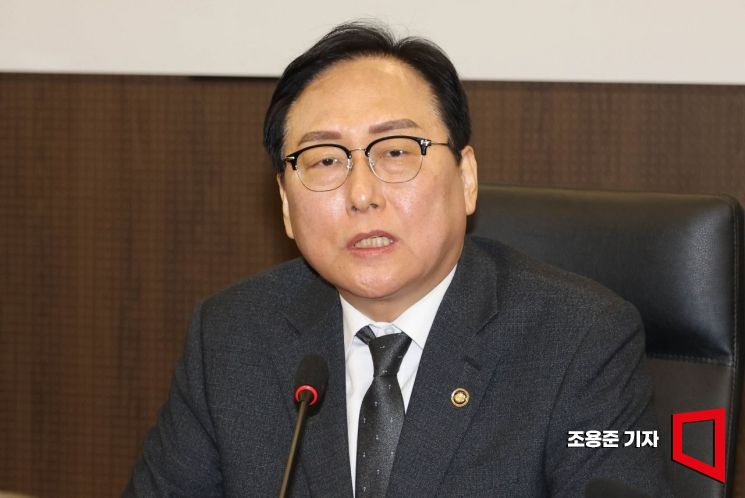 Jung In-gyo, Director General for Trade Negotiations, Ministry of Trade, Industry and Energy. Photo by Jo Yong-jun
According to a recent survey by KCCI, more than 70% of domestic mid-sized manufacturing companies are directly or indirectly affected by U.S. tariff policies. This meeting was organized to hear the government's explanation on the direction of Korea's trade policy in response to an unprecedented trade crisis and to facilitate communication among mid-sized enterprises.
Jeong In-gyo, Director General of Trade Negotiations at the Ministry of Trade, Industry and Energy, emphasized that "to effectively respond to the rapid changes in the trade environment, it is crucial to establish a public-private joint cooperation system," highlighting the slogan 'one team, one voice.' He added, "The government is making every effort to ensure seamless support for vulnerable sectors and industries affected by tariff measures, such as the recently announced emergency support plan for the automobile industry," and "We will pool government-wide capabilities to ensure that mid-sized enterprises, which are the backbone of our economy and a key part of the global supply chain, do not face difficulties."
Lee Jong-tae, Chairman of the KCCI Mid-sized Enterprise Committee, stated, "The U.S. tariff war presents new challenges for our companies," and expressed concern that "mid-sized enterprises, which have a high export dependency and are closely connected to the global value chain, will be the first to face these changes in the trade environment." He continued, "However, this can be a turning point to create new opportunities," and suggested, "It is necessary to expand trade territories through regional Free Trade Agreements (FTAs) and implement customized support policies to strengthen the export capabilities of mid-sized enterprises."
On this day, the KCCI Mid-sized Enterprise Committee members proposed various policy improvement tasks for both short-term crisis overcoming and mid-to-long-term capacity building, including tariff rate adjustments through strategic negotiations with the U.S., ▲ close information sharing by government authorities, ▲ support for reducing production costs such as tax credits, and ▲ securing alternative export markets.
Kang Myung-soo, Head of the Planning and Membership Division at KCCI, emphasized, "Domestic mid-sized enterprises are distributed across various industries, from manufacturing to retail and construction, so responses require industry-specific solutions."
© The Asia Business Daily(www.asiae.co.kr). All rights reserved.

















