Abolition of Comprehensive Real Estate Tax and Easing of Punitive Inheritance Tax
Regional and Industry-Based Differentiation of Minimum Wage
Expansion of Exceptions to the 52-Hour Workweek System
Hong Joon-pyo, former mayor of Daegu and presidential candidate of the People Power Party, revealed his vision to enter the ranks of advanced nations through "super-gap technology-led growth." To achieve this, he plans to invest at least 50 trillion won in artificial intelligence (AI), quantum technology, and room-temperature ambient-pressure superconductors.
On the 16th, Hong announced his economic, labor, and science and technology pledges at his campaign office located in the Daehwa Building in Yeouido, Seoul. The plan includes 27 tasks aimed at realizing a free market economy based on "freedom and creativity."
The five major economic policy directions are ▲promotion of a public-private economic revival plan ▲super-gap technology-led growth ▲distribution based on productivity ▲job creation and welfare focused on the working class ▲and management of national debt proportional to growth without burdening future generations.
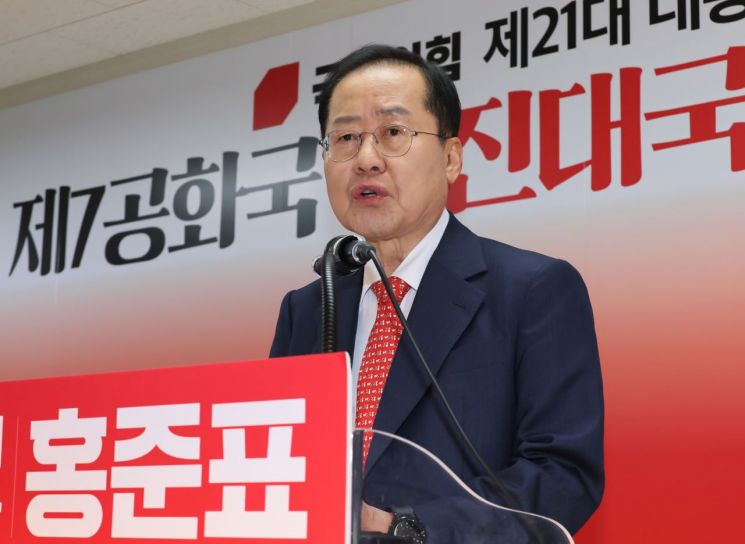
Specifically, he will establish a vice prime minister-level Future Strategy Office to formulate and implement a five-year public-private economic revival plan. He also proposed creating a "Korean version of Dubai," a regulatory exemption zone in local areas, and introducing a "New Industry Gate Free system" that allows entry into new technologies and businesses without prior government approval.
To promote technology-led growth, he announced plans to invest at least 50 trillion won over the next five years in globally leading R&D fields such as AI, quantum technology, and room-temperature ambient-pressure superconductors. Through this, he aims to proactively respond to the era of technological hegemony and strengthen national competitiveness.
He also proposed reforms to national finance and taxation. Applying the "National Debt Total Debt Repayment Ratio (DTI)," national debt will be managed in linkage with the gross domestic product (GDP). Hong believes the government should consider economic growth rates and repayment details when borrowing. Additionally, he pledged to abolish the comprehensive real estate tax and ease punitive inheritance taxes.
In the real estate sector, he promised ▲supplying 1 million housing units through reconstruction and redevelopment ▲land-lease housing for young people (where land is publicly owned and only buildings are sold) ▲and abolishing the excess profit recovery system for reconstruction. Hong expressed confidence, saying, "If old downtown areas are well developed, they can be restructured as effectively as new towns," and added, "We can build 1 million new homes over the next five years through urban restructuring projects." Furthermore, to promote balanced national development, he plans to focus on developing Incheon, Cheongju, Gwangju, Daegu, and Gadeokdo airports as gateway airports, while considering privatization of other airports.
As a core labor policy, he proposed differentiated minimum wages by industry and region. Since prices and wage structures vary by region, these differences will be reflected in the minimum wage, and different standards by age will be applied to prevent young people from losing employment opportunities due to high minimum wages. Along with this, he plans to reform militant labor unions and expand exceptions to the 52-hour workweek system.
Other pledges include ▲development of oil in the 7th offshore oil block ▲creation of a sovereign wealth fund through energy development and investment ▲moon landing by 2030 ▲transition to a job performance-based wage system ▲and fostering the urban air mobility (UAM) industry.
Hong emphasized, "Although we have reached the stage of entering advanced economies, polarization is worsening, and the disasters of low birthrate and aging are approaching," adding, "It is time for a fundamental transformation to open a future of prosperity and abundance."
© The Asia Business Daily(www.asiae.co.kr). All rights reserved.












