Nvidia Faces Losses Exceeding 7 Trillion KRW
Nvidia, Samsung, and SK Hynix Stocks Drop
Industry Voices Concerns Over Semiconductor Market Contraction
The Donald Trump administration in the United States has indefinitely restricted the export of Nvidia's artificial intelligence (AI) chip H20 to China, raising concerns that Samsung Electronics and SK Hynix, which have supplied high-bandwidth memory (HBM) for the chip, may be directly or indirectly affected. Analysts suggest that the reduced demand for AI semiconductors could impact the high-value memory business of domestic semiconductor companies.
On the 9th (local time), Nvidia announced on the 15th that it had been notified by the U.S. government that a separate license is required for exporting the H20 chip to China, and that this measure would be applied indefinitely. The U.S. government cited the potential use of the H20 in Chinese supercomputers as the regulatory basis. The H20 has been evaluated as suitable for high-performance computing due to its excellent connectivity between high-performance memory and computing chips.
The H20 is the highest-spec chip legally available for supply to China following the U.S. high-spec semiconductor export controls and was developed targeting AI demand within China. In particular, major Chinese big tech companies and AI startups have widely adopted this chip, making it the core product for AI chip demand in China. It is also known that the AI model disclosed by the Chinese AI startup DeepSeek used this chip for training.
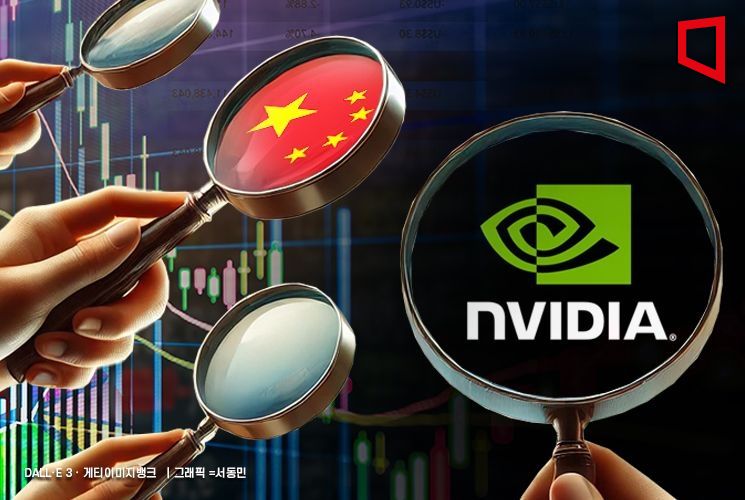
Earlier, the IT specialized media The Information reported that Chinese tech giants such as Alibaba, Tencent, and ByteDance ordered more than $16 billion (approximately 22.8 trillion KRW) worth of H20 chips between January and March this year. This figure represents an increase of over 40% compared to the previous quarter and is analyzed as orders placed before the U.S. export regulations were fully enforced. Due to this measure, Nvidia expects to incur a cost loss of about $5.5 billion (approximately 7.8567 trillion KRW) in the first quarter alone from inventory and purchase contract losses.
The concern in the domestic semiconductor industry stems from the supply of 4th generation HBM3 used in the H20. SK Hynix and Samsung Electronics supply HBM domestically. Disruptions in shipments of products like the H20 could soon lead to a decrease in related memory sales.
Although HBM currently accounts for a small portion of total memory sales, it is highly profitable and has become a key pillar in the high-value business strategies of domestic semiconductor companies. If the export restrictions shrink the overall AI chip market, there are concerns about a chain reaction including reduced HBM demand, falling memory prices, and decreased utilization rates of packaging facilities. In particular, SK Hynix is deeply connected to the AI semiconductor ecosystem centered on HBM, raising prospects of increased earnings uncertainty.
Industry insiders believe that in the short term, the impact may be limited as some existing orders are adjusted, but if the regulations are prolonged, changes in the market structure will be inevitable. In Samsung Electronics’ case, besides HBM, it is collaborating with Nvidia on packaging and post-processing, so Nvidia’s AI chip export restrictions could affect cooperation structures with domestic companies in various areas.
A semiconductor industry official said, "From a corporate perspective, export regulations inevitably raise concerns because they shrink the market itself," adding, "Since export regulations have been repeatedly reversed, it remains to be seen whether there will be a direct impact." He further stated, "However, even if Nvidia’s exports are regulated, only some channels will be blocked, and the overall market pie will not shrink, so the U.S. may not be able to stop the growth of Chinese companies."
Another official said, "Since HBM is a made-to-order product, it is difficult to see an immediate impact," but added, "However, in the long term, there is a concern that the AI chip market itself may shrink."
Meanwhile, immediately after the export regulation announcement, domestic semiconductor-related stocks collectively declined, with Samsung Electronics and SK Hynix falling 2.3% and 2.55%, respectively, as of 10:45 a.m. on the 16th compared to the previous day.
© The Asia Business Daily(www.asiae.co.kr). All rights reserved.

![Clutching a Stolen Dior Bag, Saying "I Hate Being Poor but Real"... The Grotesque Con of a "Human Knockoff" [Slate]](https://cwcontent.asiae.co.kr/asiaresize/183/2026021902243444107_1771435474.jpg)














