"China Needs to Negotiate, but We Do Not"
Repeated Calls for Talks Amid China's Silence... "Open to Dialogue"
U.S. President Donald Trump urged China, with which the tariff war is ongoing, to negotiate. As China responded more strongly than expected to the U.S. tariff attacks with retaliatory tariffs and rare earth export bans, analysts interpret this as reflecting Trump's intention to pressure China on the surface while practically wanting to avoid a catastrophe and reach a swift compromise.
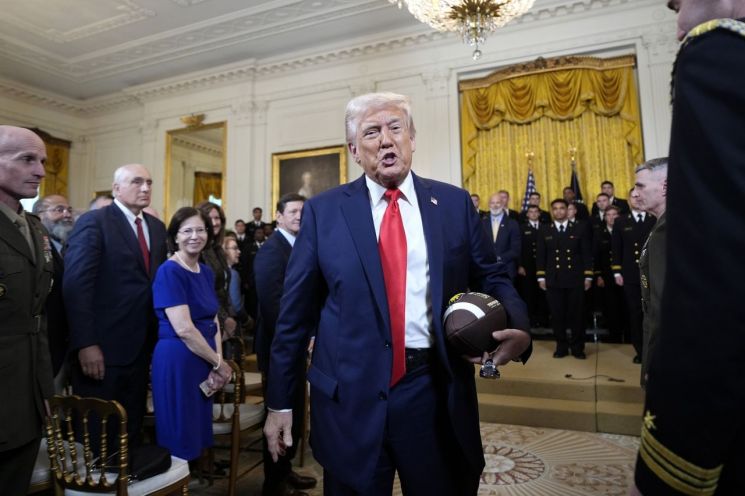
On the 15th (local time), President Trump stated in a press release, "The ball is in China's court," adding, "China needs to negotiate with us, but we do not need to negotiate with China." He said, "China is no different from other countries except that it is much bigger," and "China, like other countries, wants what we have, the American consumer. They need our money."
President Trump also sent a message to U.S. farmers, who are expected to suffer damage from the U.S.-China tariff war, urging them to endure.
On the same day, he wrote on his social media platform Truth Social, "Our farmers are great, but because of that greatness, they are on the front lines dealing with enemies like China whenever trade negotiations or trade wars like this occur," adding, "The same thing happened during my first term." He continued, "China was cruel to our farmers, and I told patriots to hold on," and "Then a great trade deal was made," he claimed.
At the same time, he left open the possibility of dialogue with China. After reading President Trump's statement, White House Press Secretary Karoline Leavitt said, "President Trump is open to a deal with China, and China needs to negotiate with the U.S.," repeatedly urging China to come to the negotiating table.
The U.S.-China "tariff war" has yet to find a breakthrough. After beginning his second term, President Trump imposed a total tariff of 145%, including a 125% reciprocal tariff on China and a 20% tariff on fentanyl. China has responded with a 125% retaliatory tariff on U.S. goods and a ban on rare earth exports, showing no sign of yielding to U.S. pressure. Recently, China instructed its airlines to halt deliveries of Boeing aircraft, a U.S. manufacturer. China is also showing moves to form a joint front with other countries against U.S. pressure, such as holding a summit with the European Union (EU) in Beijing this July.
As China has resisted more strongly than expected, President Trump has raised pressure on China while sending conciliatory gestures one after another. He has referred to Chinese President Xi Jinping as a "friend," said he "respects him very much," and mentioned that he is "waiting for a call." The recent exclusion of electronics such as smartphones and PCs from reciprocal tariffs is also analyzed as a measure to ease tensions with China. According to the RAND China Research Center, among the $390 billion worth of affected products, $101 billion, or one-quarter, are Chinese-made. Especially as indiscriminate tariff bombardments against the world have caused financial market convulsions and warnings of a U.S. economic recession, making it impossible to prolong the tariff war, and as China shows no willingness to negotiate, it is evaluated that President Trump has become rather desperate.
The New York Times (NYT) warned, "China is taking all measures against President Trump's tariff increases, sending a message that it can endure pain longer than the U.S.," and cautioned that due to the Trump administration's inconsistent China diplomacy strategy and tariff policies targeting even allies, the U.S. may have to face China alone in future negotiations.
© The Asia Business Daily(www.asiae.co.kr). All rights reserved.

![Clutching a Stolen Dior Bag, Saying "I Hate Being Poor but Real"... The Grotesque Con of a "Human Knockoff" [Slate]](https://cwcontent.asiae.co.kr/asiaresize/183/2026021902243444107_1771435474.jpg)















