International Oil Prices Continue to Fall, Import Prices Drop 0.4% in March
Consumer Prices Reflect Import Trends with 1-3 Month Lag
Domestic Factors Such as Wildfires and Weather Conditions Must Also Be Considered
Import prices have been declining for the second consecutive month. Although the won-dollar exchange rate rose, the larger drop in international oil prices led to a decrease in prices of minerals such as crude oil. This month, the downward trend in oil prices continues, suggesting that future import prices will act as a factor in lowering consumer prices.
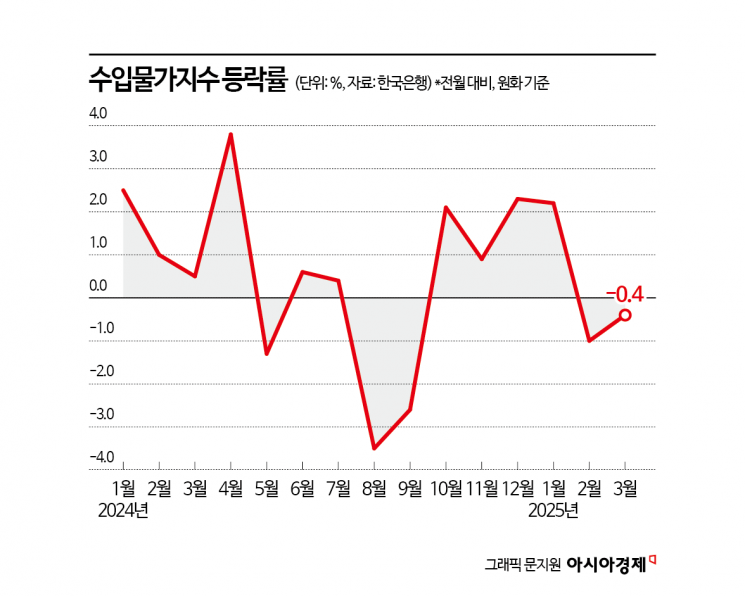
According to the 'March 2025 Export and Import Price Index and Trade Index (Provisional)' released by the Bank of Korea on the 16th, last month's import prices (based on the Korean won) fell by 0.4% compared to the previous month, marking a decline for two consecutive months. Despite the rise in the won-dollar exchange rate, prices mainly of minerals such as crude oil fell due to a significant drop in international oil prices.
Last month's average won-dollar exchange rate was 1,456.95 won, up 0.8% from February's 1,445.56 won. However, the monthly average Dubai crude oil price dropped 7.0%, from $77.92 per barrel in February to $72.49 last month, exerting a greater influence on import prices. Compared to the same month last year, it fell by 13.9%.
By usage, raw materials, centered on minerals such as crude oil, fell 3.3% from the previous month, significantly impacting the decline in import prices. Intermediate goods rose 0.7% month-on-month due to increases in primary metal products, computers, electronics, and optical devices. Capital goods and consumer goods also rose 1.6% and 0.9%, respectively, compared to the previous month. Excluding the exchange rate effect, import prices based on contract currency fell 1.4% month-on-month last month. Compared to the same month last year, they declined by 4.9%.

This month as well, the continued decline in international oil prices is supporting the downward pressure on import prices. Lee Moon-hee, head of the Price Statistics Team 1 at the Bank of Korea's Economic Statistics Department 1, said, "Among the international oil price and won-dollar exchange rate, which greatly affect import prices, the international oil price (Dubai crude) has fallen 5.4% compared to the previous month's average since the beginning of this month." He added, "The won-dollar exchange rate rose slightly by 0.3%, but due to volatile domestic and international conditions, we need to monitor the trend until the end of the month." He further stated, "Based on the current situation, since oil prices have fallen sharply, a downward pressure on import prices is expected this month as well."
The two-month consecutive decline in import prices is expected to play a role in limiting upward pressure on consumer prices. Import prices typically affect consumer prices with a lag of 1 to 3 months. Lee said, "If the decline in oil prices continues, downward pressure will be exerted on related petroleum products and chemical products, which will partially influence consumer prices," but he also noted, "Consumer price movements should be examined together with domestic production price trends." This is because consumer prices reflect many consumer goods such as agricultural, forestry, and fishery products, food and beverages, and dining-out services, which are also significantly affected by recent wildfires and weather conditions.

Last month's export prices rose 0.3% month-on-month as the won-dollar exchange rate increased and prices of computers, electronics, optical devices, and primary metal products rose. Compared to the same month last year, export prices centered on computers, electronics, and optical devices rose 6.3%. By item, agricultural, forestry, and fishery products increased 1.6% month-on-month. Manufactured goods, led by semiconductors, computers, electronics, and optical devices, rose 0.3% month-on-month. Last month, export prices based on contract currency fell 0.7% month-on-month and declined 2.5% compared to the same month last year.
The export volume index, which shows export-import fluctuations, rose 3.4% in March compared to the same month last year, influenced by increases in computers, electronics, optical devices, and primary metal products. The export value index rose 0.9%. During the same period, the import volume index increased 5.1% due to growth in machinery and equipment, computers, electronics, and optical devices. The import value index rose 1.8%.
The March net barter terms of trade index rose 0.8% year-on-year as import prices (-3.2%), mainly for minerals such as crude oil, natural gas, and thermal coal, fell more than export prices (-2.4%). The income terms of trade index rose 4.3% as both the net barter terms of trade index (0.8%) and the export volume index (3.4%) increased.
© The Asia Business Daily(www.asiae.co.kr). All rights reserved.

![Clutching a Stolen Dior Bag, Saying "I Hate Being Poor but Real"... The Grotesque Con of a "Human Knockoff" [Slate]](https://cwcontent.asiae.co.kr/asiaresize/183/2026021902243444107_1771435474.jpg)

















