Korea-US Industrial Cooperation Conference
Heritage Foundation Senior Researcher
"We Must Cooperate with the Korean Shipbuilding Industry"
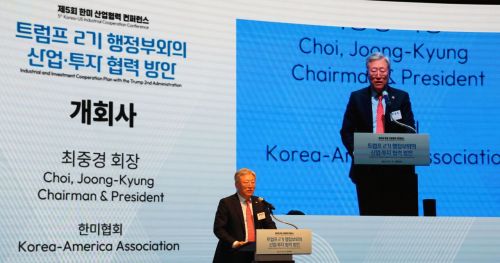 Choi Joong-kyung, Chairman of the Korea-America Association, is delivering the opening remarks at the Korea-US Industrial Cooperation Conference held at the Korea Chamber of Commerce and Industry in Jung-gu, Seoul on the 15th. 2025.04.15 Photo by Yoon Dong-joo
A conservative American think tank officially mentioned the repeal of the maritime protection law known as the 'Jones Act' to expand defense industry cooperation with South Korea. The rationale is that linkage with the Korean shipbuilding industry is necessary to address maintenance gaps during wartime. There was also a call to increase flexibility in adopting Korean weapon systems through the conclusion of the Korea-US Reciprocal Defense Procurement Agreement, a mutual trade agreement in the defense sector.
At the 'Korea-US Industrial Cooperation Conference' held on the 15th at the Korea Chamber of Commerce and Industry in Jung-gu, Seoul, Robert Peters, a senior researcher at the Heritage Foundation, stated in a video presentation, "The US's ships, aircraft, and ammunition are insufficient for power response in emergencies," adding, "In particular, the surge in maintenance demand for aging ships is crowding out shipyard space, causing a vicious cycle of delays in new ship construction."
He explained, "Expanding maintenance, repair, and overhaul (MRO) cooperation with South Korea would allow combat ships to be repaired in Korea during wartime without the need to return to the US mainland, and in peacetime, it would help secure spare space in shipyards."
Peters identified the repeal of the Jones Act as a prerequisite for such cooperation. The Jones Act stipulates that all cargo transportation between US ports must be conducted by ships built in the US, owned and operated by US citizens, and flying the US flag.
He pointed out, "As long as this law remains, practical construction cooperation with South Korea is difficult." Peters also emphasized that "the US and South Korea should conclude a Reciprocal Defense Procurement Agreement (RDP) to establish a free trade zone in the defense sector between the two countries."
This statement is considered unusual given the nature of the Heritage Foundation. Heritage is a representative conservative think tank that prioritizes protecting domestic industries and strengthening military power. However, Peters highlighted that maintenance bottlenecks could pose a threat to US security and proposed a strategic approach that prioritizes operational efficiency over protectionism. This is interpreted as a sign that a pragmatic trend is emerging within the conservative camp, balancing industrial efficiency and security effectiveness.
Professor Moon Geun-sik of Hanyang University explained, "South Korea has strengths in icebreaker ships necessary for the Arctic development that the US is pursuing," adding, "Revising the Jones Act is necessary for icebreaker construction."
There were also calls to repeal the Burns-Toelevson Act in addition to the Jones Act for Korea-US defense industry cooperation. While the Jones Act regulates commercial ships, the Burns-Toelevson Act regulates warship construction.
Jung Woo-man, Executive Director at HD Hyundai Heavy Industries, said, "The US Navy plans to build 364 new warships over the next 30 years, but the current US shipbuilding capacity alone is insufficient," adding, "Due to the Jones Act and Burns-Toelevson Act, building ships and warships overseas is basically prohibited, so resolving these legal regulations is essential."
At the conference, cooperation expansion was also discussed in fields beyond shipbuilding and defense, including energy, artificial intelligence, and semiconductors.
Professor Jung Dong-wook of the Department of Energy Systems Engineering at Chung-Ang University emphasized, "The US is requesting our participation in the Alaska liquefied natural gas (LNG) project, but Korea can export nuclear power to the US," adding, "Since Westinghouse alone cannot build all nuclear power plants in the US, exporting the Korean-type reactor (APR1400) to the US should be seen as a mutually beneficial opportunity."
© The Asia Business Daily(www.asiae.co.kr). All rights reserved.

















