From the Reformist Party to the Democratic Party’s Non-Lee Faction Discussed
"Must Create a 1:1 Race with an Anti-Lee Jae-myung Big Tent"
Presidential primary candidates of the People Power Party are igniting the 'anti-Lee Jae-myung big tent theory.' The idea is to unite former People Power Party lawmaker Yoo Seung-min, who declared he would not run after selecting the presidential candidate in the primary, Lee Jun-seok, the reformist party's presidential candidate, and the non-Lee Jae-myung factions within the Democratic Party to field a single candidate. This plan is based on the judgment that broad coalition-building is inevitable to shake the dominance of former Democratic Party leader Lee Jae-myung.
The big tent theory was brought up by former Daegu Mayor Hong Joon-pyo, who declared his presidential bid on the 14th. His plan is to form a big tent by rallying other candidates once a final candidate is chosen in the People Power Party primary. On the 15th, on SBS Radio's Kim Tae-hyun's Political Show, he stated, "Once the party's candidate is chosen, reformist parties as well as anti-Lee Jae-myung forces within the Democratic Party must unite around that person to block former leader Lee."
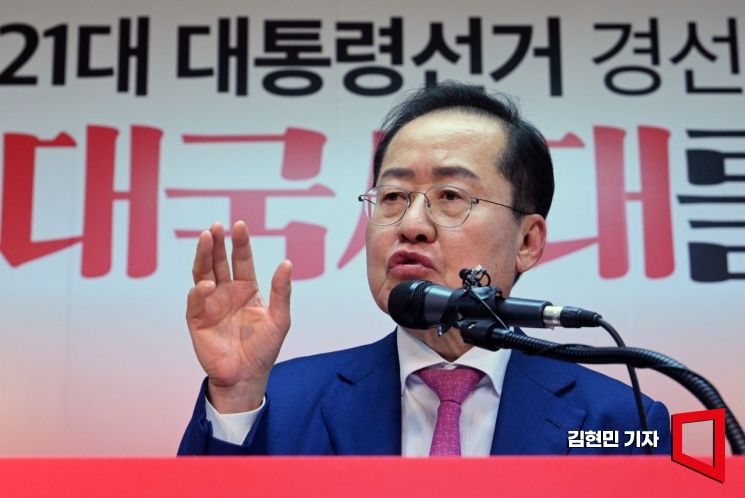 Former Daegu Mayor Hong Joon-pyo is declaring his candidacy for the 21st presidential election at the Camp office in Daehwa Building, Yeouido, Seoul on April 14, 2025. Photo by Kim Hyun-min
Former Minister of Employment and Labor Kim Moon-soo also supported the idea, saying, "The bigger the tent, the better it is to avoid rain and the safer it is," and added, "If someone can defeat former leader Lee, anyone should be welcomed into the big tent." People Power Party lawmaker Na Kyung-won left a remark on the possibility of alliance with the non-Lee factions, saying, "We must always imagine and prepare according to the changing political situation."
The big tent theory is being discussed because former leader Lee is overwhelmingly leading in various opinion polls. According to a poll commissioned by Energy Economics and released by Realmeter on the 14th (for detailed information, refer to the Central Election Poll Deliberation Commission website), major People Power Party candidates lagged behind former leader Lee by a twofold difference in support in one-on-one matchups. In this situation, the only winning strategy is to create a 1:1 contest with former leader Lee through an anti-Lee electoral coalition.
The fact that candidates who were considered strong in appealing to the moderate voters, such as Seoul Mayor Oh Se-hoon and former lawmaker Yoo Seung-min, have dropped out of the primary also strengthens the big tent theory. To win against former leader Lee, support from the moderate voters is necessary, but since the main candidates participating in the primary are anti-impeachment (anti-tan) faction, the chances of winning are not high. A senior People Power Party lawmaker said in a phone call, "It is unfortunate that valuable candidates have dropped out, but this primary should focus on consolidating the conservative base and seek to expand the coalition after the primary."
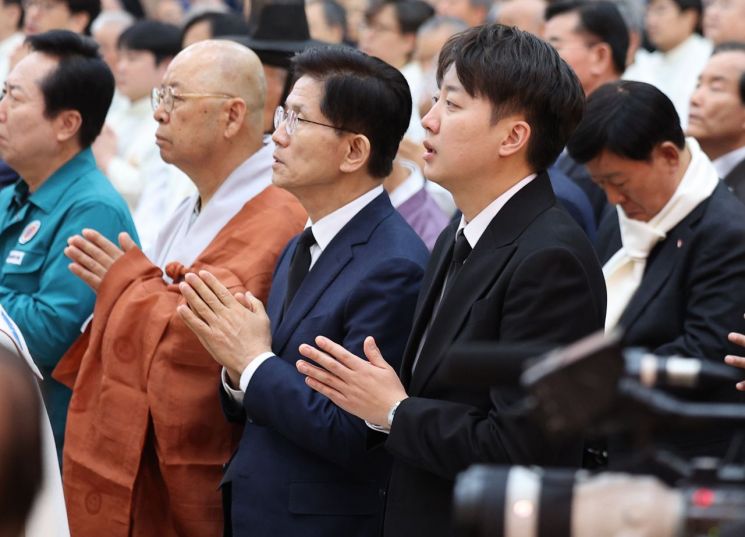
Some quarters mention the Roh Moo-hyun and Chung Mong-joon unification model. In the 2002 presidential election, Democratic Party candidate Roh Moo-hyun defeated the then overwhelming support of Grand National Party candidate Lee Hoi-chang by unifying with Chung Mong-joon, the candidate of the National Unity 21. Former Mayor Hong said, "At that time, Lee Hoi-chang had higher support than former leader Lee does now," and argued, "Even a strong front-runner candidate can be overturned within 50 days if they are not suitable as a presidential candidate."
However, there is strong opposition to including Han Duck-soo, the acting president and prime minister, in the big tent, despite ongoing calls for his draft candidacy. Former Mayor Hong dismissed this, saying, "It is against common sense to think that someone who served as prime minister of an impeached administration would run for president," and added, "There is no need to include Acting President Han in the big tent." Former party leader Han Dong-hoon also opposed, saying, "We should focus public attention on the process of selecting our party's candidate," and "Diluting the primary itself is a violation." Lawmaker Na criticized, "The mention of Acting President Han is making the primary seem less important." Only former Minister Kim did not oppose Han's candidacy, saying, "If Acting President Han runs as an independent, I will propose unification first."
© The Asia Business Daily(www.asiae.co.kr). All rights reserved.


















