US Exempts Phones and PCs from Mutual Tariffs
Trump Says "No Exception"... Semiconductor Tariffs Expected
Uncertainty Grows Amid Fluctuating Tariff Policies
Semiconductor Tariff Proposal Expected on the 14th
This Week's Focus: Corporate Earnings and Retail Sales Data
The three major indices of the U.S. New York stock market rose on the 14th (local time). Technology stocks such as Apple are rising as U.S. President Donald Trump exempted some electronic products, including smartphones and PCs, from mutual tariffs. However, President Trump and officials emphasized that this is a temporary measure and confirmed plans to impose semiconductor tariffs on these electronic products, so uncertainty surrounding tariff policies is expected to continue.
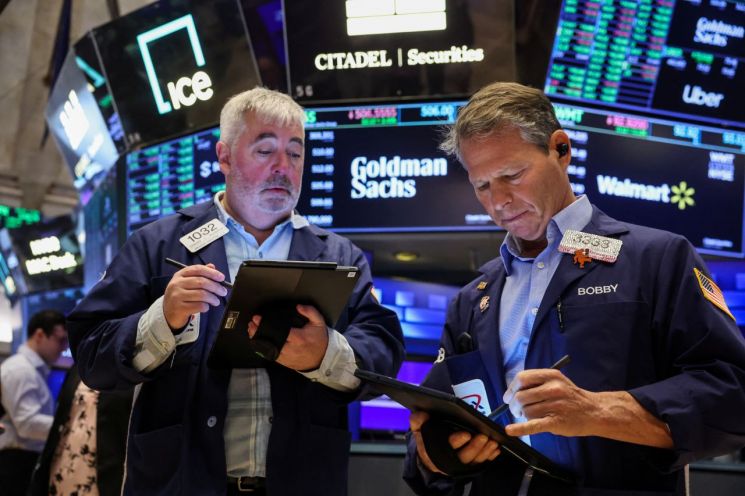
At 10:01 a.m. in the New York stock market on the day, the Dow Jones Industrial Average (Dow) focused on blue-chip stocks was trading at 40,550.55, up 337.84 points (0.84%) from the previous trading day. The S&P 500, centered on large-cap stocks, rose 63.94 points (1.19%) to 5,427.3, and the Nasdaq, focused on technology stocks, jumped 234.74 points (1.4%) to 16,959.2.
By stock, Apple rose 4.55%. The exemption from mutual tariffs on electronic products is expected to benefit Apple the most, as it has iPhone production bases in China, attracting buying interest. It was also pointed out that Apple CEO Tim Cook secured this tariff exemption based on his close friendship with President Trump. Nvidia rose 1.76%, Tesla 2.73%. Alphabet, Google's parent company, and Microsoft (MS) were up 2.48% and 1.01%, respectively.
President Trump stated on his social media platform Truth Social, which he created, "I never announced a tax exemption last Friday (April 11)" and said, "We will look at the entire semiconductor and electronics supply chain in the upcoming national security tariff investigation." Later, speaking to reporters aboard Air Force One, the presidential plane, he said semiconductor tariffs would be "implemented in the near future" and that the tariff rate would be "announced next week." He made this clarification after criticism arose that the partial exemption of mutual tariffs on some electronic products was a retreat in tariff policy. Regarding the semiconductor tariff plan, he had previously said, "I will give an answer on Monday (the 14th)."
The U.S. Customs and Border Protection (CBP) announced on the 11th that some electronic products would be excluded from mutual tariff imposition. This came just two days after the full enforcement of mutual tariffs on the 9th and a 90-day deferral of tariffs by country. Accordingly, 20 electronic products, including smartphones, laptops, and hard disk drives, are exempt from mutual tariffs imposed by the U.S. on various countries.
In response to criticism that President Trump's tariff policy is inconsistent, President Trump and administration officials directly expressed their intention to impose semiconductor tariffs on these electronic products. However, even if tariffs are imposed on electronic products containing semiconductors, there is an expectation that the tariff rate will be lower than the China tariff of 145% (mutual tariff 125% + fentanyl tariff 20%). President Trump also left open the possibility of exceptions to tariff measures, saying, "There will be flexibility for some companies."
Regarding this tariff policy confusion, the market views it as President Trump stepping back from a hardline tariff policy. As a result of all-out tariff attacks worldwide causing massive sell-offs in U.S. stocks and government bonds and growing criticism within the U.S. due to inflation and recession concerns, it is widely interpreted that the tariff policy level has been lowered. The exemption of mutual tariffs on electronic products is also analyzed as the first easing measure in the tariff war with China. According to the Rand China Research Center, among the total $390 billion worth of products affected by the mutual tariff exemption on electronic products, $101 billion, or one-quarter, are Chinese-made.
This week, investors' attention is focused on President Trump's new tariff remarks. Along with the stock market, the government bond market is also being closely watched. Due to concerns over President Trump's tariff policy, there has been a flood of sell-offs in U.S. Treasury bonds, the world's safest asset, and since this led to a retreat in President Trump's tariff policy, attention is more focused than ever on the recent abnormal surge in Treasury yields.
U.S. Treasury yields are currently calming down. The U.S. 10-year Treasury yield, a global bond yield benchmark, fell 8 basis points (1 bp = 0.01 percentage point) from the previous trading day to 4.4%, and the U.S. 2-year Treasury yield, sensitive to monetary policy, moved around 3.9%, down 5 basis points from the previous day.
This week, major companies such as Goldman Sachs, United Airlines, and Netflix will announce earnings starting on the 14th. Key economic indicators will also be released. On the 16th, March retail sales data will be released, and on the 17th, weekly initial jobless claims will be announced. Federal Reserve Chairman Jerome Powell's speech is also scheduled for the 16th. On the 18th, the U.S. financial market will be closed in observance of Good Friday.
© The Asia Business Daily(www.asiae.co.kr). All rights reserved.











