Trump Addresses Apple Tariff Controversy Himself
Lutnick and Greer Also Explain It Is a "Temporary Measure"
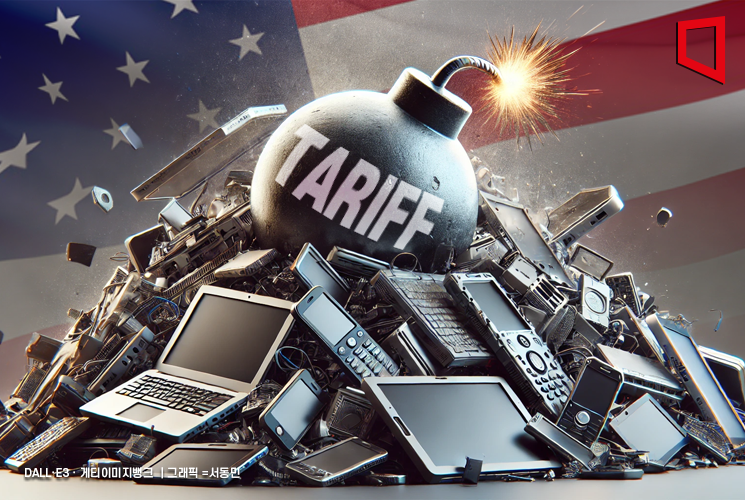
U.S. President Donald Trump expressed his determination to reimpose tariffs on electronic products such as smartphones and PCs, which had been excluded from reciprocal tariffs. U.S. officials also repeatedly stated that, despite different labels, tariffs on electronic products would be imposed under different categories about a month later. As evaluations emerged that President Trump was retreating from his tariff policy, he reaffirmed plans to impose tariffs on semiconductor items following steel, aluminum, and automobiles, increasing concerns over uncertainty surrounding tariff policies.
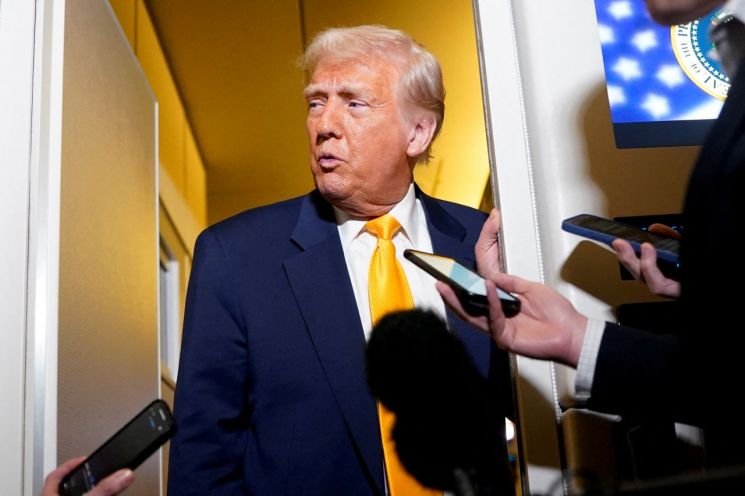
On the 13th (local time), President Trump posted on his social media platform Truth Social, which he created, stating, "I never announced tariff exemptions last Friday (April 11)," and added, "These products are subject to the existing 20% fentanyl tariff, and are simply moving to a different tariff category."
He asserted, "We will examine the entire semiconductor and electronics supply chain in the upcoming national security tariff investigation," and said, "We must produce products in the U.S. and must not be held hostage by hostile trading nations like China, which do everything to ignore the American people."
Earlier, the U.S. Customs and Border Protection (CBP) announced on the 11th that some electronic products would be excluded from reciprocal tariffs. This came just two days after the full enforcement of reciprocal tariffs on the 9th and the 90-day grace period for country-specific tariffs. Accordingly, 20 electronic products including smartphones, laptops, and hard disk drives are exempt from reciprocal tariffs imposed by the U.S. on various countries.
This sparked criticism that President Trump's tariff policy lacked consistency and that tariff exemptions were granted to items favorable to large companies like Apple, which has iPhone production bases in China. In particular, it was pointed out that Apple CEO Tim Cook secured this tariff exemption based on his close friendship with President Trump. In response, President Trump confirmed his intention to impose tariffs on electronic products and clarified that the 20% fentanyl tariff out of the 145% tariffs against China would remain, suggesting a direct effort to manage the situation.
Officials from the Trump administration also appeared on broadcasts one after another that day to explain that the electronic product reciprocal tariff exemption was a temporary measure.
U.S. Secretary of Commerce Howard Lutnick said in an interview with ABC's "This Week" that "These (electronic) products are exempt from reciprocal tariffs but will likely be included in semiconductor tariffs applied within a month or two," adding, "This is not a permanent exemption, nor can countries eliminate it through negotiations." This statement implies that after the official announcement of itemized semiconductor tariffs, tariffs will be reimposed on electronic products containing semiconductors. Jamieson Greer, U.S. Trade Representative (USTR), also appeared on CBS's "Face the Nation" that day and explained, "It is not that tariffs for reshoring (return of overseas companies) will not be imposed, but rather a different system applies (to electronic products)," and clarified, "They are moving from tariff-exempt status to potential tariff targets."
President Trump plans to push forward with imposing itemized tariffs on semiconductors soon, following steel, aluminum, and automobiles. On the 12th, he told reporters regarding semiconductor tariffs, "I will give that answer on Monday (the 14th)." On the same day, he said there would be no exemption for electronic product tariffs and stated, "No one will be spared because of unfair trade balances and non-monetary tariff barriers imposed on us by other countries." White House spokeswoman Caroline Levitt also said earlier, "President Trump will soon announce the results of the Section 232 investigation on semiconductors."
Nevertheless, some view that President Trump has stepped back from his ultra-hardline tariff policy. As global all-out tariff attacks triggered massive sell-offs in U.S. stocks and government bonds, and criticism grew domestically due to inflation and recession concerns, the prevailing interpretation is that the tariff policy was toned down. The electronic product reciprocal tariff exemption is also analyzed as the first easing measure in the tariff war with China. According to the Rand China Research Center, out of the total $390 billion worth of products affected by the electronic product reciprocal tariff exemption, $101 billion, or one-quarter, are Chinese-made.
© The Asia Business Daily(www.asiae.co.kr). All rights reserved.
![User Who Sold Erroneously Deposited Bitcoins to Repay Debt and Fund Entertainment... What Did the Supreme Court Decide in 2021? [Legal Issue Check]](https://cwcontent.asiae.co.kr/asiaresize/183/2026020910431234020_1770601391.png)
















