Survey of 64 Economic Experts:
Recession Risk Doubles Under Trump's Tariff Policy
Concerns Grow Over Stagflation and Investment Slowdown
Since the inauguration of U.S. President Donald Trump, who has unleashed a tariff bombardment against the entire world, the probability of an economic recession has sharply increased, according to forecasts by U.S. experts. As the tariff policy has been implemented much more broadly and rapidly than initially expected, concerns are spreading that consumption and corporate investment are shrinking and that the policy could boomerang back on the U.S. economy.
According to the Wall Street Journal (WSJ) on the 13th (local time), a survey of 64 economic experts conducted from the 4th to the 8th found that the probability of the U.S. entering a recession within the next 12 months was 45%. This is double the 22% recorded in a survey conducted in January, just before President Trump took office.
Experts predicted that the U.S. fourth-quarter gross domestic product (GDP) growth rate, adjusted for inflation, would be only 0.8% annualized compared to the same period last year. This is a significant drop from the 2% forecast made three months ago in January. If this figure materializes, it will be the lowest growth rate since the recession caused by the COVID-19 pandemic in 2020.
Inflation for this year is expected to reach 3.6% year-over-year as of December, a sharp increase from the 2.7% forecast in January. However, the inflation forecast for 2026 remains steady at 2.6%. The unemployment rate forecast has risen from 4.3% to 4.7%.
The reason economic forecasts have turned so pessimistic in just three months is President Trump's tariff policy. When tariffs rise, import prices increase, which can trigger inflation. Consumers close their wallets, and companies postpone investment decisions, making it highly likely that the economy will freeze rapidly. There are warnings that the risk of stagflation?a situation where prices rise while the economy slows?is growing quickly.
Considering that experts expect the average U.S. tariff rate to rise by a staggering 19 percentage points by 2025, such forecasts are not unreasonable. Last year, the average effective tariff rate in the U.S. was 2.4%, according to the Tax Foundation. Experts predict that the tariff rate will soar about ninefold within this year. In January, before President Trump's inauguration, a 10 percentage point increase was expected, but after Trump's second term began, the forecast was significantly raised due to his aggressive tariff policies.
Mike Cosgrove, an economist at Econoclast, expressed concerns about President Trump's tariff policy, saying, "Tariffs were previously seen as a negotiation tool, but now it would be lucky if the U.S. can avoid a recession," adding, "Trump should have given companies more time to adapt. Tariffs are a huge shock to the global economy."
This survey was conducted just before President Trump fully implemented reciprocal tariffs on all trading partners worldwide on the 9th. Although Trump has launched a tariff offensive against the world during his second term, he recently postponed reciprocal tariffs on countries other than China for 90 days and additionally exempted reciprocal tariffs on major electronic products such as smartphones and PCs, showing some retreat. It is analyzed that the tariff attack level was lowered as indiscriminate tariff policies triggered massive sell-offs in U.S. stocks and government bonds, and criticism over recession concerns spread within the U.S.
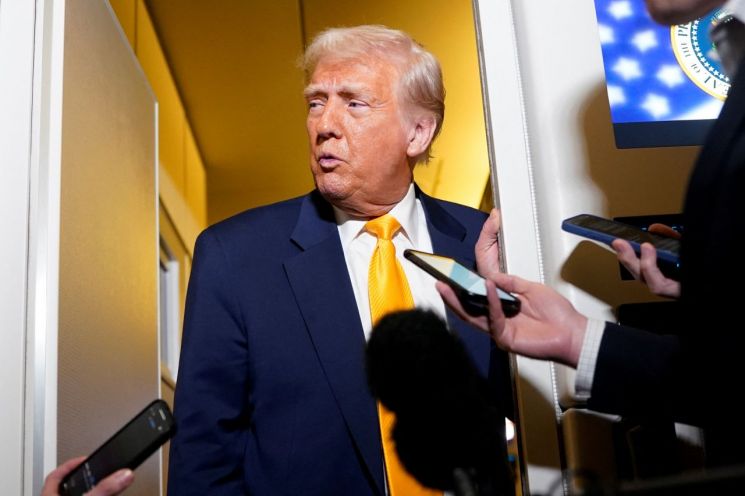
While the earlier reciprocal tariff postponement helped reduce some of the shock, confusion and economic uncertainty surrounding tariff policies are expected to continue. China, along with allies such as the European Union (EU) and Canada, has hinted at retaliatory measures against the U.S., and the U.S. is also expected to unveil additional tariff measures. On the 12th, President Trump told reporters regarding tariffs on semiconductor items, "I will give the answer on Monday (the 14th)," signaling an imminent announcement on semiconductor tariffs. On the same day, U.S. Commerce Secretary Wilbur Ross said in an interview with ABC that the exemption of reciprocal tariffs on electronic products is a temporary measure and that separate semiconductor tariffs will be imposed about a month later.
© The Asia Business Daily(www.asiae.co.kr). All rights reserved.

















