GPR Surveys Conducted on Urban and Metropolitan Railway Construction Sites
Full Deployment of Personnel and Special Safety Management Measures in Place
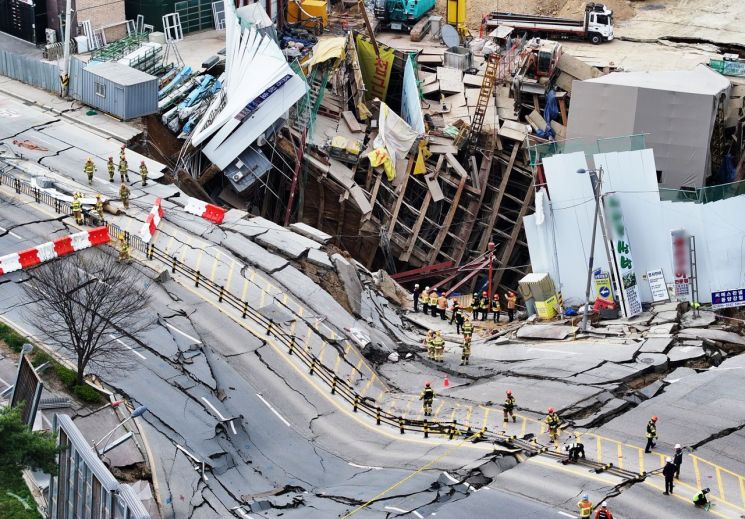
From the land subsidence (sinkhole) in Myeongil-dong, Gangdong-gu, Seoul to the collapse at the Gwangmyeong Sinansan Line construction site, ground subsidence has recently occurred near large-scale excavation sites. In response, the Seoul Metropolitan Government will conduct ground-penetrating radar (GPR) surveys on large-scale underground excavation sites and their surroundings.
On the 13th, Seoul announced that it will carry out GPR surveys on large-scale underground excavation sites and their surrounding areas. The city will first inspect large-scale underground excavation sites and their vicinity, then proceed with GPR surveys on locations selected by autonomous districts and sections deemed necessary for inspection by the city.
Initially, intensive GPR surveys will be conducted on three urban railway construction sections totaling 18.5 km within Seoul and the surrounding roads. This measure considers the recent accidents occurring near subway construction sites. The city has deployed 41 personnel and 15 pieces of equipment to conduct GPR surveys on these sections since the end of last month.
The three urban railway construction sites targeted for intensive inspection are the Seoul Metropolitan Subway Line 9 Phase 4 construction (Sections 1 to 3) covering 4.1 km, the Dongbuk Line urban railway private investment project construction (Sections 1 to 4) covering 13.4 km, and the Yeongdong-daero underground space complex development project covering 1.0 km.
Although Seoul is not the client, focused inspections to strengthen safety management will also be conducted on metropolitan railway construction sections undergoing excavation in Seoul. These include the 12.1 km Sinansan Line section passing through Seoul (Seoksu Station to Yeouido Station) and the 18.7 km Metropolitan Express Railway (GTX-A) section (Suseo Station to Seoul Station). Among these, the Seoul section of the Sinansan Line has been undergoing GPR surveys since early this month.
Next, GPR surveys on 50 priority inspection sites covering 45 km, selected by eight autonomous districts at the end of last year, are planned to be completed with investigation and analysis by the end of this month.
At the end of last year, at the request of the Ministry of Land, Infrastructure and Transport, autonomous districts were asked to voluntarily submit areas requiring special inspections for ground subsidence. Eight districts independently selected and submitted 50 locations. The city will also re-survey demand and conduct additional investigations for the 17 districts that did not submit last year. To improve the efficiency of GPR surveys, priority maintenance zones requiring inspection on maps will also be surveyed using GPR.
Furthermore, Seoul will pilot and operate the nation's first "ground subsidence observation network" by installing sensors within the ground to measure ground changes in real time. Additionally, new technology measurement equipment will be installed around construction sites. This new technology includes devices that install multiple sensors in observation wells to measure changes by geological layer.
Results from the GPR surveys and details of the new technology implementation will be disclosed on the Seoul Safety Nuri website. Han Byung-yong, Director of the Seoul Disaster and Safety Office, stated, "We will do our utmost to prepare countermeasures, such as strengthening GPR surveys and introducing real-time ground change measurement equipment, to prevent similar accidents from occurring."
© The Asia Business Daily(www.asiae.co.kr). All rights reserved.
![Clutching a Stolen Dior Bag, Saying "I Hate Being Poor but Real"... The Grotesque Con of a "Human Knockoff" [Slate]](https://cwcontent.asiae.co.kr/asiaresize/183/2026021902243444107_1771435474.jpg)
















