Macroeconomic and Financial Issues Meeting Held
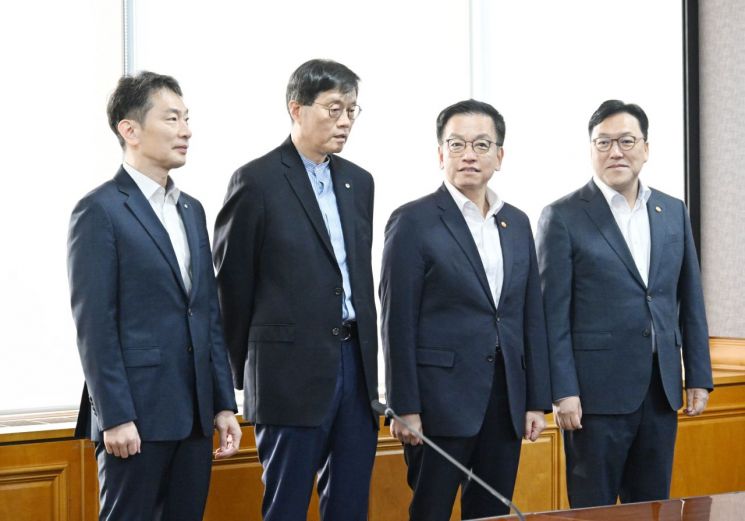 Choi Sang-mok, Deputy Prime Minister for Economic Affairs and Minister of Economy and Finance, is taking a commemorative photo with attendees at the Macroeconomic and Financial Issues Meeting held on the 11th at the Korea Federation of Banks in Jung-gu, Seoul. From the left in the photo are Lee Bok-hyun, Governor of the Financial Supervisory Service; Lee Chang-yong, Governor of the Bank of Korea; Deputy Prime Minister Choi Sang-mok; and Kim Byung-hwan, Chairman of the Financial Services Commission. Photo by [Photographer's Name]
Choi Sang-mok, Deputy Prime Minister for Economic Affairs and Minister of Economy and Finance, on the 11th noted that uncertainties remain regarding the US's mutual tariff suspension measures and urged related ministries to "strengthen monitoring across markets such as stocks, government bonds, foreign exchange, and funds."
At the macroeconomic and financial issues meeting (F4 meeting) held at the Korea Federation of Banks that morning, Deputy Prime Minister Choi stated, "Despite the US government's 90-day mutual tariff suspension, uncertainties persist due to the deepening US-China tariff dispute and continued tariffs on specific items."
He also requested, "Relevant agencies should maintain heightened vigilance and review and prepare response plans for various scenarios." The meeting was attended by Lee Chang-yong, Governor of the Bank of Korea, Kim Byung-hwan, Chairman of the Financial Services Commission, and Lee Bok-hyun, Governor of the Financial Supervisory Service.
The attendees evaluated that the shift to a decrease in the national total debt ratio for the first time in seven years, achieved through stable management of household debt, is a meaningful accomplishment.
They also agreed that to enhance the sustainability of the Korean economy, thorough management and response efforts to potential risks must continue going forward.
According to the Ministry of Economy and Finance, Korea's household debt-to-GDP ratio stood at 90.1% as of the end of last year, showing a downward trend from 98.7% in 2021 to 97.3% in 2022 and 93.6% in 2023. This represents a decrease of 8.6 percentage points from the peak in 2021.
© The Asia Business Daily(www.asiae.co.kr). All rights reserved.

![Clutching a Stolen Dior Bag, Saying "I Hate Being Poor but Real"... The Grotesque Con of a "Human Knockoff" [Slate]](https://cwcontent.asiae.co.kr/asiaresize/183/2026021902243444107_1771435474.jpg)















