Hyundai Construction -12.6, Kumho Construction -8.6, Dongbu Construction -6.2, etc.
Kumho Construction's Debt Ratio Surges from 260% to 589%
Doosan Construction, Kolon Global, and Others See Debt Ratios Exceed 300%
Among the 22 construction companies with annual sales exceeding 1 trillion KRW last year, 45% had interest expenses greater than their earnings. Representative companies that recorded operating losses last year include Hyundai Construction, Kumho Construction, Dongbu Construction, and Kolon Global. Large conglomerate affiliates such as SK Ecoplant, POSCO E&C, and GS Construction did not see their interest coverage ratios fall into negative territory but did drop below 1. As profitability in the construction industry gradually deteriorates, there is growing analysis that the risk of a wave of bankruptcies is increasing.

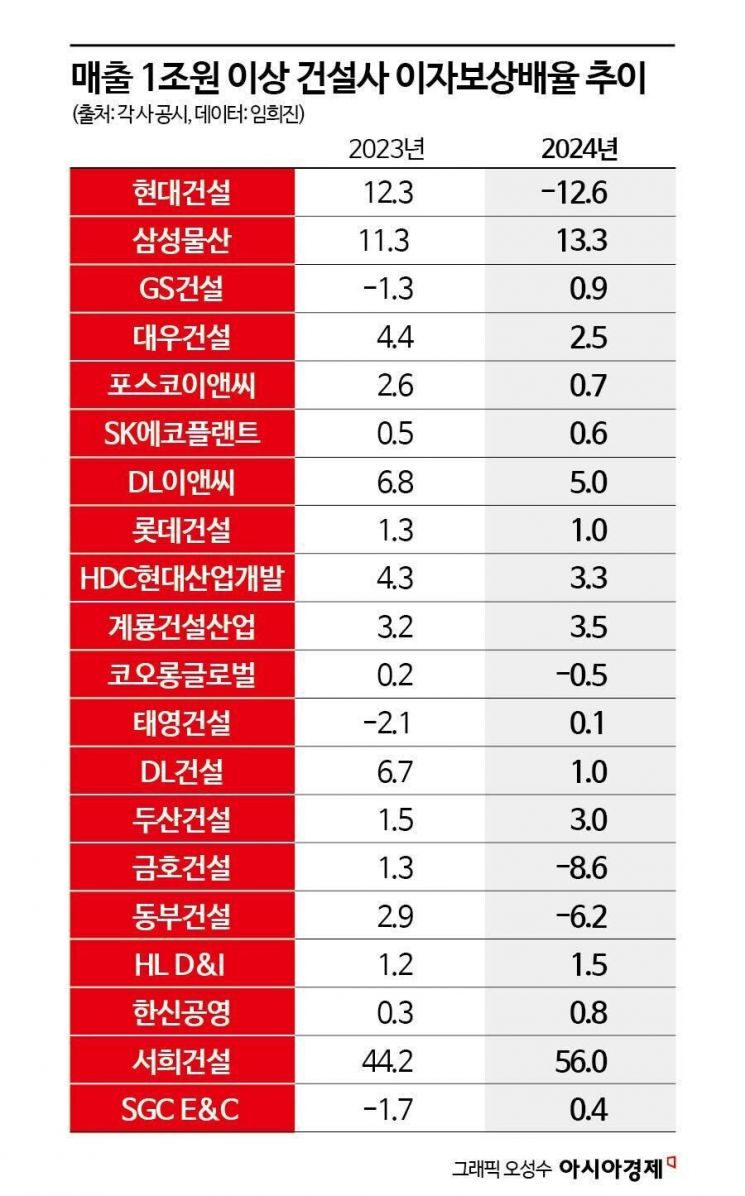
A survey of 22 construction companies with annual sales exceeding 1 trillion KRW last year found that the number of companies with an interest coverage ratio below 1 increased from 6 in 2023 to 10 in 2024. The interest coverage ratio is calculated by dividing operating profit by interest expenses; a ratio below 1 means that interest expenses exceed earnings, indicating difficulty in debt repayment.
Hyundai Construction and Kumho Construction Turn to Losses... Major Firms Also See Interest Coverage Ratio Below 1
Four companies recorded negative interest coverage ratios due to operating losses: Hyundai Construction (-12.6), Kumho Construction (-8.6), Dongbu Construction (-6.2), and Kolon Global (-0.5). Hyundai Construction posted an operating loss of approximately 1.26 trillion KRW last year, the first in 23 years, due to deteriorating overseas business profits and rising construction costs. Kumho Construction (-181.8 billion KRW), Dongbu Construction (-96.9 billion KRW), and Kolon Global (-56.6 billion KRW) also turned to losses.
Large construction firms such as Taeyoung Construction (0.1), SGC E&C (0.4), SK Ecoplant (0.6), POSCO E&C (0.7), Hanshin Engineering & Construction (0.8), and GS Construction (0.9) also saw their interest coverage ratios fall below 1.
Construction companies with significant increases in interest expenses last year include SGC E&C (135.42%), Kolon Global (124.28%), Hyundai Construction (56.95%), Dongbu Construction (47.72%), and DL Construction (46.41%).
Half of Construction Companies with Sales Over 1 Trillion KRW Have Debt Ratios Exceeding 200%
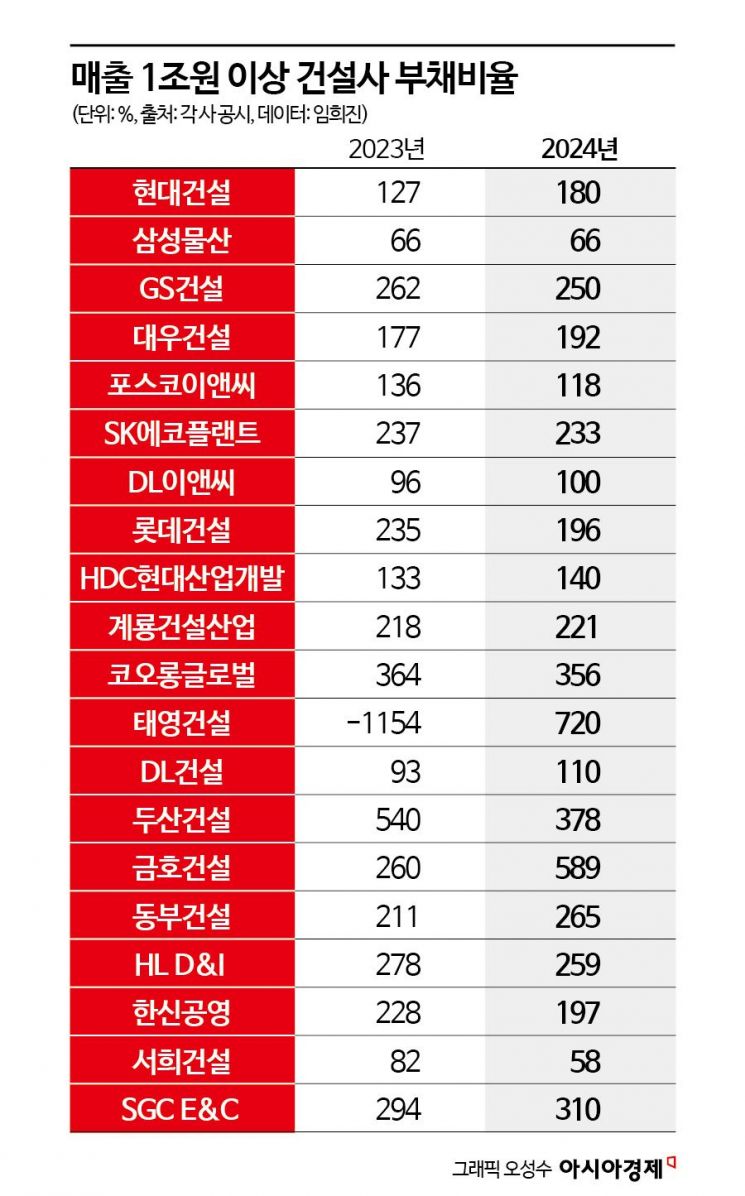
Among construction companies with sales exceeding 1 trillion KRW, about half have debt ratios exceeding 200%. In particular, Kumho Construction recorded a debt ratio of 589%, more than double the 260% recorded in 2023. This is the second highest after Taeyoung Construction (720%), which is currently under workout.
Construction companies with debt ratios exceeding 300% include Doosan Construction (540%→378%), Kolon Global (364%→356%), and SGC E&C (294%→310%).
Among large construction companies with debt ratios below 200%, Hyundai Construction (127%→180%) and Daewoo Construction (177%→192%) saw increases compared to the previous year. Among those with debt ratios above 200%, Dongbu Construction (211%→265%) experienced a significant increase, and Gyeryong Construction Industry (218%→221%) also saw an increase. SK Ecoplant (237%→233%) and HL D&I (278%→259%) saw slight decreases.
Domestic Construction Orders Have Not Recovered to Previous Levels
The situation shows no signs of improvement this year either. According to Statistics Korea, last year's domestic construction orders fell short of previous years' levels. Last year recorded 214.4808 trillion KRW (forecast), slightly surpassing the 2023 level. The order amounts over the past five years were 208.9906 trillion KRW in 2020, 230.6739 trillion KRW in 2021, 248.3552 trillion KRW in 2022, and 206.7403 trillion KRW in 2023.
Compared to the previous year, public construction orders (66.861 trillion KRW) and private construction orders (147.6197 trillion KRW) increased slightly but did not recover to the levels of two to three years ago. Private construction orders (140.6584 trillion KRW) sharply declined by 26.2% compared to 2023 (190.5867 trillion KRW) due to the real estate market downturn.
Due to the cumulative rise in construction costs over recent years, profitability has decreased, leading to an increasing number of construction companies refraining from actively pursuing orders. The worsening local real estate market and the increase in non-performing unsold units have made liquidity difficult to secure, posing a significant burden on construction companies.
Ji-hye Lee, a research fellow at the Construction Industry Research Institute, said, "Looking at the management indicators of construction companies over the past 3 to 4 years, profitability, stability, and growth are all on a declining trend. A vicious cycle continues where even if orders are secured, no profits remain. Some construction companies are selling real estate and assets to reduce debt and secure liquidity, but with rising construction costs, high exchange rates, and uncertainties in real estate policies combined, more companies may see worsening financial conditions this year."
Meanwhile, corporate rehabilitation procedures (court receivership) have continued among mid-sized construction companies this year. A total of eight companies, including Shindonga Construction, Daejeo Construction, Sambu Construction, Samjeong Enterprise, Byuksan Engineering, Angang Construction, Daewoo Shipbuilding & Marine Engineering, and Daehung Construction, have consecutively applied for court receivership.
© The Asia Business Daily(www.asiae.co.kr). All rights reserved.
![From Hostess to Organ Seller to High Society... The Grotesque Scam of a "Human Counterfeit" Shaking the Korean Psyche [Slate]](https://cwcontent.asiae.co.kr/asiaresize/183/2026021902243444107_1771435474.jpg)


















