Multicultural and Free Meal Information Also Exposed
Civic Group Demands Measures to Prevent Recurrence and Official Apology
Numerous cases have been found where the Gwangju Office of Education and its affiliated institutions exposed sensitive personal information of students and staff without any filtering while disclosing the original texts of official documents. The disclosed information included students' medical conditions, economic status, multicultural backgrounds, and details of school violence deliberations, raising concerns of serious human rights violations.
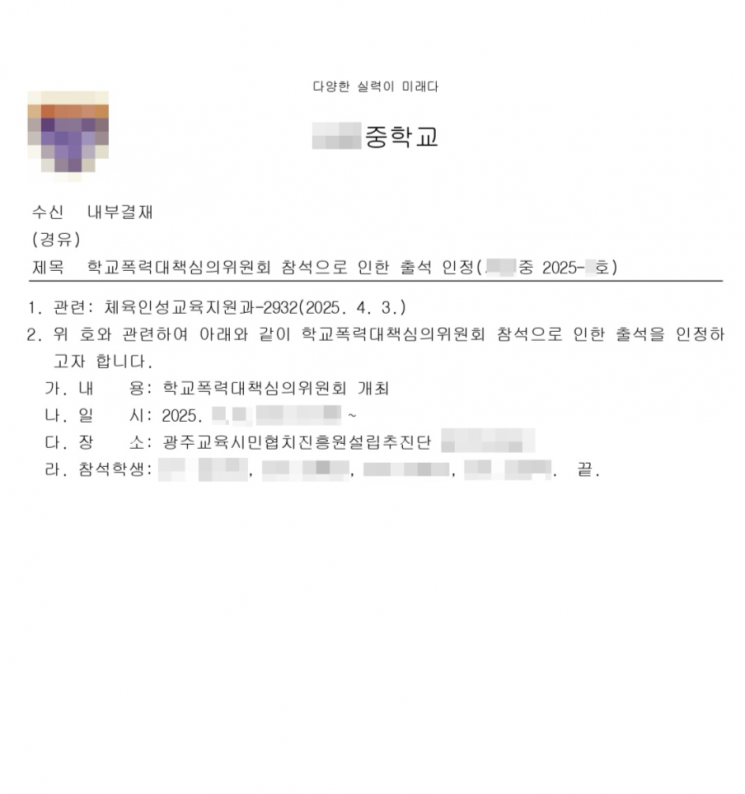 An official document acknowledging attendance at the School Violence Countermeasure Deliberation Committee, originally disclosed by a middle school in the Gwangju area. Provided by Society for a World Without Credentials
The education civic group "Citizens' Coalition for an Academic-Free Society" stated on the 10th, "According to our findings through the Information Disclosure Portal, some elementary, middle, and high schools in the Gwangju area, as well as affiliated agencies of the Office of Education, were indiscriminately exposing highly sensitive personal information during the process of disclosing original documents."
The original document disclosure system is intended to guarantee the public's right to know and administrative transparency by allowing public institutions to release documents they produce without separate requests. However, according to the coalition's investigation from December last year to recently, it was revealed that numerous official documents were being published online without any filtering.
The cases are widespread. One elementary school revealed the real name and home address of a specific instructor in a contract termination notice for an after-school English teacher. Another high school uploaded a student's name and disease in a document recognizing attendance. In a notice regarding payment for sports uniforms, the names, grades, classes, and numbers of 221 students were all exposed. Some schools even published lists of school violence deliberation committee members, students who did not undergo urine tests, and applicants for free meals.
In particular, the coalition expressed strong concern over a mentoring document that disclosed the names, schools, and grades of 143 multicultural and North Korean defector students, saying, "Students could experience prejudice, discrimination, and feelings of intimidation." They also pointed out that meal and program notices containing information on recipients of free support "could lead to teasing or stigmatization among peers."
The coalition criticized, "Most of the leaked information pertains to the everyday and sensitive areas of life for students and staff, and it is highly likely that those involved were exposed without even realizing it," adding, "This is not a simple administrative mistake but a structural problem at the level of the Office of Education."
They further pointed out, "There is no personal information filtering system in place, personal information protection education is not being properly conducted, and the inspection system is also inadequate," adding, "The Office of Education is neglecting a situation that could lead to serious human rights violations."
The coalition demanded that the Gwangju Office of Education conduct a comprehensive investigation of original document disclosures, strengthen personal information protection education, introduce an automatic filtering system, and establish an official apology and protection measures for victims.
© The Asia Business Daily(www.asiae.co.kr). All rights reserved.

















