U.S. Isolates China, Grants 90-Day Tariff Suspension to Others
Talks Pending with 70 Countries; U.S. Treasury: "Joint Response Possible"
China Strengthens Cooperation with India and Europe
EU Voices Support for Solidarity with China
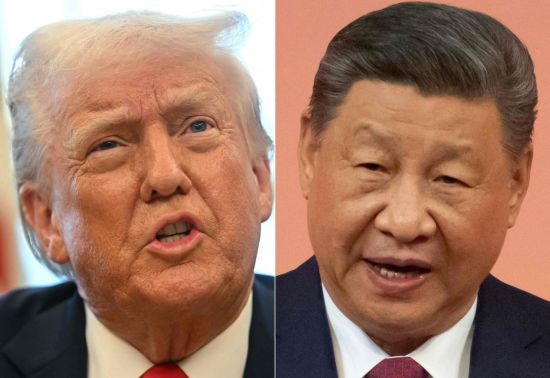 Donald Trump, President of the United States (left), and Xi Jinping, President of China (right). Photo by AFP Yonhap News
'125% (U.S. additional tariffs) vs 84% (China's additional tariffs on the U.S.)'
The United States and China, locked in a tit-for-tat tariff battle, are recruiting other countries as allies to gain the upper hand in the tariff war. By rallying friendly forces, they intend to leverage economic alliances to increase pressure on the opposing side. The U.S. hastening negotiations with its traditional allies such as South Korea, Japan, and the European Union (EU) is also seen as part of this effort. Among them, the EU, which accounts for 17.6% of the world's gross domestic product (GDP), is viewed as a potential 'game changer.'
U.S. Treasury: "Negotiations with 70 countries underway... Joint response to China possible"
According to Reuters, U.S. Treasury Secretary Scott Vestment said on the 9th (local time) at the 'American Bankers Association (ABA) Conference' in Washington, "We are ready to negotiate with more than 70 countries," adding, "After the negotiations are concluded, a joint response against China will be possible."
Since the U.S. announced reciprocal tariffs globally on the 2nd, countries have been busy. Starting with the U.S.'s traditional allies such as South Korea, Japan, and the EU, countries worldwide have begun preparing to sit at the negotiating table with the U.S. government. South Korea, Japan, and the EU have each been subjected to reciprocal tariff rates of 25%, 24%, and 20%, respectively.
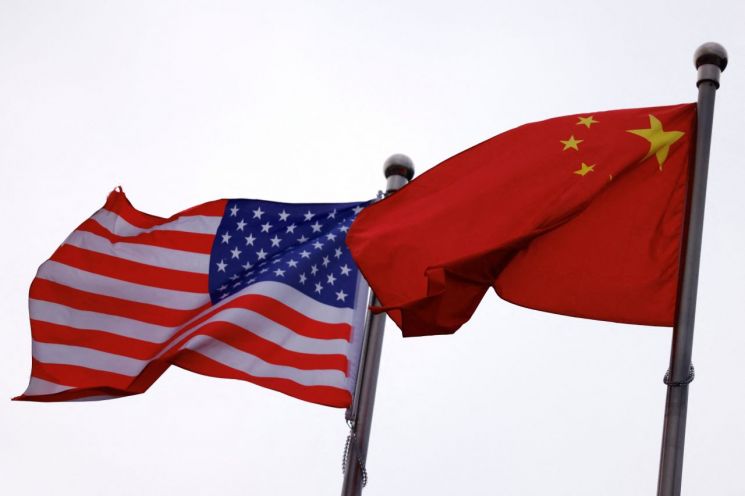
Among these, the U.S. has intensified its isolation of China. President Donald Trump announced via his social media on the same day that reciprocal tariffs on China would be raised to 125%, and country-specific reciprocal tariffs on other countries would be suspended for 90 days. This came about 13 hours after the reciprocal tariffs were fully implemented just after midnight on the so-called 'worst countries'?those with a trade surplus in goods with the U.S. This was an immediate response to China's countermeasure of raising its tariffs on U.S. goods from 34% to 84%.
China expands allies including India to increase influence
China is also expanding its allies to increase its influence. According to Xinhua News Agency, Chinese President Xi Jinping announced at the 'Central Work Conference on Surrounding Areas' that China will strengthen mutual trust and diplomatic policies with neighboring countries to build a community of shared destiny.
China is also pursuing trade diversification with Asia and Europe. In Europe, resentment against Elon Musk, CEO of the U.S. electric vehicle company Tesla, is growing, which is seen as benefiting Chinese electric vehicle company BYD. Former UK Treasury Secretary Jim O'Neill argued, "After President Trump's 'kamikaze tariff measures,' a restructuring of trade is inevitable," and that trade cooperation with China should be included as an alternative in this process.
In particular, China has reportedly proposed joint action against U.S. tariff abuses by considering India as a cooperative partner, according to the UK Guardian. Earlier this month, President Xi sent a letter to Indian President Droupadi Murmu commemorating 75 years of bilateral trade, stating, "As partners of mutual achievement, realizing the 'tango of the dragon (China) and the elephant (India)' is the right choice."
Europe: Whose side will they take? Voices for solidarity with China
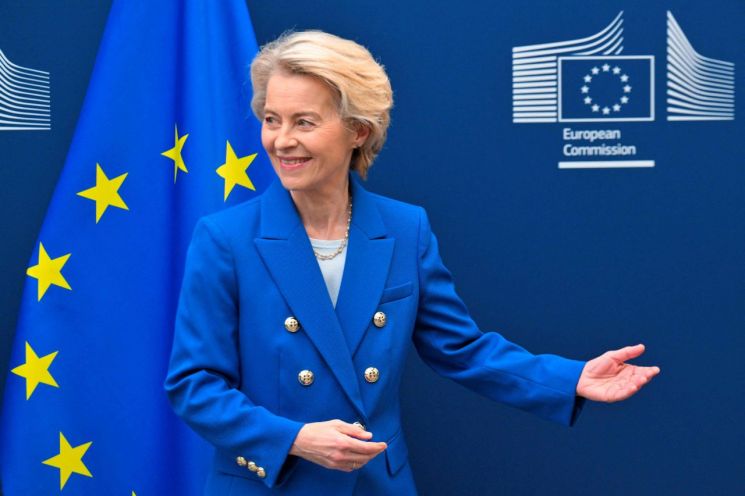 Ursula von der Leyen, President of the European Commission leading the European Union (EU) Executive Committee. Photo by AFP Yonhap News
In the U.S.-China standoff, the question of which side Europe, bound as an economic community through the EU, will support is expected to be significant. According to the World Bank, the EU's GDP reached $18.591 trillion (2,715 trillion KRW) as of 2023, accounting for 17.6% of the global economy.
Within Europe, voices advocating solidarity with China are gaining strength. Christopher Dent, professor at Edge Hill University's Business School, said, "Trump's aggressive trade policies will ultimately lead other countries to strengthen their trade alliances with each other," adding, "There is a possibility that the EU and China will patch up or suspend the trade dispute and lead free trade together with the UK, Canada, Japan, South Korea, and Australia."
Such movements have also been cautiously observed within the EU Commission. Maros Sefcovic, the EU Commissioner for Trade and Economic Security, said after a recent meeting with Chinese Vice Premier He Lifeng, "Relations can only be open when trade and investment guarantee symmetrical flows." However, it is also true that the EU inevitably faces concerns about abandoning its traditional ally, the U.S.
The U.S. has reacted sensitively to this. When a senior Spanish official said, "Europe should strengthen relations with China," Treasury Secretary Vestment strongly criticized it, saying, "That is like cutting your own throat."
© The Asia Business Daily(www.asiae.co.kr). All rights reserved.
![Clutching a Stolen Dior Bag, Saying "I Hate Being Poor but Real"... The Grotesque Con of a "Human Knockoff" [Slate]](https://cwcontent.asiae.co.kr/asiaresize/183/2026021902243444107_1771435474.jpg)













