Development of the 'ODSEI Chip' for Large-Scale Analysis of Over 1,000 Tumor Spheroids
Clarifying Drug Resistance to Breast Cancer Treatments and Supporting Patient-Specific Therapy Development; Featured on the Cover of Advanced Science
A chip technology capable of precisely simulating and analyzing in real time the interactions between cancer cells and blood vessels, closely mimicking the actual human environment, has been developed.
This is being hailed as a new breakthrough in the development of patient-specific anticancer drugs.
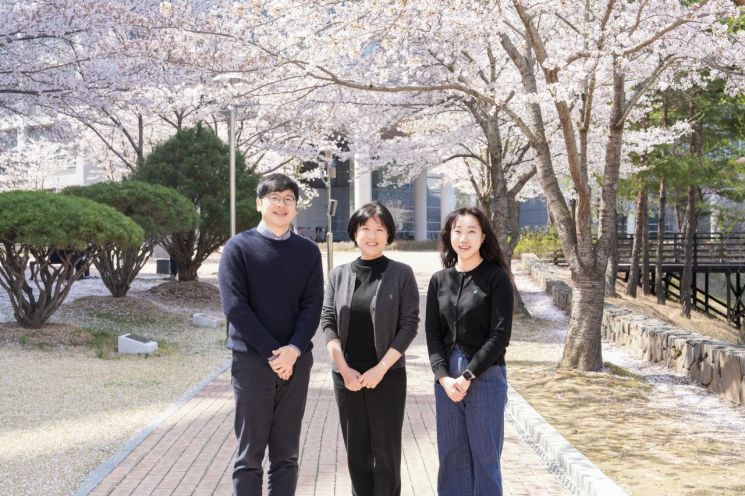
The research team led by Professor Cho Yoonkyung from the Department of Biomedical Engineering at UNIST announced on the 14th that they have developed the 'ODSEI chip,' a microfluidic chip that enables large-scale, real-time analysis of interactions between cancer cells and blood vessels.
Cancer cells require more nutrients and oxygen than normal cells to grow rapidly. Since they cannot produce these resources on their own, they stimulate surrounding vascular cells to draw in the necessary resources. Understanding the interactions between cancer and blood vessels is essential to elucidate the mechanisms of unpredictable cancer metastasis and drug resistance, and to establish effective treatment strategies.
The ODSEI chip developed by the research team is a device that can culture and analyze over 1,000 cancer cell clusters (tumor spheroids) together with vascular cells.
Unlike conventional closed systems, it is designed with an open structure, allowing specific spheroids to be selectively retrieved at desired time points for genetic analysis. This enables researchers to track the process by which cancer cells acquire resistance through interactions with blood vessels.
Using this technology, the team investigated the development of resistance to the breast cancer drug tamoxifen. Through single-cell RNA sequencing and protein analysis, they identified IL-8 and TIMP-1 as biomarkers that can enhance the efficiency of vascular drug delivery.
They also clarified that these signaling molecules activate survival signals in cancer cells and suppress the response to therapeutics, thereby elucidating the process by which cancer cells develop drug resistance.
No Jooyoung, the first author of the study, explained, "The chip is designed with a specially coated double-layered porous membrane, allowing it to maintain an open structure while closely simulating the actual human environment." Although the cancer cells and vascular cells are physically separated, signaling molecules can freely move between them, enabling mutual influence. In addition, each cancer spheroid is cultured separately in individual wells, allowing for independent observation and analysis of each spheroid without interference.
Professor Cho Yoonkyung stated, "A new pathway has opened for effectively studying drug resistance under conditions that precisely mimic the tumor microenvironment," adding, "This technology will become an important platform for developing patient-specific therapies."
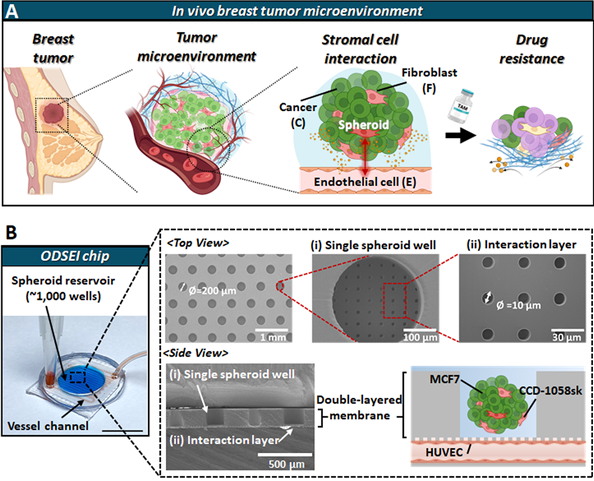 Development of the ODSEI chip capable of mimicking the complex environment surrounding cancer cell clusters.
This research was supported by the Institute for Basic Science (IBS) and the Ministry of Health and Welfare, and the results were published in the world-renowned journal Advanced Science on April 3.
Recognized for its innovation and significance, it was selected as the cover article and also featured as a hot topic in the field of microfluidic chips.
© The Asia Business Daily(www.asiae.co.kr). All rights reserved.


















