Japan Considers Cash Payment of About 500,000 Won to All Citizens
In Response to High Inflation and Tariff Measures by Trump Administration
The Japanese government is considering a plan to provide approximately 500,000 won per person in cash to all citizens. This is in response to high inflation and the impact of tariff measures imposed by the Donald Trump administration in the United States.
According to local media such as the Asahi Shimbun on the 9th, the Japanese government and the ruling party are currently promoting a plan to pay 40,000 to 50,000 yen (about 400,000 to 500,000 won) per person regardless of income. To this end, they plan to allocate the related funds in this year's supplementary budget and pass it through the National Diet in June.
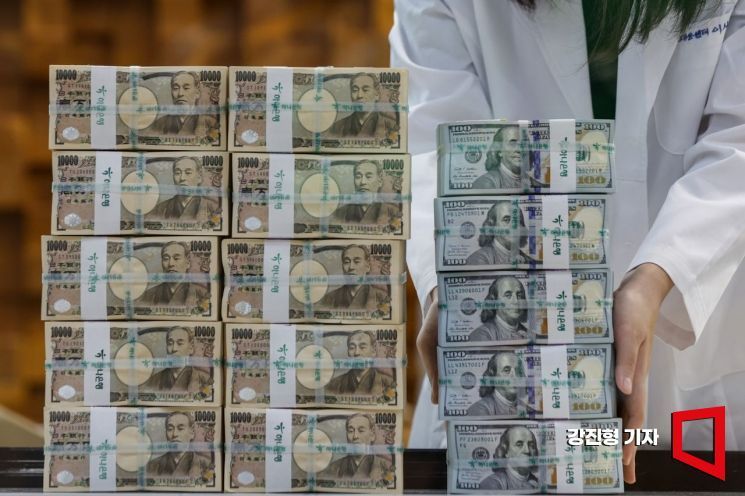 An employee is organizing US dollars and Japanese yen at the Hana Bank Counterfeit Response Center in Jung-gu, Seoul. Photo by Kang Jin-hyung
The Yomiuri Shimbun reported that within the Liberal Democratic Party (LDP), there is a consensus that at least 30,000 yen per person should be paid. The Komeito Party, which forms a coalition government with the LDP, has proposed raising the payment to a maximum of 100,000 yen for all citizens. At a press conference on the 8th, Komeito Secretary-General Nishida Makoto stated, "Wage increases, support payments, and tax cuts help lower the non-tariff barriers demanded by the Trump administration," urging for support payments that can be implemented quickly instead of tax cuts, which require legal amendments.
The reason Japan is considering large-scale support payments is that it believes the impact of the Trump administration's high tariffs will not end in the short term. The Asahi Shimbun analyzed that, with persistent high inflation, early countermeasures are deemed necessary. On the 7th, Japanese Prime Minister Ishiba Shigeru expressed a sense of crisis by describing the U.S. reciprocal tariffs as "a situation that can be called a national crisis for Japan." Japanese government spokesman and Chief Cabinet Secretary Hayashi Yoshimasa also expressed concern at a press conference that day, saying, "The broad trade restrictions by the U.S. will have a significant impact on the economic relations between Japan and the U.S., the global economy, and the trade system." On the 8th, Japan established an inter-agency task force to discuss economic measures such as tariff relief in response to the U.S. tariff measures.
Opposition parties in Japan have also raised calls for tax cuts. On the previous day, Tamaki Yuichiro, leader of the Democratic Party for the People, proposed at a press conference, "The impact of tariff imposition on the Japanese economy is unavoidable," and suggested "lowering the consumption tax to reduce the burden on citizens." Meanwhile, the U.S. government has implemented reciprocal tariffs by country and imposed a 24% tariff on Japanese products.
© The Asia Business Daily(www.asiae.co.kr). All rights reserved.

















