White House: "iPhone Production Can Move to the U.S."
Wall Street Analyst: "A Fictional Story... Difficult to Realize"
"Even with the Same Supply Chain, Tariffs Will Drive Prices Up"
As U.S. President Donald Trump raised tariffs on China to 125% while announcing a 90-day suspension of reciprocal tariffs for other countries, a forecast emerged that the price of the iPhone, a representative American consumer product, could exceed three times its current price if produced in the United States. On the 9th (local time), Yonhap News quoted CNN reporting, "Dan Ives, Global Technology Research Head at Wedbush Securities, a well-known Wall Street analyst, predicted that if the iPhone is produced in the U.S., its price could soar to $3,500 (approximately 5.12 million KRW)."
 Customers visiting the Apple Store in Myeongdong, Jung-gu, Seoul, on the 20th, when Apple's first artificial intelligence (AI) smartphone, the 'iPhone 16,' was released in Korea, are seen looking at the product. Photo by Jinhyung Kang aymsdream@
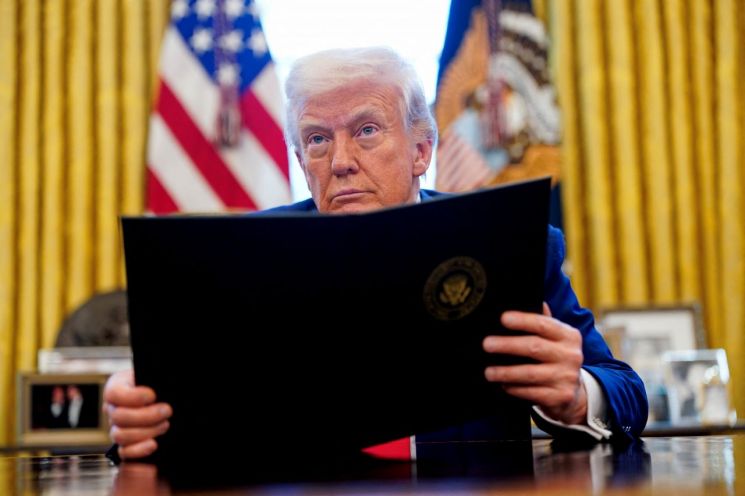
On the 8th, White House spokesperson Caroline Levitt said in a briefing, "President Trump believes Apple can move iPhone production to the United States." However, Ives dismissed this as "fictional" and asserted, "Producing the iPhone in the U.S. is unlikely to be realized." He explained, "An iPhone produced in the U.S. could cost more than three times the current price of about $1,000 because the highly complex production ecosystem established in Asia would have to be replicated in the U.S."
Ives further stated, "For example, if semiconductor factories were built in West Virginia or New Jersey, that would result in a $3,500 iPhone," and projected, "Even if Apple relocates only 10% of its entire supply chain to the U.S., it would require $30 billion (approximately 43.635 trillion KRW) and three years." In an earlier report, he also argued, "The reality that a $1,000 iPhone is the world's top consumer product for American consumers will disappear," adding, "The current price is unrealistic, and prices will rise sharply."
According to CNN, even if the supply chain remains intact, the iPhone price is expected to rise significantly due to the reciprocal tariffs initially announced by President Trump. Investment bank Rosenblatt Securities predicted, "If Apple passes the high tariff costs entirely to consumers, iPhone prices could increase by 43%." Additionally, Neil Shah, Vice President of market research firm Counterpoint Research, said, "It can vary depending on the production location," but added, "Prices could rise by about 30%."
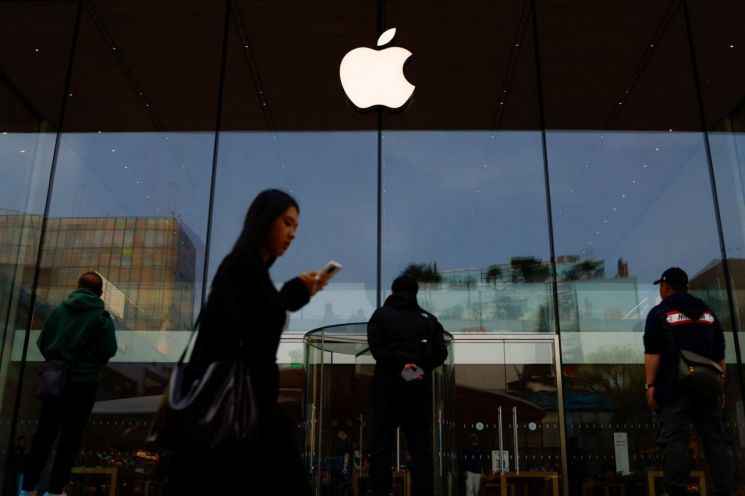 People are passing in front of the Apple Store located in Beijing, China. Photo by Reuters and Yonhap News.
However, there is also analysis that Apple is already exploring production bases outside China, such as India and Brazil. This is because relocating core component production to countries with lower tariff barriers could help suppress iPhone prices. According to the reciprocal tariffs initially announced by President Trump, India’s tariff was 26%, and Brazil’s was the lowest at 10%. However, these countries are also evaluated as not having production capacity sufficient to replace China.
On the same day, about 13 hours after the start of country-specific reciprocal tariffs, President Trump raised tariffs on China to 125% while suspending country-specific reciprocal tariffs for other countries for 90 days and imposing only a 10% basic tariff. On his social media platform 'Truth Social,' he announced, "We are immediately raising tariffs on China to 125%" in response to China's retaliatory tariff measures against U.S. reciprocal tariffs.
President Trump said, "Hopefully, at some point in the near future, China will realize that the days of exploiting the U.S. and other countries are no longer sustainable or acceptable."
© The Asia Business Daily(www.asiae.co.kr). All rights reserved.



















