China Raises Tariffs on U.S. Imports from 34% to 80%
EU to Impose 25% Tariffs on U.S. Products Starting from the 15th
Market Volatility Increases Amid Tariff Uncertainty and Bargain Hunting
Unusual Drop in U.S. Treasury Prices... Suspicions of Chinese Sell-Off
The three major indices of the U.S. New York stock market are on the rise on the 9th (local time), the day when reciprocal tariffs were fully implemented. The market, which had started lower due to concerns over a global trade war as China and the European Union (EU) hinted at retaliatory measures against the U.S. tariff bomb, is rebounding as investors engage in bargain hunting. Extreme volatility caused by tariff uncertainties continues. U.S. Treasury bonds, considered the world's safest assets, are seeing increased selling pressure, especially in long-term bonds, causing yields to rise. There are observations that China is selling off large amounts of U.S. Treasuries as a retaliatory measure against the U.S.
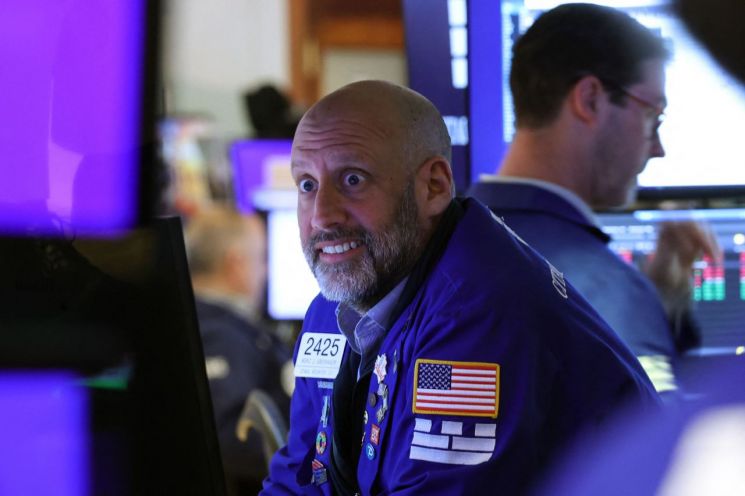
As of 10:20 a.m. in the New York stock market on the day, the Dow Jones Industrial Average (Dow) focused on blue-chip stocks is trading at 37,721.59, up 76 points (0.2%) from the previous trading day. The S&P 500, centered on large-cap stocks, is up 23.87 points (0.48%) at 5,006.64, and the Nasdaq, focused on technology stocks, is up 218.8 points (1.43%) at 15,486.71.
By individual stocks, Apple is up 3.03%. Tesla is up 3.92%, and Nvidia is up 3.41%. General Motors (GM) and Ford are down 0.99% and 0.81%, respectively.
On the same day, China announced it would raise additional tariff rates on all U.S. imports from 34% to 84%. This is a retaliatory move after the U.S. implemented reciprocal tariffs at midnight, increasing the reciprocal tariff rate on China by 50 percentage points from the previous 34% to 84%. Earlier, U.S. President Donald Trump warned that if China imposed reciprocal tariffs at the same level of 34% as a retaliatory measure, he would impose an additional 50% tariff on China as a counter-retaliation. As a result, since the start of Trump's second term, the cumulative additional tariffs imposed by the U.S. on China have risen to 104%.
The EU will also impose tariffs of up to 25% on major U.S. imports starting from the 15th. This is a countermeasure against the 25% tariffs on all steel and aluminum imports that the U.S. implemented on the 12th of last month, and it is the first retaliatory measure against the U.S. tariff bombardment since the start of Trump's second term. Canada also reaffirmed on the day its plan to impose a 25% tariff on U.S.-made automobiles as retaliation against the U.S.'s 25% tariff on automobiles.
Concerns about the spread of the global trade war are rising in the market. As the vicious cycle of tariffs, retaliatory tariffs, and counter-retaliations continues between the U.S. and major countries, worries have grown that not only the U.S. but also the global economy will be directly hit. President Trump posted on his social media platform Truth Social, which he created, saying, "Everything will be fine, and America will be bigger and better than ever," adding, "Now is a very good time to buy (stocks)." Some interpret positively the fact that Trump appointed Treasury Secretary Scott Baesant, a Wall Street veteran who has sent conciliatory messages to the market, as the chief negotiator in tariff talks instead of Peter Navarro, the White House trade and manufacturing advisor known as a 'tariff hawk,' and Commerce Secretary Howard Lutnick.
Prices of U.S. Treasuries, considered the world's safest assets, are plunging. Typically, investors sell risky assets like stocks and buy safe assets like government bonds during times of high uncertainty, but an unusual simultaneous sell-off of both stocks and bonds is occurring. As a result, bond yields, which move inversely to bond prices, are soaring. The yield on the 10-year U.S. Treasury, a global bond yield benchmark, rose 11 basis points (1bp = 0.01 percentage points) to 4.37% compared to the previous trading day, and the yield on the 2-year U.S. Treasury, sensitive to monetary policy, rose 2 basis points to 3.76%. It is analyzed that China, which holds a large amount of U.S. Treasuries, is selling them off in response to President Trump's tariff bombardment.
Alexandre Baradez, Chief Market Analyst at IG Markets, said, "We have entered a stage where the trade war is intensifying, and investors have nothing to hold onto right now," adding, "What is clear is that the U.S. Treasury market is no longer a safe haven for investors and is instead putting pressure on the stock market."
© The Asia Business Daily(www.asiae.co.kr). All rights reserved.

















