Han, as Acting President, belatedly appoints Ma Eun-hyuk and nominates two Constitutional Court justices from the President's quota
Constitutional law scholars: "An acting president has no authority to nominate justices"
Prime Minister and Acting President Han Duck-soo appointed constitutional court justice Ma Eun-hyuk, whose appointment had been delayed for 104 days, restoring the Constitutional Court to a full nine-member panel for the first time in six months. However, with Acting President Han also appointing two presidential nominees for constitutional court justices belatedly, concerns and criticisms have poured in from constitutional law scholars and opposition parties, calling it an "unconstitutional overreach beyond authority."
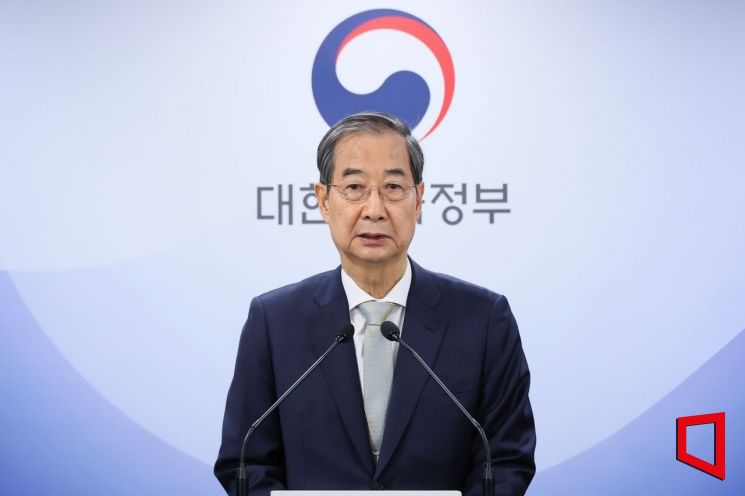 Acting President and Prime Minister Han Duck-soo is delivering a national address on the 4th at the Government Seoul Office following the Constitutional Court's ruling to dismiss President Yoon Seok-yeol. [Photo by Prime Minister's Office]
According to the legal community on the 9th, Acting President Han nominated Lee Wan-gyu, head of the Legislation Office, and Ham Sang-hoon, chief judge of the Seoul High Court, as successors to Moon Hyung-bae, acting chief justice of the Constitutional Court, and Justice Lee Mi-sun, whose terms end on the 18th. If confirmed as is, the court will consist of seven moderate and conservative justices and two progressive justices.
The Constitution stipulates that the court has nine justices, with three each nominated or elected by the President, the Chief Justice of the Supreme Court, and the National Assembly. The final appointment authority lies with the President. In the case of Justice Ma, who was selected as a nominee from the National Assembly's quota, the appointment was a formal and passive exercise of authority, but the nomination of justices from the President's quota is a direct and active exercise of the President's exclusive authority, marking a significant difference.
This is the first time in constitutional history that an acting president has nominated candidates for constitutional court justices from the President's quota. Previously, during the impeachment trial of former President Park Geun-hye in 2017, when Chief Justice Park Han-chul retired at the end of his term, Acting President Hwang Kyo-ahn did not nominate a successor.
Constitutional law scholars unanimously agree that the appointment of constitutional court justices from the President's quota is beyond the authority of an acting president. Professor Kim Sun-taek of Korea University Law School said, "An acting president appointing a six-year term justice during a two-month acting period is mocking the people and is an unconstitutional overreach beyond authority done routinely," adding, "The Constitutional Court made it clear last month in the impeachment trial of Han Duck-soo that an acting president does not inherit the status of the President but merely performs the duties."
Professor Cha Jin-ah of Korea University Law School explained, "An acting president is granted authority only within the scope of maintaining the status quo, whereas nominating constitutional court justices is an active authority involving a change in the status quo that only the President can exercise directly," adding, "Unlike the President, the acting president is not directly elected and therefore cannot exercise the same powers as the President."
However, since the President's quota justices do not require the consent of the National Assembly, it seems difficult to prevent the exercise of nomination authority if Acting President Han does not withdraw the nominations. On the 8th, Speaker Woo Won-shik of the National Assembly stated, "We will not accept requests for parliamentary confirmation hearings for these nominees," but the Confirmation Hearing Act allows the President to appoint nominees even if the National Assembly does not adopt and submit a confirmation report within the deadline.
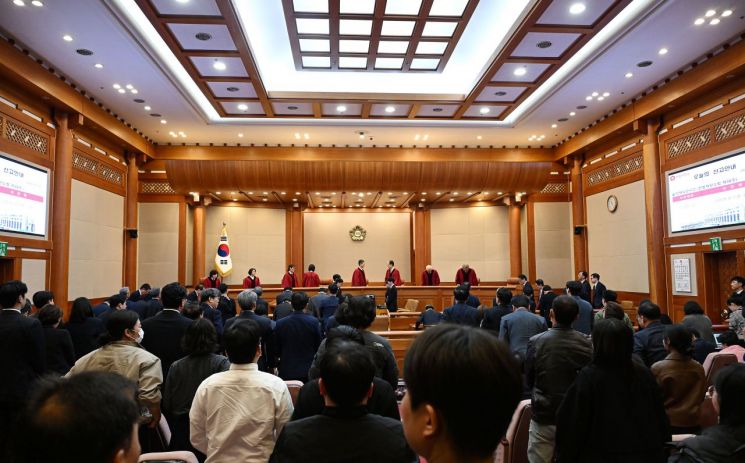
However, constitutional law scholars believe it is possible for parties involved in constitutional litigation to claim the illegality of the court's composition and file constitutional complaints along with injunctions to suspend the effect. In such cases, the court's composition itself would be deemed illegal, and trials involving justices appointed by Prime Minister Han could be invalidated.
© The Asia Business Daily(www.asiae.co.kr). All rights reserved.
!["The Woman Who Threw Herself into the Water Clutching a Stolen Dior Bag"...A Grotesque Success Story That Shakes the Korean Psyche [Slate]](https://cwcontent.asiae.co.kr/asiaresize/183/2026021902243444107_1771435474.jpg)

















