Professor Matt Qvortrup, Architect of the UK Recall Law, Interviewed by Public Interest Hub
"To Overcome the Limits of Representative Democracy, the Public Must Monitor Power"
"It Is Time for Korea to Seriously Consider Introducing the Recall System"
Public Interest Hub: "Elections and Judicial Sanctions Alone Are Not Enough... A Korean-Style Recall System Is Needed"
 Matt Quattrup, a visiting professor at the ANU College of Law and known as a global authority on referendums, said, "The recall system is an emergency brake that can be used against arrogant or incompetent politicians who disregard voters." Gongik Hub
Matt Qvortrup, a visiting professor at the Australian National University (ANU) College of Law and a globally recognized authority on referendums, stated on the 9th that "the recall system is an emergency brake that can be used against arrogant or incompetent politicians who ignore voters."
In a written interview conducted with the Policy and Legislation Research Center Public Interest Hub, Professor Qvortrup said this and added, "It is a sound means to maintain a responsible government." He emphasized, "To overcome the limitations of representative democracy, where politicians include only topics they want to discuss on the agenda, the public must be able to monitor power. For this reason, Korea has also reached a point where it should seriously consider introducing the recall system."
The United Kingdom is one of the most representative countries operating a recall system. After long debates, it enacted the Recall of MPs Act 2015 and implemented the recall system for members of the House of Commons starting March 4, 2016. Professor Qvortrup served as an advisor on the design of the UK’s recall law. He explained, "The final adopted system was somewhat different from the ideal version I proposed." This is because the recall law stipulates that voters can recall their constituency MP only if the MP is found to have committed certain offenses meeting specific criteria.
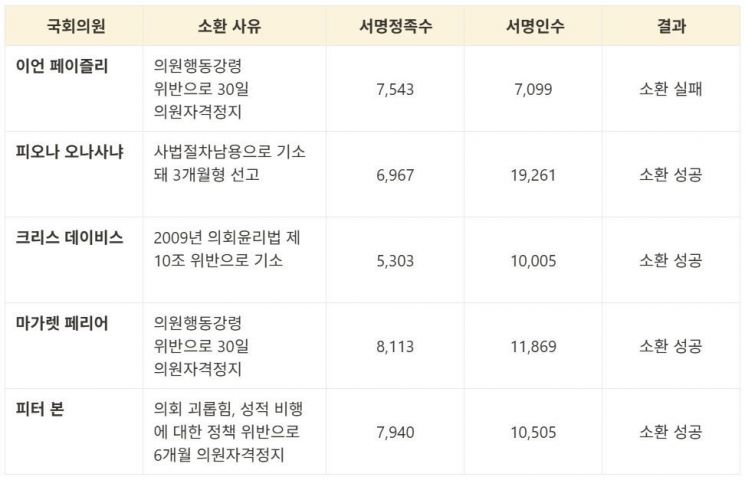
The UK’s recall system limits grounds for recall to ▲ prosecution and imprisonment for criminal acts ▲ suspension from duties for a certain period following sanctions by the House of Commons Committee on Standards ▲ cases where MPs were prosecuted for false or misleading allowance claims under the 2009 Parliamentary Standards Act. Professor Qvortrup said, "Jack Goldsmith, who was a Conservative MP at the time, believed the recall law would be ineffective and have no impact." However, despite legal constraints, the UK’s recall system is regarded as highly utilized. By January 2024, five recall votes for MPs had been held in the UK, with four resulting in confirmed recalls. Professor Qvortrup stated, "Although there is room for improvement, the UK’s recall law has proven effective, much to many people’s surprise."
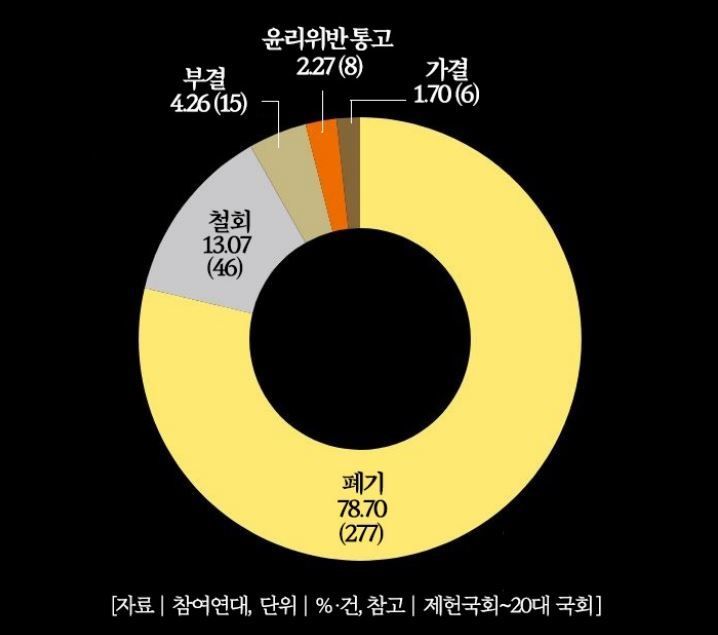
The Public Interest Hub pointed out, "There is no way for the public to remove or hold accountable MPs who act against the will of the majority." Aside from elections, judicial sanctions are a means to control elected officials. However, judicial sanctions require considerable procedures and time, as seen in the impeachment trial of former President Yoon, which took 112 days. The judicial trial period for MPs also exceeds one year. After the 21st general election in 2020, it took an average of 423 days for verdicts to be finalized for 26 MPs prosecuted for election law violations. The National Assembly itself lacks self-purification ability. Since the first Constituent Assembly in 1948 to the current 22nd National Assembly, spanning 77 years, only four resolutions urging the expulsion of MPs have been proposed. Since the establishment of the Special Committee on Ethics in 1991, out of 352 disciplinary cases submitted, only six resulted in actual disciplinary actions.
The Public Interest Hub said, "Some argue that the People Power Party, which sympathized with former President Yoon’s attempted rebellion, should be subject to an unconstitutional party dissolution trial for illegal acts," but added, "Considering the Constitutional Court’s nature, where individual justices’ tendencies can lead to political rulings, the unconstitutional party dissolution trial has the drawback of not guaranteeing a just outcome."
The Public Interest Hub advocated for the introduction of a 'Korean-style recall' without restrictions on grounds for recall, suggesting that recall could be another alternative to judge MPs after elections. They argued that not only officials who commit illegal acts but also those who are politically incompetent and morally corrupt should be subject to recall. Yoon Jeong-hee, a researcher at the Public Interest Hub, explained, "The essence of the recall system lies in realizing responsible politics, so the sovereign people must be able to broadly control undemocratic and arbitrary policy implementation."
© The Asia Business Daily(www.asiae.co.kr). All rights reserved.



















