193,000 More Employed in March
Job Losses Continue in Construction and Manufacturing
Youth Unemployment Rate Rises to 7.5%
Number of Young People Not Seeking Work Grows to 455,000
Last month, the number of employed persons increased by 193,000, continuing the upward trend for the third consecutive month, but bleak employment trends persisted in various sectors. The construction industry, which is highly affected by the economy, saw a decrease in employment for the 11th consecutive month, marking the largest decline since related statistics began in 2013. The employment rate for the youth population was 44.5%, the lowest since March 2021.
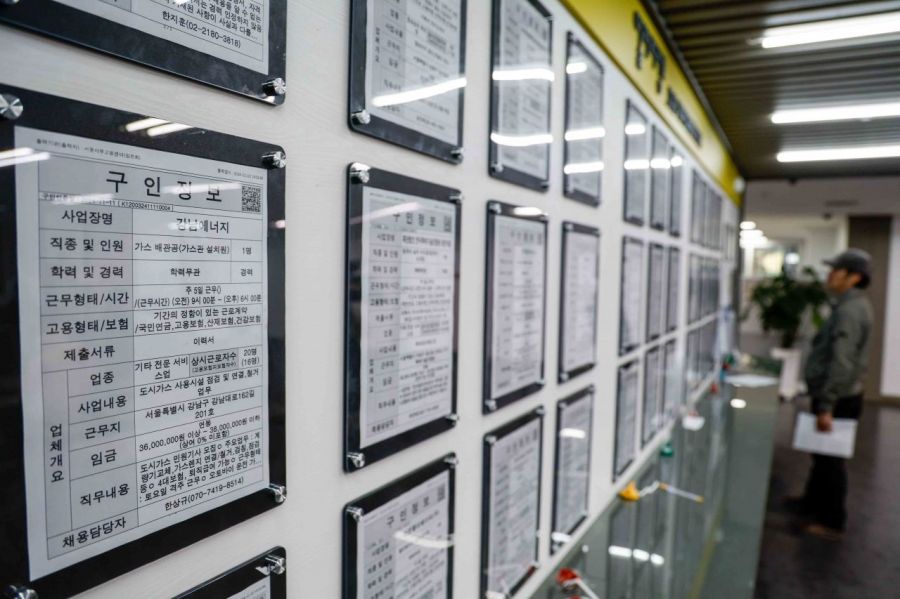
According to the 'March 2025 Employment Trends' released by Statistics Korea on the 9th, the number of employed persons in March was 28,589,000, an increase of 193,000 compared to the same month last year. This increase marks the third consecutive month since January, maintaining an increase in the range of 100,000s.
By industry, employment increased in health and social welfare services (212,000), public administration, defense and social security administration (87,000), and finance and insurance (65,000). Conversely, employment decreased in construction (-185,000), manufacturing (-112,000), and agriculture, forestry and fisheries (-79,000).
In particular, the construction industry recorded the largest decline since the 11th revision of the industrial classification in 2013. The downward trend in construction employment has continued for 11 consecutive months, which is also the first time since 2013. The employment decline rate in construction (-8.7%) was also the lowest since 2013. Manufacturing also saw its largest decrease since November 2020 (-113,000). The decline in manufacturing employment has continued for nine consecutive months.
By age group, employment increased among those aged 60 and over (365,000) and those in their 30s (109,000), but decreased among those in their 20s (-202,000), 40s (-49,000), and 50s (-26,000).

Especially, employment indicators for the youth population (ages 15-29) are on a worsening path. The youth employment rate fell by 1.4 percentage points to 44.5%, the lowest since March 2021 (43.3%). Mi-sook Gong, Economic Trend Statistics Officer at Statistics Korea, noted, "Hiring practices have shifted to irregular and experience-based recruitment, which can be challenging for young people," adding, "The early 20s tend to be in school or economically inactive at higher rates compared to other age groups, which explains this phenomenon."
These difficulties are also reflected in the unemployment rate indicators. Last month, the unemployment rate was 3.1%, up 0.1 percentage points from the same month last year. The increase was largely influenced by rises among those in their 20s. The youth unemployment rate was 7.5%, up 1.0 percentage point compared to the same month last year.
The employment rate for ages 15-64, the OECD (Organisation for Economic Co-operation and Development) comparison standard, was 69.3%, up 0.2 percentage points from the same month last year.
The economically inactive population decreased by 40,000 to 16,201,000. However, when broken down by age group, the number of inactive youth increased by 52,000 to 455,000.
© The Asia Business Daily(www.asiae.co.kr). All rights reserved.
!["The Woman Who Threw Herself into the Water Clutching a Stolen Dior Bag"...A Grotesque Success Story That Shakes the Korean Psyche [Slate]](https://cwcontent.asiae.co.kr/asiaresize/183/2026021902243444107_1771435474.jpg)

















