Emergency Measures Announced to Counter U.S. Auto Tariffs
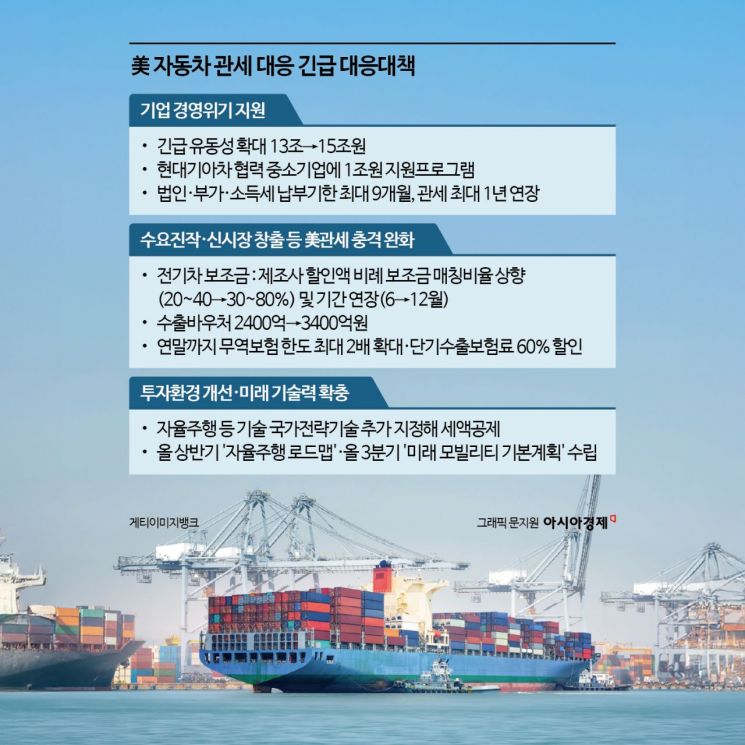
2 Trillion Won in Policy Finance, 1 Trillion Won Support from Hyundai-Kia for Partners
Increased EV Subsidies to Boost Domestic Demand
Active Expansion into New Markets such as the Philippines
As the U.S. government imposes a 25% tariff on automobiles, significant damage, including a decrease in exports to the U.S., is expected to be inevitable. In response, the government has decided to provide an additional liquidity supply worth 3 trillion won to the automotive industry to support companies in overcoming the crisis. Furthermore, the government plans to extend the implementation period of the subsidy system, which provides additional support based on the discount amount offered by electric vehicle manufacturers, until the end of the year and increase the support rate up to 80%, aiming to mitigate the impact of reduced exports to the U.S. by expanding domestic demand.
On the 9th, the government held an Economic Relations Ministers' Meeting combined with the Industrial Competitiveness Enhancement Ministers' Meeting, chaired by Deputy Prime Minister and Minister of Economy and Finance Choi Sang-mok, and announced the "Emergency Response Measures to Strengthen the Automotive Ecosystem," which centers on these points. The U.S. government has been imposing a 25% tariff on automobiles since the 3rd of this month based on the Trade Expansion Act. Tariffs on automotive parts are expected to be imposed before May 3rd.
Since automobiles and parts are Korea's top export items to the U.S., a 25% tariff inevitably deals a significant blow to the domestic automotive industry. Last year, Korea exported about $34.7 billion worth of automobiles to the U.S., nearly half of the total automobile exports ($70.8 billion). The item tariffs are also imposed equally on Mexico, Canada, Japan, and the European Union (EU). However, the government analyzes that Korean finished car manufacturers are relatively disadvantaged compared to these countries because their local production ratio in the U.S. is low. GM produces 63% of its U.S. sales locally, while Toyota produces 49%, and Hyundai-Kia produces only 42% in the U.S.
A government official explained, "Specialized institutions estimate that if the U.S. imposes a 25% tariff on automobiles, Korea's exports to the U.S. will decrease by $6.5 billion, and if the tariff is absorbed as operating costs, the operating profit of finished car companies will decrease by 10 trillion won. Ultimately, the specific damage scale depends on how much individual companies can bear the tariff, so this measure is intended to provide a safety net first."
First, to expand emergency liquidity for automotive companies, the government will increase the automotive industry policy finance from the existing 13 trillion won to 15 trillion won, an increase of 2 trillion won. The additional policy finance will be focused on companies affected by tariffs rather than facility expansion, research and development (R&D), or future vehicle transition. Also, through the supplementary budget to be announced next week, the government will expand emergency management stabilization funds for small and medium-sized enterprises affected by tariffs, which currently amount to 250 billion won this year. For tariff-affected companies, the government plans to extend the payment deadlines for corporate, value-added, and income taxes by up to 9 months and tariffs by up to 1 year. Hyundai-Kia will also operate a 1 trillion won support program for cooperating small and medium-sized enterprises.
Efforts to stimulate domestic automobile demand to alleviate the tariff shock will also be pursued. To this end, electric vehicle subsidies will be increased. The government currently provides additional subsidies proportional to the discount amount offered by companies, and this period will be extended until the end of the year. The government's matching discount rate will be raised by 10 percentage points from the existing 20-40% to 30-80%.
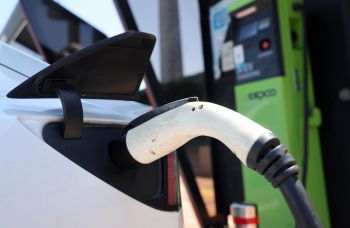
The government has also decided to provide additional support if necessary for the flexible individual consumption tax rate (from 5% to 3.5%) applied to new car purchases until June this year and a 70% reduction in individual consumption tax when purchasing a new car after scrapping an old one. Furthermore, the government plans to complete the purchase of business vehicles by government, local governments, and public institutions early by the third quarter of this year.
The government will also promote the development of automobile export markets utilizing Free Trade Agreements (FTAs). An official from the Ministry of Trade, Industry and Energy said, "We will actively target Indonesia and the Philippines, where tariffs are 0% through the Regional Comprehensive Economic Partnership (RCEP) and FTAs. We will promptly resume FTA negotiations with Mexico to benefit automotive parts companies and aim to implement agreements already concluded with the United Arab Emirates (UAE) and Ecuador within this year."
Export vouchers and trade insurance to secure alternative markets will also be significantly expanded. The scale of export vouchers, including tariff response vouchers currently at about 240 billion won, will be increased by more than 100 billion won. The doubling of trade insurance limits and a 60% discount on short-term export insurance premiums, scheduled to end in June this year, will be extended until the end of the year.
In the mid-to-long term, the government will also work on expanding investment in the automotive industry and strengthening technological competitiveness. To induce investment, the government plans to designate automotive technologies such as autonomous driving as national strategic technologies after consultations with related ministries and expert evaluations. Additionally, the scope of tax incentives for facility investments in the metropolitan area overconcentration control zone will be expanded from the existing 'painting' to include 'body and interior' for eco-friendly automotive production facilities. The government will establish the first plan for nurturing the future mobility industry ecosystem, the "Future Mobility Basic Plan (2025-2029)," within the third quarter of this year and prepare the "Pan-Ministerial Autonomous Driving Integrated Technology Roadmap" in the first half of the year.
An official from the Ministry of Trade, Industry and Energy said, "The government will reorganize the strategic governance for the U.S. through meetings such as the Economic Security Strategy Task Force (TF) and continuously identify negotiation agendas to secure tariff conditions that are not disadvantageous compared to allied countries. The support framework will be thorough, and the support scale will be adjusted timely according to the damage situation and the progress of negotiations with the U.S., with necessary measures added and implemented as needed."
© The Asia Business Daily(www.asiae.co.kr). All rights reserved.