American Colossal Biosciences Team Succeeds in Producing Baby Wolves
First Step Toward Restoring the Extinct Dire Wolf
Three Pups Born Using DNA from Fossilized Remains
American scientists have taken the first step toward restoring the 'Dire Wolf,' which went extinct about 13,000 years ago.
The Dire Wolf is a wolf that appeared as the symbol of House Stark in the American drama "Game of Thrones." It was known as a top predator that once roamed North America. It was a large creature, with an average height of 150 cm and a weight of 60 to 68 kg.
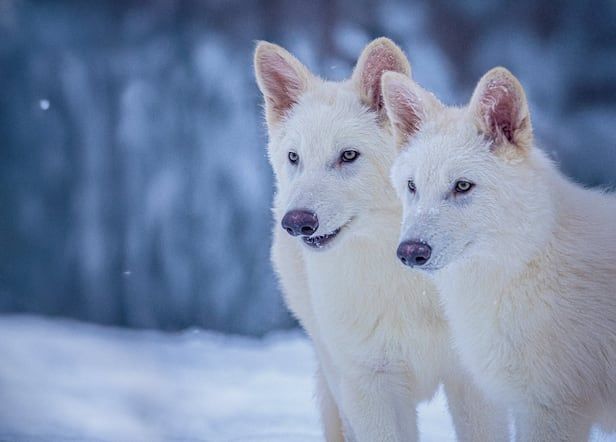 Male wolves Romulus and Remus with dire wolf characteristics. This photo shows them at 3 months old. Provided by Colossal Bioscience.
Bigger than the gray wolf, with stronger teeth and jaws, it hunted horses, bison, and mammoths, but it is believed to have disappeared along with its prey.
On the 8th, Yonhap News, citing The New York Times (NYT), reported that the Dire Wolf has been restored by scientists. Researchers at the American biotechnology company Colossal Biosciences succeeded in producing a baby wolf using DNA extracted from the fossilized teeth and skull of the extinct Dire Wolf.
As a result, three baby wolves were born: male wolves Romulus and Remus, and a female wolf Calici. Romulus and Remus were named after the founders of Rome, and Calici was named after a protagonist in "Game of Thrones." They are currently being raised at a private facility in northern United States.
The Dire Wolf is about 20% larger than the gray wolf and has dense, lighter-colored fur. Its tail fur is unusually thick, and it has mane-like fur growing around its neck.
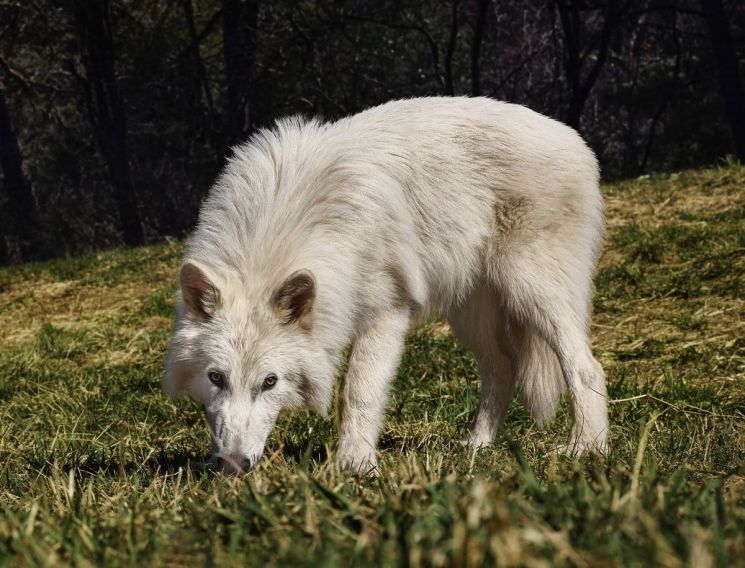
Colossal's Chief Scientific Officer Beth Shapiro claimed that these baby wolves are "the first successful case of bringing a species back from extinction."
Some critics argue that this is not a proper restoration. Since the restored wolves were created by modifying some DNA, they are not genetically identical to the extinct species, so it is not a perfect restoration.
Cornell University geneticist Adam Boyko said, "Although the restored pups have twenty Dire Wolf genes, there may be more genes that distinguish gray wolves from Dire Wolves, so it is difficult to consider this a true restoration."
© The Asia Business Daily(www.asiae.co.kr). All rights reserved.













