Beyond Legal Reasoning, Emphasizing Social Unity
The 'conclusion' section of the impeachment trial decision document for former President Yoon Seok-yeol was initially drafted and then supplemented to reflect the intentions of the justices. The justices devoted great care, reviewing the final wording up until the morning of the verdict day.
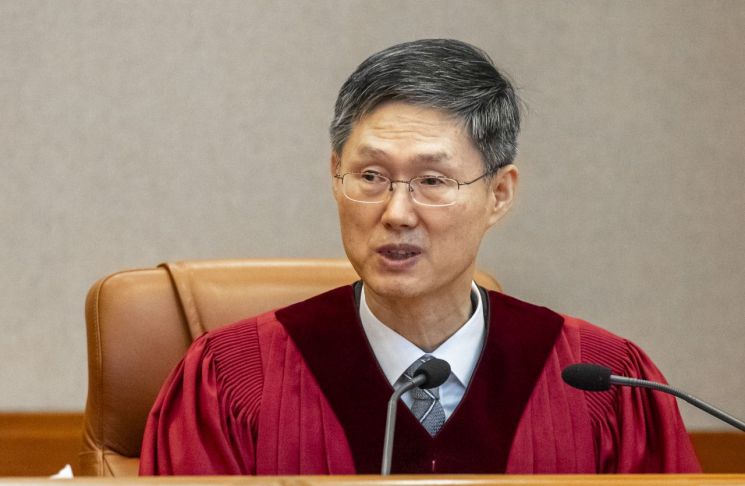 The impeachment trial verdict of President Yoon Seok-yeol held at the Grand Bench of the Constitutional Court in Jongno-gu, Seoul. Acting Chief Justice Moon Hyung-bae of the Constitutional Court is delivering the verdict on President Yoon Seok-yeol's impeachment trial. April 4, 2025 Photo by Joint Press Corps
On the 6th, Yonhap News reported that the section starting with Article 1, Paragraph 1 of the Constitution and ending with the phrase "Daehan Gukmin" (the Korean people) was originally written after the justices reached a unanimous agreement to dismiss former President Yoon, and that the conclusion part was added afterward. It was also reported that a constitutional researcher from the task force (TF) was instructed to draft this section.
Other parts of the decision document were already completed when additional instructions from the justices were issued. These included the recognition of facts, review of legal violations, and reasoning on the gravity of the matter.
The justices are known to have reviewed the draft multiple times. Through this process, they completed the final five-page conclusion of the decision document that was made public to the people. The justices held deliberations throughout the two days following the announcement of the verdict. It is reported that they reviewed the final wording until the morning of the 4th, the day of the verdict.
Typically, the conclusion of a Constitutional Court impeachment decision is limited to 3 to 4 lines. It usually only states the distribution of the justices' opinions and the resulting order. This was the case in the impeachment cases of former Presidents Park Geun-hye and Roh Moo-hyun, as well as Prime Minister Han Duck-soo (acting president).
However, following the declaration of martial law for the first time in 45 years, sharp divisions of opinion emerged, leading to the phrase "psychological civil war." In response, there were calls inside and outside the Constitutional Court for a message that goes beyond legal reasoning to promote unity and reconciliation.
The Constitutional Court appears to have taken this into consideration. Ultimately, through an unusually lengthy conclusion, it emphasized the 'constitutional spirit' that Korean society must reflect upon. The justices seem to have reached a consensus that this decision document is not an ordinary judgment but should convey a message to society.
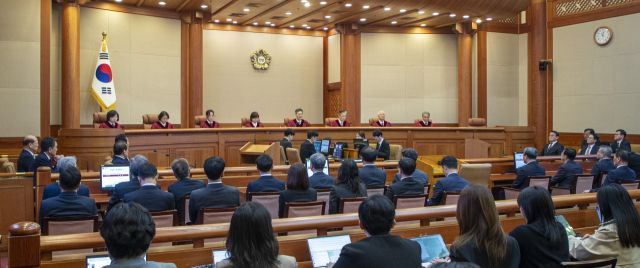 Constitutional Court justices are seated on the 4th at the Grand Bench of the Constitutional Court in Jongno-gu, Seoul, for the ruling on the impeachment trial of President Yoon Seok-yeol. From the left, Justices Jeong Gye-seon, Kim Bok-hyeong, Jeong Jeong-mi, Lee Mi-seon, Moon Hyeong-bae, Kim Hyeong-du, Jeong Hyeong-sik, and Jo Han-chang. Photo by Joint Press Corps
The carefully crafted introduction to the conclusion includes the sentence from Article 1, Paragraph 1 of the Constitution: "The Republic of Korea is a democratic republic." The final phrase includes the expression "Daehan Gukmin," which appears in the preamble of the Constitution.
The two expressions?Article 1, Paragraph 1, which proclaims the identity of the Republic of Korea as a democratic republic at the beginning of the Constitution's main text, and "Daehan Gukmin," emphasizing the people as the sovereign of the state in the preamble, which precedes the main text?are placed at the very beginning and end, forming a chiastic structure.
The Constitutional Court wrote "The Republic of Korea is a democratic republic," from Article 1, Paragraph 1 of the Constitution, at the start of the conclusion. It then presented a major premise: "Democracy is based on a pluralistic worldview that trusts the autonomous reason of individuals and presumes that all political views possess relative truth and rationality, and its essence lies in autonomous and cooperative public decision-making founded on respect and fraternity among equal fellow citizens."
The subsequent content unfolds according to a four-step logic. First, it mentions that former President Yoon may have perceived that "state affairs were paralyzed and national interests were significantly impaired" due to opposition party budget cuts and an unusually high number of impeachment attempts during his term. It then points out that it is difficult to assign responsibility unilaterally and that problem-solving must occur within the principles of democracy.
The Constitutional Court defined former President Yoon's purpose in declaring martial law as "to overcome confrontation with the National Assembly by mobilizing military forces" and judged that "this undermines the premise of democratic politics and is difficult to see as compatible with democracy."
It also pointed out that there were other alternatives available to a president of a democratic country, such as proposing constitutional amendments, holding a national referendum, submitting bills, and considering filing for the dissolution of unconstitutional parties.
The Constitutional Court stated, "The respondent reproduced the history of abuse of emergency powers, shocking the people and causing chaos in all areas of society, economy, politics, and diplomacy. As the president of all the people, he violated the duty to serve the entire nation beyond the scope of those who support him and to unify the social community." This forms the rationale for dismissal.
The final sentence mentions "Daehan Gukmin." This phrase is taken from the preamble of the Constitution, which begins with "Our Korean people, shining with a long history and tradition..." Although some viewed it as awkward since it is not a phrase used in everyday life, after discussion, it was decided to use the expression from the constitutional preamble as is.
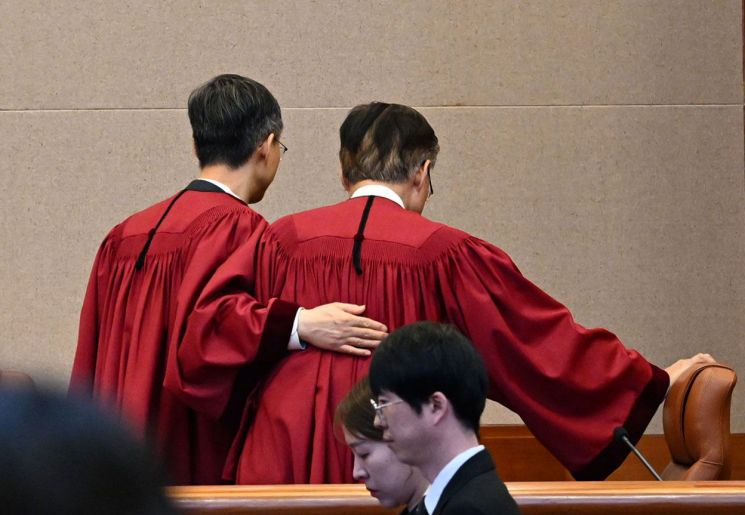 Moon Hyung-bae, Acting Chief Justice of the Constitutional Court, is leaving the courtroom with Justice Kim Hyung-doo after delivering the ruling to accept the impeachment trial of President Yoon Seok-yeol at the Grand Bench of the Constitutional Court in Jongno-gu, Seoul, on the morning of the 4th.
 2025.4.4 Photo by Joint Press Corps
© The Asia Business Daily(www.asiae.co.kr). All rights reserved.














