Trump Announces '10%+α' Reciprocal Tariffs Worldwide
Panic Selling Spreads Amid Recession and Trade War Fears
S&P Expected to See Largest Drop Since September 2022
The three major indices of the U.S. New York stock market plunged around 4% in early trading on the 3rd (local time), the day after President Donald Trump's announcement of 'reciprocal tariffs.' Selling pressure surged due to tariff rates exceeding Wall Street's expectations. Concerns grew that the U.S. economy could fall into a recession as President Trump pulled the trigger on reciprocal tariffs, potentially escalating the global trade war into a full-scale conflict.
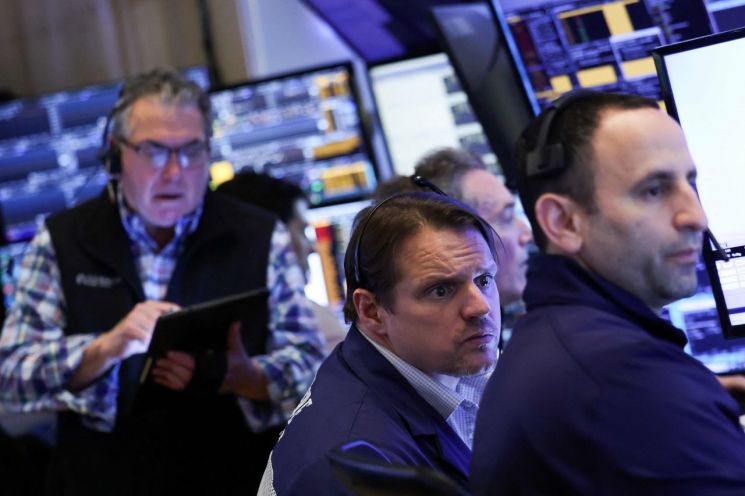
At 10:29 a.m. in the New York stock market that day, the Dow Jones Industrial Average (Dow Index), centered on blue-chip stocks, was trading at 40,744.54, down 1,480.78 points (3.51%) from the previous trading day. The S&P 500 Index, focused on large-cap stocks, plunged 220.26 points (3.88%) to 5,450.71, expected to record the largest daily drop since September 2022. The tech-heavy Nasdaq Index fell sharply by 849.83 points (4.83%) to 16,751.22.
By stock, Nike, classified as a consumer goods company, dropped nearly 13%. Apple, which produces the most iPhones in China, fell 7.8%. Five Below, a discount retailer mainly selling imported goods, dropped 27.5%, Dollar Tree fell 9.7%, and apparel company Gap plunged 21%. Due to risk aversion, tech stocks also plummeted, with Nvidia and U.S. electric vehicle maker Tesla falling 5.1% and 5.5%, respectively.
President Trump announced at the White House Rose Garden the previous day that he would impose reciprocal tariffs of at least 10% on all trading countries worldwide. After imposing a basic 10% tariff on all countries, he plans to impose an additional '10%+α' tariff on so-called 'worst offender' countries deemed to have high trade barriers, including both tariff and non-tariff barriers.
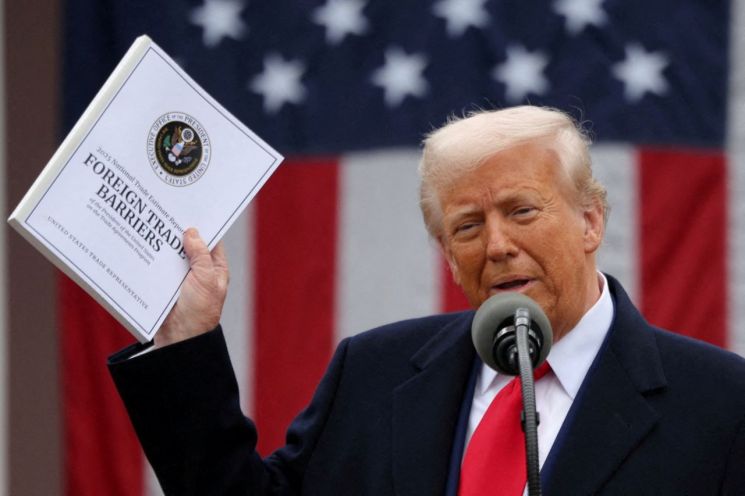
South Korea accepted the highest tariff rate of 25% among Free Trade Agreement (FTA) partner countries. China, the opponent in the trade war that began during Trump's first term, faces a 34% tariff, and the European Union (EU), which Trump has repeatedly expressed dissatisfaction with regarding tariffs, faces a 20% tariff. The 10% basic tariff will take effect on the 5th, and the individual '+α' tariffs will be implemented on the 9th.
On the day following the tariff announcement, President Trump posted on his social media platform Truth Social, which he created, saying, "The surgery is over," and "The patient has survived and is healing." He added, "The prognosis is that the patient will be much stronger, bigger, better, and more resilient than ever before," and wrote his campaign slogan, "MAKE AMERICA GREAT AGAIN!" This metaphor compares America to a 'patient' and reciprocal tariffs to 'surgery,' implying that the tariff policy will lead to the recovery and rebuilding of the ailing U.S. economy.
The U.S. is expected to negotiate with individual countries following the reciprocal tariff announcement, but for now, Wall Street views the announced reciprocal tariff rates as much higher than expected. The market had anticipated reciprocal tariffs capped between 10% and 20%, but President Trump stated that they would start at a minimum of 10%.
Mary Ann Bartels, Senior Investment Strategist at Sanctuary Wealth, said, "This was the worst-case scenario regarding tariffs, and it was not priced into the market," adding, "A risk-averse reaction is occurring." She also predicted, "The S&P 500 index could fall 5-10%, bottoming out between 5,200 and 5,400."
Due to concerns over the global trade war and economic recession, demand for safe-haven assets like bonds surged, causing bond yields to plummet. The 10-year U.S. Treasury yield, a global bond yield benchmark, fell 16 basis points (1bp = 0.01 percentage points) from the previous trading day to 4.03%, while the 2-year U.S. Treasury yield, sensitive to monetary policy, plunged 18 basis points to 3.71%.
© The Asia Business Daily(www.asiae.co.kr). All rights reserved.













