One in Four Medium and Large Stores Vacant in Q4 Last Year
Building Owners Halve Rents Compared to Pre-COVID-19 Levels
Merchants' Association: "A Public Parking Lot Is Needed to Boost Foot Traffic"
Local Government: "Car-Free Street Events Will Revitalize the Commercial District"
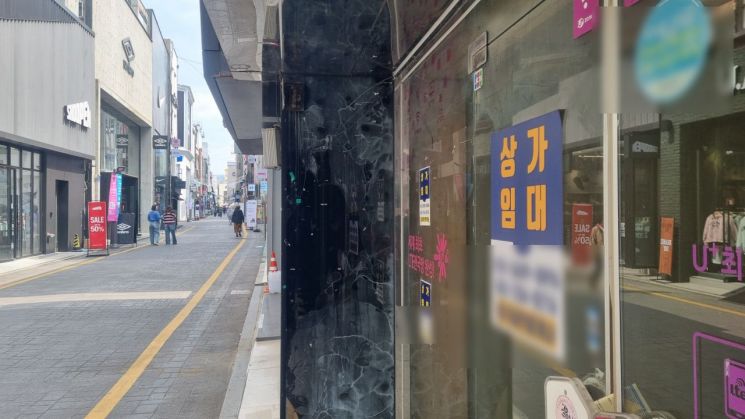 On the afternoon of the 3rd, a closed store window in the Chungjangno area of Donggu, Gwangju, displayed an advertisement inquiring about commercial space rental. Photo by Min Chanki
"The floating population needs to increase in order to reduce vacancy rates, so a solution for revitalizing the commercial district?whether it's building a public parking lot or creating a car-free street?must be found quickly."
On the afternoon of the 3rd, in the Chungjang-ro area of Dong-gu, Gwangju. Once called the "Street of Youth," Chungjang-ro now sees noticeably fewer pedestrians. Every few buildings, there were rows of vacant stores with "For Lease" signs, and closed businesses were either discarding items or undergoing renovations.
As the vacancy rate continues to rise in Chungjang-ro, the representative commercial district of the Honam region, merchants and local governments remain at odds over solutions for revitalizing the area.
The Chungjang-ro 1, 2, and 3-ga Merchants' Association argues that building a public parking lot and offering affordable parking fees is necessary to increase the floating population. However, Gwangju City and Dong-gu are pushing for a "car-free street" as part of their public transport, bicycle, and pedestrian (Dae-Ja-Bo) policy, aiming to revitalize the commercial district through cultural events and similar activities.
Recently, building owners in the Chungjang-ro 1~3-ga area decided to cut rents to half-price levels to address the issue of vacant stores. Until 2019, before the COVID-19 pandemic, the monthly rent for a first-floor store of 165 square meters (about 50 pyeong) in Chungjang-ro 2-ga was 20 to 25 million won, and in 1 and 3-ga, it was around 12 million won. These rents have recently been reduced to 5 to 10 million won.
According to the Korea Real Estate Board, in the fourth quarter of last year, the vacancy rate for medium and large stores in the Chungjang-ro and Geumnam-ro commercial districts was 24.3%, about twice the national average (13%). This is a 7.2 percentage point increase from the fourth quarter of 2019, before the COVID-19 pandemic, when the vacancy rate was 17.1%. Medium and large stores refer to those with three or more floors or a total floor area of at least 330 square meters (about 100 pyeong).
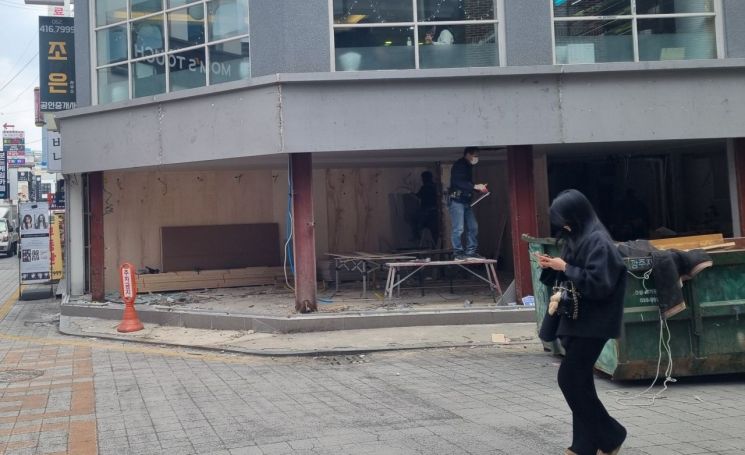 On the afternoon of the 3rd, workers are organizing the interior of a closed store in the Chungjangro area of Donggu, Gwangju. Photo by Min Chanki
Despite the steady reduction in rents since COVID-19, one out of every four medium and large stores remains vacant. The location where the Baskin Robbins Hwanggeum branch, which opened in 2006, used to be was now being cleared out by workers.
Small stores, perhaps due to their lower rents, were more occupied than medium and large stores, but some merchants were still considering closing due to sharply declining sales. In the fourth quarter of last year, the vacancy rate for small stores in Geumnam-ro and Chungjang-ro was 11.2%.
The Merchants' Association insists that, in exchange for lowering rents, the local government should build a public parking lot to help revitalize the commercial district. They claim that Chungjang-ro is the only commercial area in Gwangju with a merchants' association that does not have a public parking lot.
Indeed, at the "Half-Price Rent Win-Win Agreement Ceremony" held at the Chungjang-ro Gallery Zone on the 12th of last month, the Merchants' Association requested the construction of a public parking lot from Gwangju City. The event was attended by Mayor Kang Gijung, Dong-gu District Chief Lim Taek, and building owners. However, discussions about the public parking lot reportedly ended without any concrete conclusions, as the Merchants' Association and Gwangju City remained at odds.
Currently, a temporary public parking lot has been set up in Chungjang-ro 1-ga until January next year. It has a total of 18 parking spaces, with a fee of 1,400 won per hour and a maximum of 8,000 won per day.
However, there are doubts about whether building a public parking lot will directly lead to the revitalization of the commercial district. There are already seven parking lots in Chungjang-ro 1~5-ga, and many more within a 500-meter radius. Still, as private parking fees are around 3,000 to 5,000 won per hour, the public parking lot is expected to help reduce costs.
In contrast, Dong-gu District is pursuing policies such as "car-free streets" that run counter to the Merchants' Association's demands, and the gap between the two sides remains wide. Dong-gu currently operates a "car-free street" by blocking a 540-meter, five-lane section from Geumnam Park to the front of Jeonil Building 245 on the first Sunday of every month.
A Dong-gu official said, "Currently, Chungjang-ro does not lack parking lots. We expect that as citizens are drawn in by cultural events on the car-free street, the commercial district will naturally be revitalized."
Jeong Ilseong, president of the Chungjang-ro 1, 2, and 3-ga Merchants' Association, said, "We have been requesting a public parking lot for years, as Chungjang-ro is the only commercial district with a merchants' association in Gwangju that does not have one, but our requests have not been accepted. If a public parking lot is built, private parking lots will also lower their fees, which will naturally increase the influx of people."
Jeong added, "We were originally opposed to the car-free street, fearing that customer accessibility would decrease and sales would decline in the long term once vehicle restrictions began, but for now, we are trusting and watching the local government's policy."
© The Asia Business Daily(www.asiae.co.kr). All rights reserved.
![From Hostess to Organ Seller to High Society... The Grotesque Scam of a "Human Counterfeit" Shaking the Korean Psyche [Slate]](https://cwcontent.asiae.co.kr/asiaresize/183/2026021902243444107_1771435474.jpg)

















