Applied to All Countries Including Allies
China 34%, Japan 24%, EU 20% Tariffs Imposed
South Korea, Ranked 8th in U.S. Trade Deficit, Mentioned Several Times
Tariff Rate Calculated as 50% Despite 0% Under FTA
U.S. President Donald Trump has officially announced the imposition of reciprocal tariffs of at least 10% on all trading partners worldwide, effectively triggering a global trade war. South Korea will face the highest tariff rate of 25% among countries with Free Trade Agreements (FTA) with the U.S. China, the initial target of the trade war that began during Trump’s first term, will be hit with a 34% tariff, while the European Union (EU), which Trump has repeatedly criticized over tariffs, will face a lower 20% tariff than South Korea.
Starting with tariffs on Mexico, Canada, and China just two months into his second term in January, Trump’s tariff war has gradually expanded to include steel, aluminum, and automobiles, and now has escalated to a global full-scale conflict. As the U.S., the world’s largest buyer, openly rejects free trade and the rules-based global trade order, there are concerns that protectionism will spread worldwide, signaling a restructuring of the global economic and trade system.
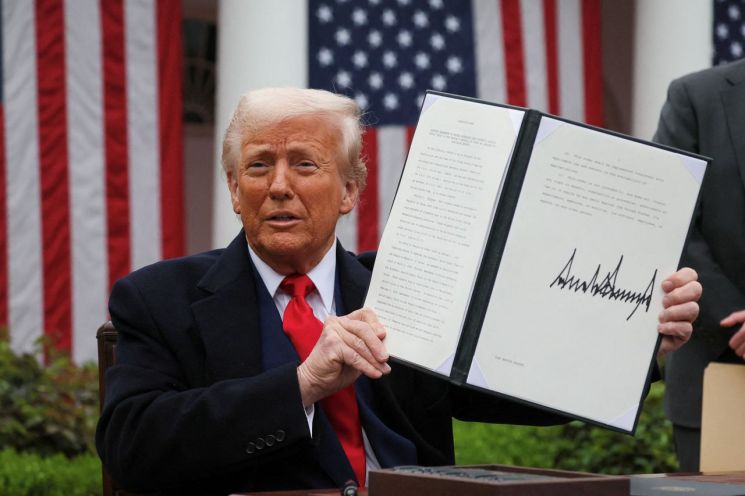
Trump Shakes Trade Barrier Report, Says "Reciprocal Tariffs Are Half of Their Level"
On the afternoon of the 2nd, President Trump delivered a speech titled “Making America Wealthy Again” at the White House Rose Garden, attended by many members of his second-term administration, and announced plans to impose reciprocal tariffs. As expected, this reciprocal tariff measure was based on the International Emergency Economic Powers Act (IEEPA).
He criticized, “For decades, we have been plundered by all countries, whether near or far, friend or foe,” adding, “Other countries impose massive tariffs on American products and create non-monetary (non-tariff) barriers that destroy our industries.” He then declared, “That will no longer happen. Now it’s our turn to prosper.” During his speech, Trump also emphasized the legitimacy of imposing reciprocal tariffs by shaking the U.S. Trade Representative’s (USTR) “Country-by-Country Trade Assessment Report” released two days earlier.
Reciprocal tariffs will apply to all countries, starting with a basic tariff of 10%. The U.S. will impose tariffs of “10% plus alpha” on so-called “worst offender” countries deemed to have high trade barriers, including tariffs and non-tariff barriers. The basic 10% tariff will take effect on the 5th, and the individual “plus alpha” tariffs will be implemented on the 9th.
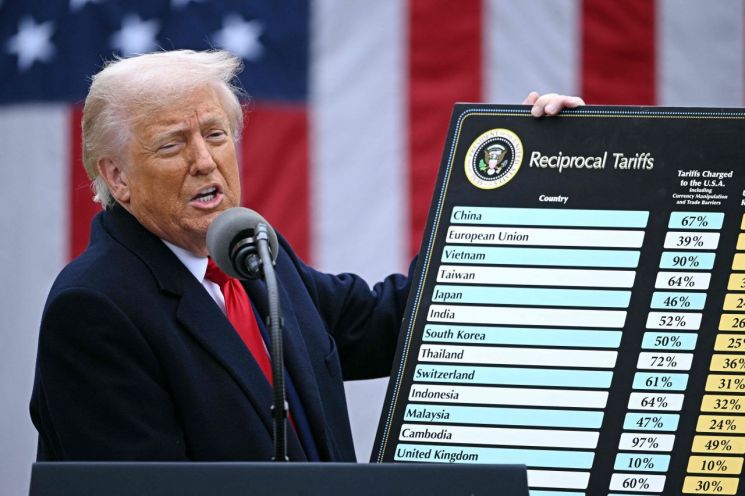
On that day, President Trump held up a chart showing each country’s tariff rates on U.S. goods and the U.S.’s reciprocal tariff rates, and announced the reciprocal tariff rates by country. China will face 34%, the EU 20%, Vietnam 46%, Japan 24%, India 26%, and the UK the lowest at 10%. South Korea will be hit with a 25% tariff. Trump claimed that he estimated each country’s tariff rate on U.S. goods by considering various non-tariff barriers including currency manipulation, but did not provide specific evidence. Critics argue that this is essentially a reckless calculation aimed at targeting countries with large U.S. trade deficits. However, Trump boasted, saying, “We will impose roughly half the level they impose on us,” adding, “Therefore, the tariffs are not completely reciprocal.”
However, the White House clarified that reciprocal tariffs will not be additionally applied to items such as steel, aluminum, automobiles, and future tariff announcements on semiconductors, pharmaceuticals, lumber, and copper, which have already been or will be subject to tariffs. Imports from Canada and Mexico under the United States-Mexico-Canada Agreement (USMCA) will continue to be tariff-free as before.
Trump Pinpoints South Korea’s Non-Tariff Barriers as the Worst... '25% Tariff Bomb' Puts Exports to U.S. on High Alert
South Korea, which belongs to the so-called “Dirty 15” countries with large trade deficits with the U.S., is now in a state of emergency as all products exported to the U.S. will face a 25% tariff bomb due to this measure. South Korea’s trade surplus with the U.S. reached a record high of $55.7 billion last year. This is expected to deal a significant blow to the Korean economy, which relies heavily on trade. During his speech, Trump mentioned South Korea several times, criticizing non-tariff barriers and trade imbalances. He said, “Perhaps the worst are the non-monetary (non-tariff) sanctions imposed by South Korea, Japan, and many other countries,” and pointed out, “81% of the cars sold in South Korea are produced domestically. Also, South Korea imposes tariffs exceeding 500% on U.S. rice.” This reflects a negative perception of South Korea, which ranks eighth among countries with the largest U.S. trade deficits. In fact, South Korea’s tariffs on U.S. goods are effectively zero due to the Korea-U.S. FTA, but the chart Trump held showed South Korea’s tariff rate on U.S. goods as high as 50%.
Based on this, it is expected that the U.S. will intensify its offensive by targeting non-tariff barriers during individual trade negotiations with South Korea. Issues such as the longstanding ban on imports of U.S. beef over 36 months of age, restrictions on the export of location-based data, and defense offset trade are likely to become contentious points as the U.S. demands a reduction in the trade surplus. Since the U.S. has announced a “tariffs first, negotiations later” policy by implementing reciprocal tariffs first while leaving room for negotiations with each country, South Korea is expected to focus on actively proposing measures to reduce trade imbalances, such as new investments in the U.S. by Korean companies and expanding imports of U.S. energy, to secure tariff reductions or exemptions. However, concerns remain that even if reciprocal tariffs are lowered, it will be difficult for South Korea to escape the U.S. tariff net easily, as key export items like steel, automobiles, and semiconductors are already or will be subject to tariffs imposed by President Trump.
Immediately after the U.S. announced reciprocal tariffs, the South Korean government held an “Emergency Economic Security Strategy Task Force (TF) Meeting” chaired by Acting President and Prime Minister Han Duck-soo on the morning of the 3rd (Korean time) to discuss countermeasures. Choi Sang-mok, Deputy Prime Minister and Minister of Strategy and Finance, stated at the meeting, “Based on a thorough analysis of U.S. tariff policies, we will focus government-wide efforts on negotiations with the U.S. to minimize damage to our economy, and through the Economic Security Strategy TF, the public and private sectors will work together to prepare the best response strategies.”
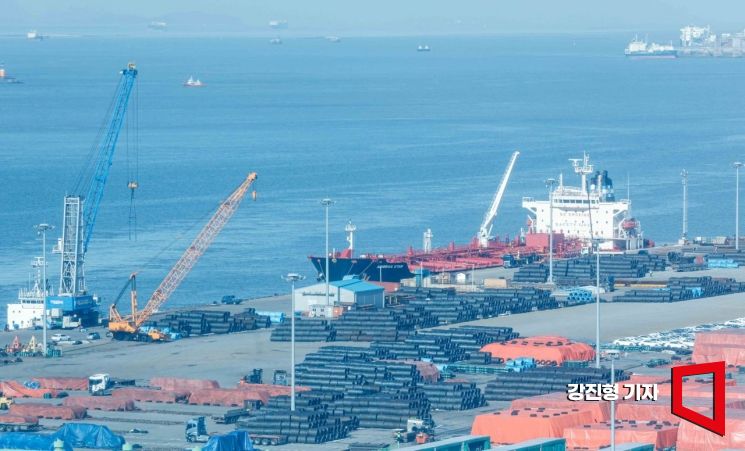 Steel products are piled up at the export yard of Pyeongtaek Port, Gyeonggi Province, on the 13th, as major countries such as Japan, the United Kingdom, and the European Union (EU) rush to respond following President Donald Trump's signing of a proclamation imposing a 25% tariff without exceptions on steel and aluminum products imported into the United States. 2025.2.13. Photo by Kang Jin-hyung
Will Trump’s Tariff War Escalate into a Global Trade War?
Until now, Trump’s tariff war had been limited to specific countries and products, but with the introduction of reciprocal tariffs, it is expected to expand from a localized conflict to a full-scale war. Shortly after taking office on January 20, Trump imposed two rounds of 10% tariffs on China, totaling 20%, and announced 25% tariffs on Mexico and Canada, which were temporarily postponed. Starting with 25% tariffs on steel and aluminum on the 12th of last month, followed by tariffs on automobiles and parts, and now the reciprocal tariff bombs by country, the tariff war appears to be reaching its peak. But it does not end there. Trump is expected to continue a barrage of tariffs on semiconductors, pharmaceuticals, and lumber. If Canada, the EU, and China, who have already warned of retaliatory measures, respond in kind, there is growing fear that this could escalate into a global trade war. Some also warn that such tariff policies could boomerang on the U.S. economy, causing inflation and recession.
© The Asia Business Daily(www.asiae.co.kr). All rights reserved.
![Clutching a Stolen Dior Bag, Saying "I Hate Being Poor but Real"... The Grotesque Con of a "Human Knockoff" [Slate]](https://cwcontent.asiae.co.kr/asiaresize/183/2026021902243444107_1771435474.jpg)


















