Development of a Condensation-Based Virus Collection and Paper Immunosensor Monitoring System
Faster Than PCR and Capable of Infectivity Analysis... Published in Environ. Sci. Technol.
According to the Korea Disease Control and Prevention Agency, the flu, which had previously subsided, is showing signs of spreading again as schools reopen.
The flu is a disease caused by infection with the influenza virus. A domestic research team has developed a technology that can quickly detect this virus floating in indoor air.
This technology is expected to help in the early detection and prevention of the spread of viral infectious diseases such as the flu and COVID-19 in places like schools and hospitals.
The team led by Professor Jang Jaesung from the Department of Mechanical Engineering at UNIST has developed a new monitoring system that can collect viruses from indoor air without damaging them and analyze them rapidly.
 Professor Jae-Sung Jang at UNIST.
Unlike conventional airborne virus collection methods used in epidemiological investigations, this system was able to detect type A influenza virus.
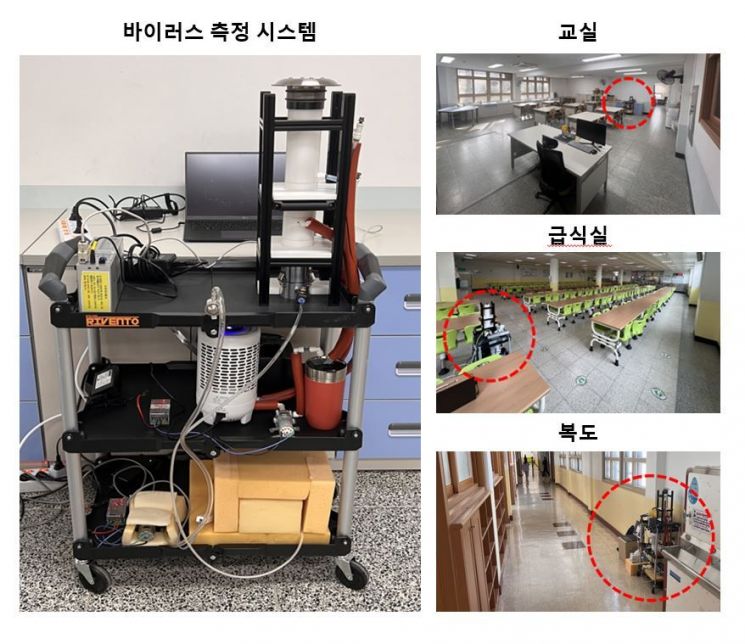
The system first draws air into the device, then condenses moisture onto virus particles inside to collect them, and detects them using a paper immunosensor. Because airborne viruses are small and light and are not easily collected as they are, the system coats the virus surface with droplets to make them larger and heavier, thus facilitating collection. When a rapid airflow is created inside, the virus droplets cannot follow the airflow due to inertia and collide with the surface of the collector.
When the virus samples collected in the device are transferred to the paper immunosensor, the presence of the virus can be determined within 30 minutes. The immunosensor is a detection technology that utilizes the antigen-antibody reaction of proteins. Hemagglutinin (HA) and nucleoprotein (NP) on the virus surface react with antibodies and are detected.
The developed system not only shortens the virus detection time, but also allows estimation of whether the detected virus is actually infectious. Conventional PCR tests detect the genetic material (DNA, RNA) of viruses, requiring expensive equipment and several hours for amplification of genetic material.
Furthermore, because dead viruses' genetic material can also be detected, it is not possible to determine actual infectivity. In contrast, hemagglutinin protein detected by this technology is found in greater quantities the more infectious the virus is.
In fact, the research team collected and analyzed a total of 17 air samples from elementary school classrooms, hallways, and cafeterias, and type A influenza virus (H1N1) was detected in four of them. The virus was not detected using commercial equipment commonly used for aerosol epidemiological investigations.
Professor Jang Jaesung said, "This technology can be applied not only to influenza but also to various respiratory viruses, including COVID-19," and added, "Through further research to advance the system, it could make a significant contribution to early infection monitoring and response in public spaces, hospitals, schools, and more."
This research was published on March 30 in Environmental Science & Technology, an international journal issued by the American Chemical Society (ACS).
The study was supported by the National Research Foundation of Korea and the Ministry of Environment.
© The Asia Business Daily(www.asiae.co.kr). All rights reserved.
![Clutching a Stolen Dior Bag, Saying "I Hate Being Poor but Real"... The Grotesque Con of a "Human Knockoff" [Slate]](https://cwcontent.asiae.co.kr/asiaresize/183/2026021902243444107_1771435474.jpg)











