Extended for One Year Until April 26 Next Year
Apgujeong, Yeouido, Mokdong, Seongsu First Designated in April 2021
Five Moa Town Road Areas Newly Designated
Seoul City will extend the designation of land transaction permission zones in the Apgujeong, Yeouido, Mokdong, and Seongsu areas, which expire on the 26th of this month, for one year.
On the 3rd, Seoul City announced that it held the 5th Urban Planning Committee meeting and re-designated land transaction permission zones for four major redevelopment sites (Apgujeong, Yeouido, Mokdong, Seongsu Strategic) covering a total area of 4.58㎢.
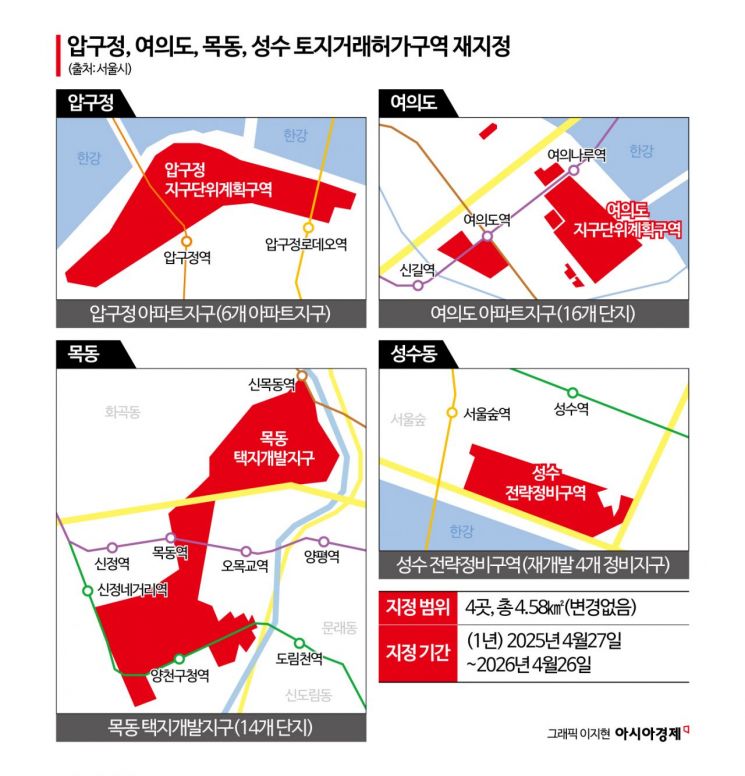
Apgujeong, Yeouido, Mokdong, Seongsu Extended for One Year Until April 26 Next Year
The targeted areas are △ Apgujeong Apartment District in Gangnam-gu △ Yeouido Apartment District and 17 nearby complexes in Yeongdeungpo-gu △ 14 complexes in the Mokdong Housing Development Project in Yangcheon-gu △ Seongsu Strategic Maintenance District (Zones 1 to 4) in Seongdong-gu.
With this re-designation, the effectiveness of the land transaction permission zone designation for redevelopment complexes will be extended for one more year until April 26 next year.
Land transaction permission zones were introduced to prevent speculative transactions in large-scale development areas. They can be designated without limit on the number of times for up to five years. The Apgujeong, Yeouido, Mokdong, and Seongsu areas were first designated as permission zones in April 2021.
When designated as a land transaction permission zone, transactions involving houses, commercial buildings, or land above a certain standard require approval from the mayor or district office head. For houses, only sales for actual residence purposes are allowed for two years, and so-called 'gap investments,' where purchases are made with leases or jeonse (long-term deposit rentals), are not permitted.
Currently, land transaction permission zones in Seoul include △ Gangnam 3 districts (Gangnam, Seocho, Songpa) and apartments in Yongsan-gu (until September 30) △ natural green areas in Gangnam and Seocho △ Seoripul District △ areas selected for New Integrated Planning and Public Redevelopment △ Yongsan Maintenance Depot area (Ichon-dong, Hangang-ro 1, 2, 3-ga, Yongsan-dong 3-ga), among others.
New Designation of Moa Town Area... Adjustment of Designation Boundaries
The city also designated five locations in the Moa Town area, including 61 Sungin-dong, Jongno-gu, and 46-1 Changjeon-dong, Mapo-gu, as land transaction permission zones, along with nearby areas. Additionally, new designations were made for areas around 199-1 Jeongneung-dong, Seongbuk-gu; 791-1134 Mia-dong, Gangbuk-gu; and 11-360 Hongneung-dong, Seodaemun-gu.
The designation period for the five locations is from the 15th of this month until April 14, 2030. This measure limits the designated targets to land classified as 'roads' to preemptively block speculative activities using fractional ownership splitting. Considering the mandatory usage period (5 years) when acquiring roads, the designation period was set to five years.
For 681 Jayang-dong, Gwangjin-gu; 534 Wolgye-dong, Nowon-gu; and 650 Sillim-dong, Gwanak-gu, the designation boundaries will be adjusted to be limited to the project area boundaries. Jayang-dong and Wolgye-dong remain as Moa Town areas with only land classified as 'roads' subject to permission, while the Sillim-dong area is a New Integrated Planning target site with the entire area subject to permission.
Due to a project withdrawal request from Gwangjin-gu, the designation of the land transaction permission zone for 12-10 Jayang-dong in the Moa Town target area has been lifted.
Seoul City explained, "We judged that if the designation is lifted in areas with high development expectations, the possibility of speculative demand inflow will increase," adding, "This is an unavoidable measure to thoroughly block speculative transactions and establish a transparent market order centered on actual demand."
© The Asia Business Daily(www.asiae.co.kr). All rights reserved.

![Clutching a Stolen Dior Bag, Saying "I Hate Being Poor but Real"... The Grotesque Con of a "Human Knockoff" [Slate]](https://cwcontent.asiae.co.kr/asiaresize/183/2026021902243444107_1771435474.jpg)














