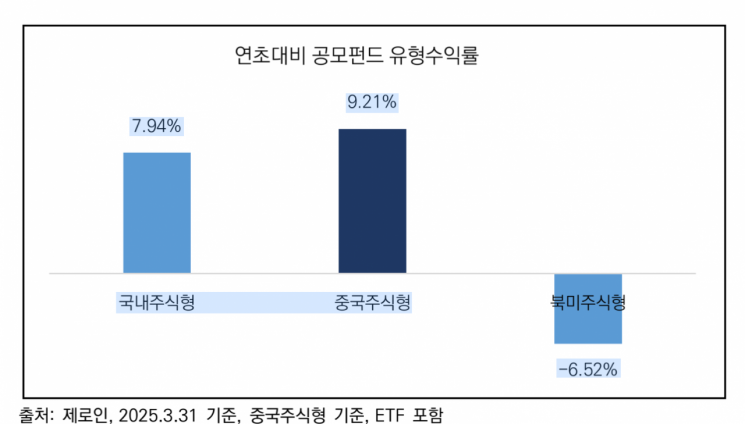
Capital inflows into Chinese equity mutual funds have been gaining momentum this year. According to fund rating agency KG Zeroin, Chinese equity funds saw an inflow of 358.7 billion KRW in March alone, increasing their assets under management by 4.7%. This figure significantly surpasses that of domestic and North American equity funds and marks the first net inflow in 13 months on a monthly basis, as well as the highest level since April 2022.
Funds with differentiated investment strategies are attracting capital. Gradual inflows are occurring into funds that focus intensively on Chinese growth and technology stocks, such as KCGI China Fund, Mirae Asset China Growth, and KB Tong China 4th Industry (Equity).
The KCGI China Fund recorded a 33.8% return over the past six months, ranking first among Chinese funds with assets exceeding 50 billion KRW. It attracted an additional 8.9 billion KRW last month alone. Its five-year return also reached 89.7%, establishing it as a representative Chinese fund combining stability and profitability. The fund invests not only in mainland China but also in the broader Chinese market including Hong Kong and Taiwan, employing a ‘barbell strategy’ that balances Chinese technology stocks with domestic consumer stocks. The barbell strategy manages risk by simultaneously incorporating high-risk, high-return assets and stable assets.
The inflow of capital into Chinese equity funds is driven by growing expectations for Chinese technology stocks. Recently, the concept of ‘T10 (Terrific 10)’ has spread among investors, drawing attention as a potential replacement for the U.S. ‘M7 (Magnificent 7).’ The T10 includes Alibaba, Tencent, Xiaomi, Meituan, BYD, SMIC, Geely, Baidu, NetEase, and JD.com.
Jeff Weniger, Chief Strategist at U.S. asset management firm WisdomTree, emphasized, “China’s T10 is outperforming the U.S. M7,” adding, “It will take time for market participants to recognize this.”
The Chinese government’s shift away from past regulations on technology companies and its declaration of technological self-reliance, accompanied by proactive support policies, are also positive factors. As China’s competitiveness in artificial intelligence (AI) gains prominence, global investors’ interest is increasing.
The recovery of China’s economic fundamentals is another key factor driving capital inflows. GDP growth in the fourth quarter of last year exceeded expectations, and government stimulus measures such as the issuance of special bonds to boost consumption continue. The ‘China version of value-up policy,’ which encourages dividend increases and share buybacks and cancellations, is also positively impacting the stock market.
Global institutional investors are buying Chinese stocks. The proportion of China within global funds, which surged to 15% in 2020, bottomed out at 5% in 2023 and showed a recovery to 6.3% by the end of last year.
© The Asia Business Daily(www.asiae.co.kr). All rights reserved.

















