Trump Announces Country-Specific Reciprocal Tariffs
Japan 24%, EU 20%, Vietnam 46%
Trump-Led Tariff War Expands Into Global Full-Scale Conflict
'Export-Driven' South Korean Economy on High Alert
Trump Repeatedly Criticizes South Korea's Non-Tariff Barriers
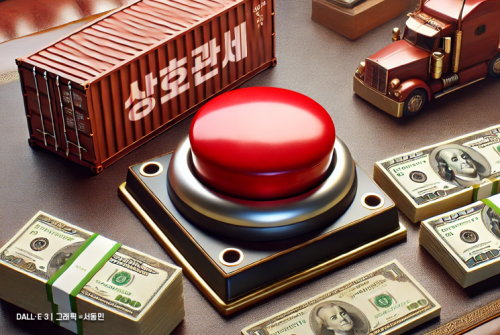
U.S. President Donald Trump has formalized the imposition of reciprocal tariffs against major trading partners worldwide. South Korea will face a 25% tariff. China, a trade war adversary since Trump’s first term, will be hit with a 34% tariff, while Vietnam, considered a bypass export route to the U.S. from China, will face a staggering 40% tariff. The UK will be subject to a basic tariff rate of 10%.
Starting two months after the inauguration of his second term in January, Trump expanded tariffs initially imposed on Mexico, Canada, and China to include steel, aluminum, and automobiles, gradually widening the front lines. This Trump-led tariff war, with no allies or enemies, has now escalated to a global full-scale conflict. Observers suggest that as the U.S., the world’s largest buyer power, openly rejects free trade and a rules-based global trade order, protectionism may spread worldwide, signaling a restructuring of the global economy and trade order.
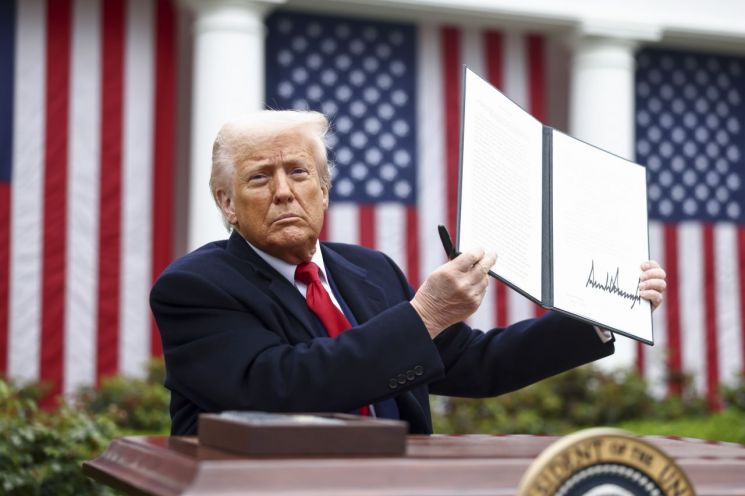
Trump: "Reciprocal tariffs at half their level"... China 34%, Vietnam 46%, EU 20%
On the afternoon of the 2nd, President Trump delivered a speech titled "Making America Wealthy Again" at the White House Rose Garden, attended by many members of his second-term administration, and announced plans to impose reciprocal tariffs.
President Trump criticized, "For decades, the U.S. has had its industries, jobs, and dreams plundered by other countries, including allies," adding, "Other countries have imposed massive tariffs on American products and created non-monetary (non-tariff) barriers." He declared, "That will no longer happen," and said, "April 2 will forever be remembered as the day America began to become wealthy again."
Reciprocal tariffs will apply to all countries, starting with a basic tariff of 10%. Tariff rates will increase for countries deemed to have high trade barriers, considering both tariff and non-tariff obstacles.
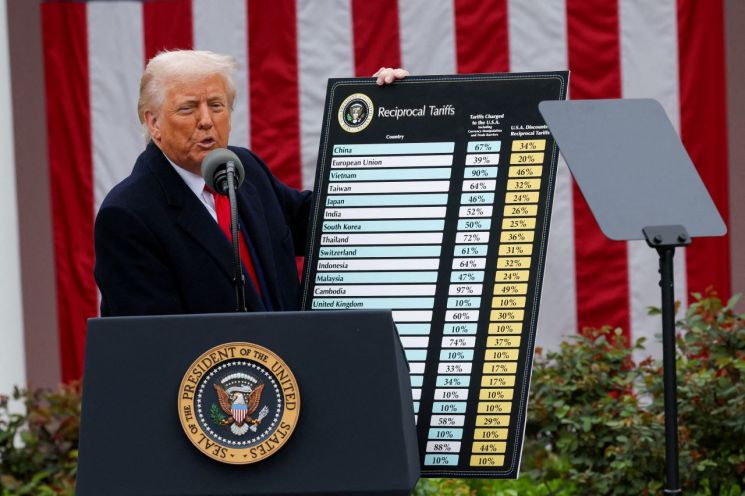
President Trump held up a chart showing estimated tariffs imposed on the U.S. by various countries alongside the reciprocal tariffs the U.S. will impose, and explained the rates by country. The reciprocal tariff rates are: China 34%, European Union (EU) 20%, Vietnam 46%, Taiwan 32%, Japan 24%, and India 26%. South Korea will face a 25% tariff. The UK will be subject to a 10% basic tariff. Additionally, Thailand will have a 36% tariff, Switzerland 31%, Indonesia 32%, Malaysia 24%, and Cambodia 49%.
President Trump claimed, "We will impose roughly half the level of tariffs they impose on us," adding, "Therefore, the tariffs will not be completely reciprocal."
U.S. applies 25% to South Korea, claims "50% tariff rate on U.S."... Export-driven economy on high alert
South Korea is on high alert as it faces reciprocal tariffs more than double the basic tariff rate. South Korea’s trade surplus with the U.S. reached a record $55.7 billion last year. Given South Korea’s economy relies heavily on trade, this measure is expected to directly impact exports to the U.S. Furthermore, with President Trump having already formalized 25% tariffs on steel, aluminum, and automobiles, and the possibility of semiconductor tariffs being announced soon, South Korea’s economy, which relies heavily on steel, automobiles, and semiconductors as key exports, is expected to suffer significant damage.
The U.S. is expected to implement reciprocal tariffs first and then engage in individual trade negotiations with each country. U.S. Treasury Secretary Steven Mnuchin told lawmakers that reciprocal tariffs would serve as a "cap." This confirms the previously announced approach of "tariffs first, negotiations later" by key aides. South Korea is likely to face pressure to remove non-tariff barriers such as the ban on imports of U.S. beef over 36 months old, restrictions on the export of location-based data, and defense offset trade, as highlighted recently in a report by the U.S. Trade Representative (USTR). Although South Korea has mostly eliminated tariffs on U.S. goods under the Korea-U.S. Free Trade Agreement (FTA), the chart President Trump displayed shows South Korea’s tariff rate on U.S. goods at 50%. Based on this, the U.S. is expected to demand resolution of non-tariff barriers and trade imbalances during future negotiations.
Regarding South Korea, President Trump also stated, "South Korea produces 81% of its automobiles domestically and imposes tariffs exceeding 500% on U.S. rice," adding, "Countries like South Korea and Japan impose non-monetary sanctions against the U.S."
Trump-led tariff war spreads to global full-scale conflict... Heading toward a trade war?
Until now, the Trump-led tariff war was limited to specific countries and products, but it is expected to expand into a full-scale global conflict. Shortly after his inauguration on January 20, President Trump imposed two rounds of 10% tariffs on China, totaling 20%, and announced 25% tariffs on Mexico and Canada, which were temporarily delayed. On the 12th of last month, he imposed 25% tariffs on all imported steel, aluminum, and related products, and starting at midnight on the 3rd of this month, 25% tariffs on foreign automobiles and parts will also take effect. With the addition of reciprocal tariff bombs, the tariff war is seen as reaching its peak.
Concerns are growing that the U.S. will unleash a barrage of tariffs. After announcing reciprocal tariffs, President Trump is expected to sequentially announce product-specific tariffs on semiconductors, pharmaceuticals, and lumber, as previously indicated. There are also expectations that copper tariffs will be officially imposed within weeks. If Canada, the EU, China, and others, who have already warned of retaliatory measures, respond in kind, the situation could escalate into a global trade war, heightening fears.
Meanwhile, the Rose Garden, where this event was held, is the venue where U.S. presidents announce major policies or hold press conferences during summits. President Trump’s announcement of reciprocal tariffs at his first Rose Garden event after starting his second term is interpreted as a reaffirmation to the world that tariff policy is a top national priority as a means to resolve trade imbalances and restore manufacturing. Some voices warn that such tariff policies could boomerang, causing inflation and recession in the U.S. economy.
© The Asia Business Daily(www.asiae.co.kr). All rights reserved.
![Clutching a Stolen Dior Bag, Saying "I Hate Being Poor but Real"... The Grotesque Con of a "Human Knockoff" [Slate]](https://cwcontent.asiae.co.kr/asiaresize/183/2026021902243444107_1771435474.jpg)


















