ChatGPT Image Generation Requests Automatically Blocked
ChatGPT Image Generation Raises Copyright Controversy
Perfectly Replicates Even Receipt Stains and Creases
The ChatGPT feature that transforms images into famous animation styles such as Studio Ghibli and Disney is gaining popularity. Some people are turning their profile pictures into Ghibli-style artwork and uploading them on social networking services (SNS), spreading like a trend. Meanwhile, the use of OpenAI's ChatGPT image generation model, which sparked the Ghibli craze, has become more strictly regulated. Since the 31st of last month, OpenAI's GPT-4o-based image generation system has internally started applying much more sophisticated and stringent restrictions on photo-based image generation, along with strengthened content policies.
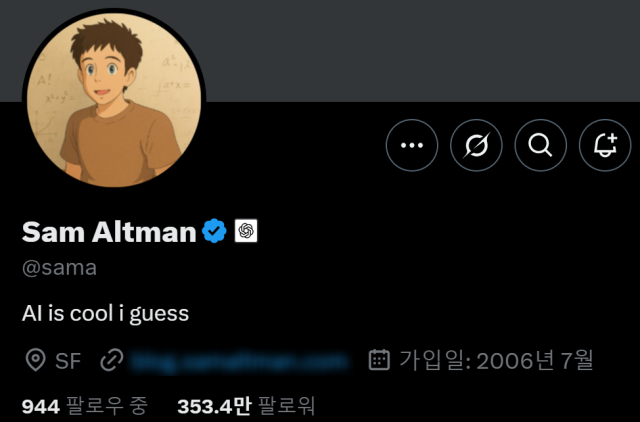 Sam Altman, CEO of OpenAI, also changed his profile picture to a 'Ghibli-style illustration.' Sam Altman X (X)
Inside OpenAI, after updating the safety filters for the DALL·E image generation model, the system has become more sensitive in determining whether a request to reinterpret or modify an uploaded photo involves the "reproduction of a real person." As a result, content policies related to photos are being enforced more strictly, and ChatGPT is outright rejecting generation requests based on automatic judgments.
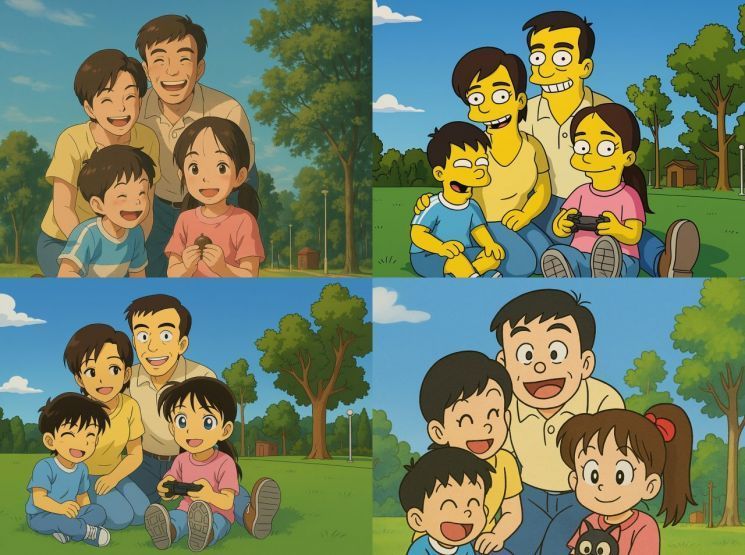 In fact, several users have received messages stating, "The content was automatically blocked because it was determined to be a scene composed based on the uploaded photo." Requests like "Change this photo to Ghibli style" are blocked as before, and users must describe the appearance in the photo in detail with text to make a request. The same applies to other art styles such as Disney, Ghibli, Slam Dunk, or Pixar. Asia Economy DB
In fact, some users receive rejection messages such as "This violates content policy" or "It is difficult to provide due to system constraints" when requesting "Change it to Ghibli style." To obtain results similar to before, users now need to describe the appearance of photos and drawings in detail through text. The same applies to other styles like Disney, Ghibli, Slam Dunk, or Pixar.
Additionally, many users who pay for ChatGPT report experiencing a "fast and uninterrupted" service, while free users often face rejections or difficulty obtaining desired results. This is because when image generation requests surge on ChatGPT, GPU resources are prioritized for paid users. Currently, OpenAI offers paid subscription services: "ChatGPT Plus" at $20 per month (about 27,000 KRW) and "ChatGPT Pro" at $200 (about 270,000 KRW). There are concerns that this relatively high price may deepen the gap in AI accessibility.
GPT-4o-Based Image Generation Feature Gains Popularity Worldwide
Meanwhile, the GPT-4o-based image generation feature has been hugely popular since its release on the 25th, with daily image generation volumes reaching approximately 420 million to 560 million images during the first week. In South Korea, a boom occurred as SNS and KakaoTalk profile pictures were all replaced with ChatGPT-generated images. People are amazed at how it perfectly replicates the warm and lyrical style of Studio Ghibli, founded by the legendary Japanese animation director Hayao Miyazaki.
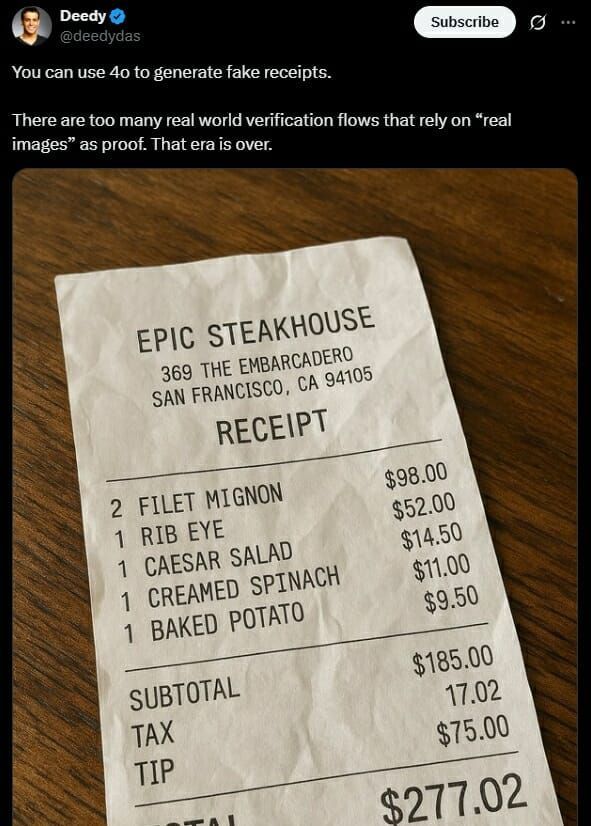 Among these, recently, AI images have raised increasing concerns about being exploited for crimes such as false expense claims or refund fraud, with the emergence of 'fake receipt' images created using ChatGPT. Didi Das X (X)
It also faithfully reproduces styles like The Simpsons and Disney. However, concerns about copyright infringement have been raised. OpenAI has not clearly disclosed whether it has copyright agreements with animation studios. It is also not officially known whether the original creators consented to the AI training on their images. Legal experts have varying opinions: some say that training without partnerships could violate copyright law, while others argue that merely capturing the atmosphere does not constitute a problem.
Meanwhile, recently, "fake receipt" images created using ChatGPT have appeared, raising concerns that AI-generated images could be exploited for crimes such as false expense claims or refund fraud. These images have advanced to the point where even food stains and crumpled paper textures are expressed, making them difficult to distinguish without close inspection. Experts emphasize the urgent need for institutional measures to prevent the spread of AI-manipulated content that undermines trust.
© The Asia Business Daily(www.asiae.co.kr). All rights reserved.



















