NYT and WP: "20% Universal Tariff Imposed"
WSJ: "Compromise Plan Under Review"... Policy Discussions Ongoing
The so-called 'Trump reciprocal tariffs' will take effect immediately upon announcement on the afternoon of the 2nd (local time). Three scenarios are being discussed: a differentiated tariff rate by country as previously mentioned, a blanket 20% universal tariff, and a new tariff plan that compromises between the two. Once the reciprocal tariffs are fully implemented, the tariff front, which has so far targeted certain countries such as China, Canada, and Mexico, and certain products such as steel, aluminum, and automobiles, is expected to expand.
On the 1st, White House spokesperson Karoline Leavitt confirmed in a briefing that U.S. President Donald Trump’s reciprocal tariffs will take effect immediately upon announcement on the 2nd, stating, "Tomorrow’s historic action by President Trump will improve America’s competitiveness across all industries, reduce the massive trade deficit, and ultimately protect the U.S. economy and national security."
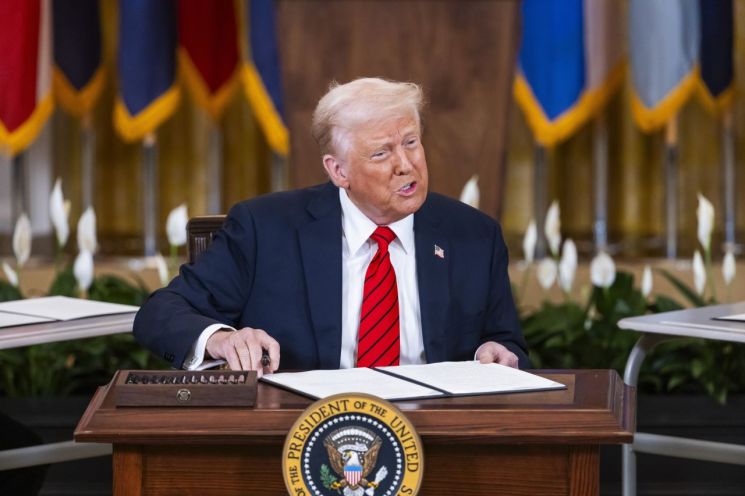
Earlier, the White House announced that President Trump plans to deliver a speech at 4 p.m. on the 2nd at the White House Rose Garden under the theme "Making America Wealthier." This hinted that President Trump would announce the reciprocal tariffs at this event.
The White House did not provide clear answers regarding the scope and rates of the tariffs under the Trump administration. Spokesperson Leavitt said, "The President said he made a decision yesterday, but I don’t want to speak ahead of that," adding, "You will know within about 24 hours."
On the eve of the tariff imposition, three likely adopted plans are being discussed. Foreign media reported that the Trump administration is in the final stages of reviewing three options: a 20% universal tariff, reciprocal tariffs, and a compromise plan.
On that day, The New York Times (NYT), The Washington Post (WP), and others reported that the White House is considering imposing a single 20% tariff on nearly all U.S. imports as one option. It is also reported that a draft for the 20% universal tariff has been prepared. The Trump administration expects that adopting such a plan could increase U.S. government revenue by more than $6 trillion.
However, these media outlets also reported that the Trump administration is discussing imposing different tariffs by country, known as reciprocal tariffs, which take into account the tariff rates imposed by trading partners on the U.S. This approach would allow avoiding tariff penalties through trade agreements.
The Wall Street Journal (WSJ) reported that the U.S. Trade Representative (USTR) is preparing a third option to impose tariffs on all exports to the U.S. from certain countries. Until now, only reciprocal tariffs and the 20% universal tariff had been mentioned, but a new plan has emerged just before the tariff imposition. Sources said the tariff rates imposed on these countries are likely to be lower than the 20% universal tariff.
This is a kind of compromise plan. After reports emerged that the Trump administration was considering a 20% universal tariff, industry and labor groups protested, and some Republican senators appeared ready to support a tariff criticism resolution pushed by Democrats in the Senate, leading to the preparation of a compromise plan.
Many foreign media, citing sources, said it is still unclear which plan President Trump will choose. Although he said the tariff imposition decision was made the day before, policy discussions are ongoing. President Trump has repeatedly emphasized that reciprocal tariffs are mutual measures in response to tariffs imposed by other countries and that the tariff rates will be lower than those imposed by other countries on the U.S. He said the day before, "Whatever they (other countries) impose on us, we will impose as well, but we are kinder than they are," adding, "The numbers (tariff rates) will be lower than the tariffs they impose on us, and in some cases, much lower."
Countries are negotiating intensely to avoid tariffs until the day before the announcement. On that day, spokesperson Leavitt said, "I don’t know the exact numbers, but quite a few countries have called President Trump and his team to discuss tariffs," adding, "But the country President Trump cares about most is the United States."
When asked if the administration is open to negotiations if other countries hint at possible changes to their tariffs on the U.S., she replied, "The President is always open to taking calls."
Regarding the 25% tariff on foreign automobiles, Leavitt confirmed it will take effect from the 3rd. When asked whether the tariff exemption for Canadian and Mexican goods under the United States-Mexico-Canada Agreement (USMCA), which expires on the 2nd, would be extended, she replied, "I will let the President speak on that."
© The Asia Business Daily(www.asiae.co.kr). All rights reserved.
!["The Woman Who Threw Herself into the Water Clutching a Stolen Dior Bag"...A Grotesque Success Story That Shakes the Korean Psyche [Slate]](https://cwcontent.asiae.co.kr/asiaresize/183/2026021902243444107_1771435474.jpg)
















