Financial Authorities Announce Indemnity Insurance Reform Plan
New 5 Million KRW Annual Copayment Limit for Severe Non-Reimbursable Items
"Concerns About Insurance Fraud by 'Malingerers' Are Low"
Inpatient Cases Recognized as Severe Under Reimbursable Items
The government will consider inpatient treatment as severe and apply a 20% copayment rate for indemnity health insurance. The 'non-reimbursable' items, which have been pointed out as the main cause of excessive insurance payments, will be managed by dividing them into 'severe' (Special Contract 1) and 'non-severe' (Special Contract 2). In particular, for non-severe non-reimbursable items, the compensation limit will be reduced from the current 50 million KRW per year under the 4th generation insurance to 10 million KRW per year. A new copayment limit of 5 million KRW per year for severe non-reimbursable items (Special Contract 1) has also been established.
On the 1st, the Financial Services Commission and the Financial Supervisory Service announced the 'Indemnity Insurance Reform Plan' and held a related briefing at the Government Complex Seoul in Jongno-gu, Seoul.
The scope of coverage for severe cases has been expanded compared to the policy forum presentation in January. The plan features strengthening the compensation system centered on reimbursable (universal) medical expenses and severe patients. This means preventing insurance payments from leaking through non-reimbursable items and reorganizing the system to pay insurance benefits mainly to patients with severe conditions who truly need them.
First, reimbursable expenses will be divided into inpatient and outpatient (ambulatory) care, and the copayment rates for indemnity insurance will be differentiated. Support will be strengthened for inpatient care and minimized for outpatient care. Inpatient treatment will be considered severe, and a uniform copayment rate of 20% will be applied to enhance coverage.
Notably, the non-reimbursable items are divided into 'severe' (Special Contract 1) and 'non-severe' (Special Contract 2) categories, allowing consumers to choose their coverage scope.
Special Contract 1 is assumed to cover mostly severe patients visiting tertiary general and general hospitals, and a new annual copayment limit of 5 million KRW has been established. Authorities expect that moral hazard from 'malingerers' who claim insurance benefits without being ill will not be significant.
Ko Young-ho, Director of the Insurance Division at the Financial Services Commission, said, "Healthcare professionals also did not express major concerns about moral hazard related to insurance claims by severe patients," adding, "The 5 million KRW limit was set considering the copayment limit regulations of the National Health Insurance Service."
Lee Kwon-hong, Director of the Insurance Actuarial Product Supervision Bureau at the Financial Supervisory Service, said, "Most patients under Special Contract 1 are likely severe patients hospitalized and undergoing surgery at university hospitals," and "Hospitals detecting malingerers will likely advise them to seek other care facilities, so concerns about insurance fraud are not expected to be high."
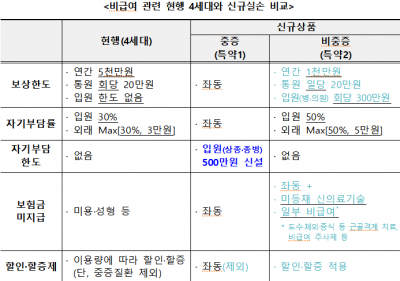 Comparison between the current 4th generation and new actual expense insurance regarding non-reimbursable items. In the case of Special Contract 2, which covers the 'non-severe' non-reimbursable segment, the compensation range is significantly reduced compared to the 4th generation. Provided by the Financial Services Commission and Financial Supervisory Service
For non-severe non-reimbursable items (Special Contract 2), the coverage limit and scope will be reduced, and copayment rates will be increased.
Non-reimbursable treatments with high risk of misuse, such as manual therapy, extracorporeal treatments, proliferation therapy for musculoskeletal conditions, and non-reimbursable injections, will be converted to managed care covered by health insurance, and the patient copayment ratio for managed care will be raised up to 95%.
According to financial authorities, the compensation limit under the 4th generation insurance is 50 million KRW per year, but for Special Contract 2 (non-severe non-reimbursable), it will drop to 10 million KRW, one-fifth of the previous limit. While the 4th generation compensation system does not set a limit for inpatient care, Special Contract 2 in the 5th generation will limit hospital or clinic inpatient care to 3 million KRW per admission.
Most importantly, the scope of non-payment of insurance premiums will be greatly expanded. Under the 4th generation insurance, only cosmetic and plastic surgery were excluded, but under the 5th generation Special Contract 2, insurance payments for 'unregistered' new medical technologies related to manual therapy, extracorporeal treatments, proliferation therapy, and non-reimbursable injections will become difficult.
The current non-reimbursable discount and surcharge system operated under the 4th generation indemnity insurance will be applied identically to the new (5th generation) products. The discount and surcharge system will apply only to non-severe non-reimbursable items (Special Contract 2) to address the possibility of excessive use and ensure fairness in insurance premium burdens.
The non-reimbursable discount and surcharge system increases premiums (100-300%) for subscribers who received non-reimbursable insurance payments exceeding 1 million KRW in the previous year (about 1%). The surcharge collected is used to reduce premiums for subscribers who received zero non-reimbursable insurance payments (over 60%).
Director Ko said, "The core of the reform is to provide appropriate compensation focusing on universal medical expenses and severe treatments," adding, "It will support the normalization of the medical system, including strengthening essential medical care."
He continued, "Applying the reform plan to several insurance companies showed that premiums decreased by about 30-50%," emphasizing, "The reform will alleviate the burden on the public and enhance fairness."
© The Asia Business Daily(www.asiae.co.kr). All rights reserved.













