Nikkei Analyzes Impact of U.S. Tariff Policies
U.S. GDP Projected to Decrease by 2.5%
Trump Administration Highlights Tariff Revenue
There is a forecast that the global gross domestic product (GDP) could decline by 0.6% by 2027 due to the impact of U.S. President Donald Trump's tariff policies.
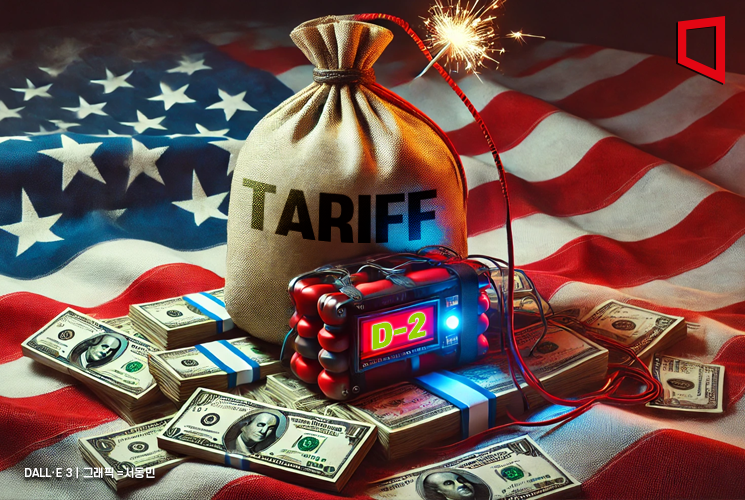
The Nihon Keizai Shimbun (Nikkei) reported on the 1st, citing data from the Japan External Trade Organization (JETRO) Asia Economic Research Institute, that an analysis of the effects of the reciprocal tariffs imposed or planned by President Trump, tariffs on imported cars, and an additional 20% tariff on China led to this projection.
According to JETRO, the activation of reciprocal tariffs and automobile tariffs worldwide, along with the already imposed additional 20% tariff on China, is estimated to reduce the global GDP by 0.6% in 2027. Nikkei explained that a simple calculation of 0.6% of the $127 trillion global GDP forecasted by the International Monetary Fund (IMF) for 2027 amounts to a decrease of approximately $763 billion (1,123 trillion KRW).
Nikkei predicted that the country most affected by the tariffs would be none other than the United States. JETRO estimated that the U.S. GDP would shrink by 2.5% in 2027 due to Trump's tariffs. As the import prices of Chinese goods rise, the profits of U.S. companies dependent on Chinese parts will also be pressured.
The U.S. stock market is already experiencing its worst period due to the aftershocks of the tariffs. On the 31st of last month (local time), the S&P 500 index closed at 5611.85, up 0.55% from the previous session, while the tech-heavy Nasdaq Composite Index fell 0.14% to 17,299.29 at the New York Stock Exchange. As a result, for the first quarter, the S&P 500 index dropped 4.6%, and the Nasdaq index fell 10.4%, marking the worst performance since 2022.

The impact of automobile tariffs is also expected to be significant. If the increase in car prices leads to immediate price hikes and job reductions, the tariff bill will ultimately be paid by the American public. Increased costs due to tariffs may be passed on to consumers, worsening inflation and reducing purchasing power. The Yale University Tax and Budget Research Institute (TBL) warned that automobile tariffs alone could reduce disposable income per American household by $492 to $615 annually.
The institute forecasted that while China's GDP would decrease by 0.9% in 2027 due to U.S. tariff policies, South Korea and Japan could see increases of 0.5% and 0.2%, respectively. The institute explained that because reciprocal tariffs impose equal tariffs on the counterpart country, the impact on countries with lower tariff rates like Japan is minimal, and sales of Korean and Japanese products are expected to increase as Chinese products become less competitive.
Despite these warnings from both inside and outside the U.S., the Trump administration continues to promote the revenue effects of tariffs, emphasizing their legitimacy. Peter Navarro, the White House trade and manufacturing advisor, stated in an interview with Fox News on the 30th of last month that tariffs would generate about $6 trillion (approximately 8,850 trillion KRW) in revenue over ten years. Navarro added that tariff revenues would be used as funds for "the largest tax cuts in American history for the middle class."
He also projected that automobile tariffs alone could secure $100 billion (about 148 trillion KRW) in annual tax revenue, with other tariffs bringing in an additional $600 billion (about 885 trillion KRW) annually.
© The Asia Business Daily(www.asiae.co.kr). All rights reserved.
![Clutching a Stolen Dior Bag, Saying "I Hate Being Poor but Real"... The Grotesque Con of a "Human Knockoff" [Slate]](https://cwcontent.asiae.co.kr/asiaresize/183/2026021902243444107_1771435474.jpg)












