'Liberation Day' Reciprocal Tariff Imposition Just Two Days Away
Trump Announces Plan to Impose Tariffs on 'Basically All' Countries
First Quarter Growth Rate Forecast at 0.3% Amid Tariff Impact
Key Employment Indicators to Be Released This Week
Department of Labor's March Employment Report to Be Released on April 4
The three major indices of the U.S. New York stock market are all showing weakness in early trading on the 31st (local time), the last trading day of the month. As April 2nd, the day President Donald Trump named 'Liberation Day' for the announcement of reciprocal tariffs, approaches in two days, investors are selling stocks due to concerns over tariff policies.
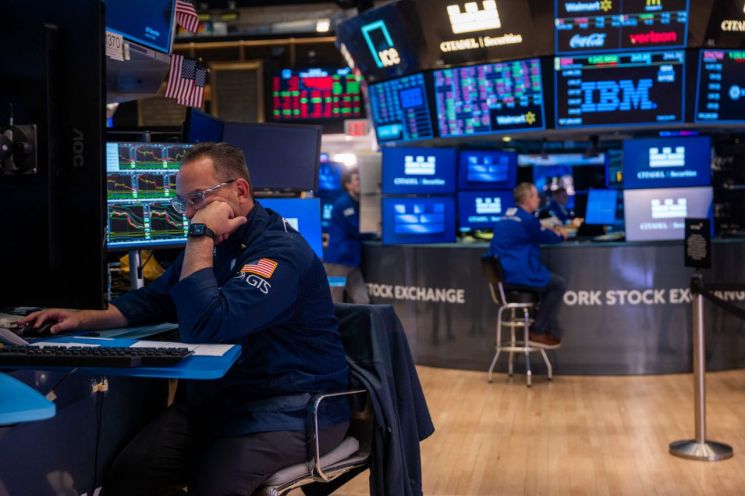
As of 10:50 a.m. in the New York stock market on this day, the Dow Jones Industrial Average (Dow Index), centered on blue-chip stocks, is down 14.16 points (0.04%) from the previous trading day, standing at 41,569.29. The S&P 500 Index, focused on large-cap stocks, is trading at 5,536.9, down 44.04 points (0.79%), falling more than 10% from the February peak and entering a technical correction phase again. The tech-heavy Nasdaq Index is sharply down 318.83 points (1.84%) at 17,004.17. This is the lowest level since September last year, representing a 16% decline from the December peak.
By individual stocks, technology stocks are sharply falling. AI leader Nvidia is down 4.72%, a level more than 30% below its 52-week high. Meta Platforms, Facebook's parent company, is down 2.86%. Microsoft (MS) and Alphabet, Google's parent company, are down 2.93% and 1.61%, respectively. U.S. electric vehicle maker Tesla is sharply down 5.83%.
As the announcement of reciprocal tariffs approaches, investor sentiment is rapidly freezing. President Trump announced a 25% tariff on all imported automobiles on the 26th and will announce reciprocal tariffs targeting trading partners on April 2nd. Although the specific details such as the targets and rates of reciprocal tariffs have not been revealed, local media including The Washington Post (WP) and The Wall Street Journal (WSJ) reported that President Trump recently ordered his aides to adopt a more aggressive tariff policy. The WSJ reported the previous day that the Trump administration considered imposing 'broader and higher' reciprocal tariffs, including a tariff rate as high as 20%. Regarding this, President Trump told reporters the previous day that he would impose reciprocal tariffs on "basically all" trading partners.
As President Trump maintains his determination to push forward with an aggressive tariff policy, concerns are growing that the U.S. economy will slow down rapidly. According to a survey of 14 economists conducted by CNBC and released on this day, the U.S. real gross domestic product (GDP) for the first quarter is expected to have increased by 0.3% annualized compared to the previous quarter. This is not only significantly below the finalized 2.4% GDP growth rate for the fourth quarter of last year but also the lowest figure since 2022. Inflation, based on core personal consumption expenditures (PCE) price index, is expected to rise 2.8% in the first quarter, 2.6% in the second quarter, 3.0% in the third quarter, and then slow to 2.4% in the fourth quarter. Wall Street is increasingly anticipating a recession. Investment bank Goldman Sachs forecasted on this day that the U.S. GDP growth rate for the first quarter would be 0.2%, with an annual growth rate of only 1%. The probability of a recession occurring within the next 12 months was raised from 20% to 35%.
David Kostin, U.S. equity strategist at Goldman Sachs, lowered the year-end forecast for the S&P 500 index from 6,200 to 5,700, stating, "If growth prospects and investor confidence deteriorate, valuations could fall more than expected."
Investors are closely watching President Trump's reciprocal tariff announcement this week while also awaiting key employment indicators. On the 1st of next month, the U.S. Department of Labor's February Job Openings and Labor Turnover Survey (JOLTs) will be released; on the 2nd, the private labor market research firm ADP will release the March employment report; and on the 3rd, weekly initial jobless claims will be published. The Department of Labor's March employment report, which includes both private and public sector employment numbers and is a reliable indicator to assess the overall health of the labor market, will be released on the 4th of next month. Nonfarm payrolls for this month are expected to have increased by 139,000, below February's 151,000. The unemployment rate is expected to have remained steady at 4.1% as in the previous month.
Bond yields are declining. The 10-year U.S. Treasury yield, a global bond yield benchmark, is down 4 basis points (1bp = 0.01 percentage points) from the previous trading day to 4.21%, while the 2-year U.S. Treasury yield, sensitive to monetary policy, is down 2 basis points to 3.88%.
© The Asia Business Daily(www.asiae.co.kr). All rights reserved.












