Emergency Support Measures for Farmers Affected by Wildfires
Free Rental of Agricultural Machinery and Rice Seeds to Help Farmers Resume Farming
50% of Disaster Insurance Payouts to Be Provided in Advance Upon Request
Discounted Supply of Fertilizers and Pesticides, and Free Repairs for Damaged Equipment
Livestock Farms to Receive Feed, Veterinary Support, and Facility Restoration Funds
Repayment of Agricultural Loans Deferred and Interest Waived for Up to Two Years
Comprehensive Support to Minimize Instability in Crop Supply and Restore Daily Life
The government has decided to provide free rental of agricultural machinery and supply government-owned rice seeds free of charge to help farmers affected by wildfires quickly resume farming. Additionally, if farmers wish, 50% of the disaster insurance payout will be paid in advance.
On the 31st, the Ministry of Agriculture, Food and Rural Affairs announced at the Government Complex Sejong that it discussed such support measures to enable farmers in the Ulsan, Gyeongbuk, and Gyeongnam regions affected by wildfires to promptly resume farming and restore their daily lives.
An official from the Ministry of Agriculture, Food and Rural Affairs stated, "Most of the agricultural damage caused by this wildfire occurred in the Gyeongbuk region, and it has been confirmed that various agricultural machinery and tools such as hoes and shovels necessary for farming were destroyed. The Ministry has decided to prioritize emergency support measures to help farmers affected by the wildfire resume farming."
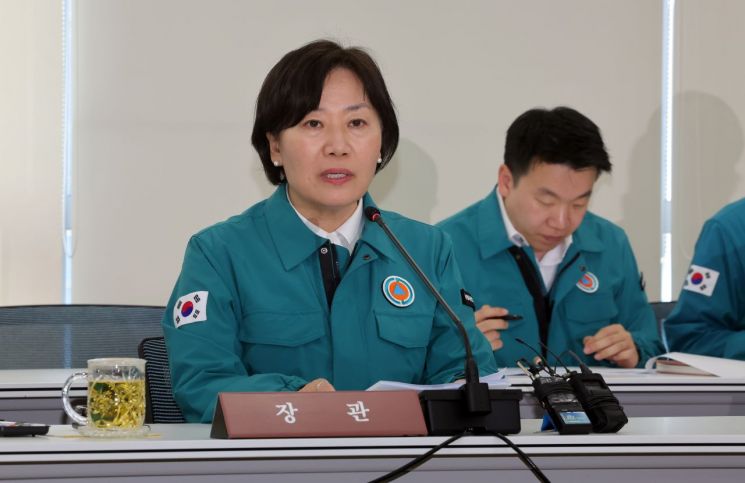 Song Mi-ryeong, Minister of Agriculture, Food and Rural Affairs, is presiding over a meeting to review support measures for farmers affected by wildfires in the Gyeongsang region at the Government Sejong Complex on the 31st.
First, to ensure no disruption to spring farming, necessary quantities of agricultural machinery, fertilizers, pesticides, farming tools, seeds, and seedlings will be prepared in advance by region and item to support farmers' swift resumption of farming. Considering that some agricultural machinery was damaged by the fire, free rentals will be provided to affected farms through city and county agricultural machinery rental centers and regional agricultural cooperative machinery banks. Shortages of agricultural machinery will be supplemented and supported through agricultural machinery companies and rental centers in other regions.
Additionally, farming work delegation teams will be organized with 200 safety specialists at agricultural technology centers and 40 personnel at regional agricultural cooperative machinery banks to provide farming work delegation services to vulnerable groups such as elderly farmers. Fourteen repair volunteer teams will be formed to conduct巡回 inspections and free repairs for agricultural machinery that was not completely destroyed. Fertilizers, pesticides, and farming tools such as hoes and shovels have already been secured in quantities exceeding the annual demand for the affected areas by the agricultural cooperatives (with a next-day delivery system established upon order). These will be supplied at a discount through agricultural cooperative farming material sales outlets in the affected areas. Furthermore, government-owned rice seeds will be supplied free of charge, and fruit tree seedlings will be prioritized for supply to affected farms through consultations with seedling companies and private firms holding stock.
To support the rapid recovery of livestock farms, 110 billion KRW in feed purchase funds (loans) have been preferentially allocated to the affected areas. Agricultural cooperatives will supply up to 240 bags (20 kg each) of feed per farm free of charge. Animal medical support teams (46 teams) will be organized and operated to provide prompt veterinary care, and necessary supplies such as animal medicines and immune boosters will also be supported. Support will be provided for emergency demolition of livestock facilities at risk of collapse through heavy equipment rental fees (via livestock cooperatives) and funds for modernization of livestock facilities to aid recovery. Biosecurity measures at pig farms will be strengthened in preparation for increased movement of wild boars infected with African swine fever.
Support will also be provided to stabilize farmers' management and livelihoods. To ensure rapid payment of disaster insurance, 596 damage assessors have been deployed on-site to complete field investigations within three days of damage report. If farmers wish, 50% of the estimated insurance payout will be paid in advance.
Repayment of agricultural and livestock management funds will be deferred, and interest will be waived for up to two years. Disaster management funds and funds necessary for restoring agricultural facilities such as vinyl greenhouses and orchards will also be provided promptly. Separately, the agricultural cooperative will provide 200 billion KRW in interest-free funds and emergency livelihood stabilization funds of up to 30 million KRW per household to affected cooperative members.
The Ministry of Agriculture, Food and Rural Affairs plans to closely analyze the damage situation and its impact on supply and demand of major crops to minimize instability in agricultural product supply caused by the wildfire. For spring cabbage currently being transplanted and garlic and apples in growth stages, crop-specific growth management councils will be immediately formed to monitor growth conditions until harvest, and if necessary, on-site technical support and provision of pesticides, fertilizers, and nutritional supplements for pest and disease control will be promoted.
Minister Song Mi-ryeong of the Ministry of Agriculture, Food and Rural Affairs said, "To enable the rapid resumption of farming and restoration of daily life for wildfire-affected farms, we will mobilize all support policies that can be immediately implemented based on local government damage surveys and carry them out without delay. We will also actively consult with related ministries such as the Ministry of the Interior and Safety to consider additional support measures beyond existing systems and frameworks. We will systematically guide affected farmers so they can easily recognize various support projects."
© The Asia Business Daily(www.asiae.co.kr). All rights reserved.












