The won-dollar exchange rate entered the 1470 won range, marking the highest level in 16 years since the financial crisis in March 2009.
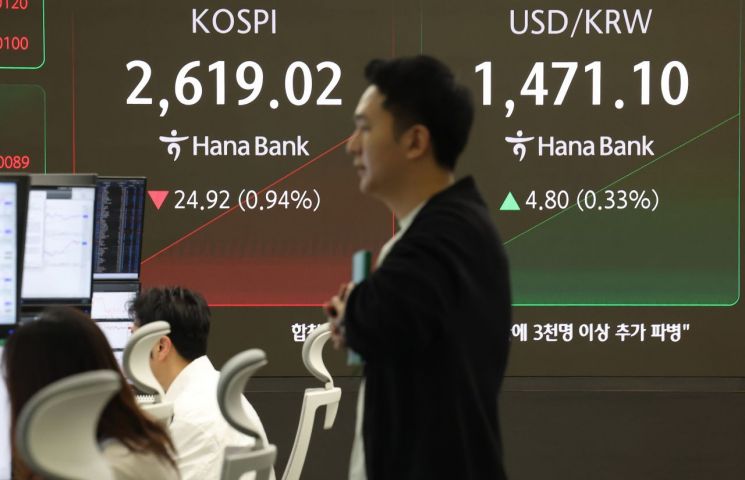
On the 31st, in the Seoul foreign exchange market, the won-dollar exchange rate closed at 1472.9 won at 3:30 PM, up 6.4 won from the previous trading day. This is the highest point this year and the second time since January 13 (1470.8 won) that weekly trading ended in the 1470 won range. Notably, it is the highest level since March 13, 2009 (1483.5 won), during the financial crisis.
On that day, the won-dollar exchange rate started trading at 1470.6 won and fluctuated between the high 1460 won range and the low 1470 won range.
The rise in the won-dollar exchange rate appears to be influenced by increased risk aversion due to concerns over the imminent mutual tariff hikes by the U.S. Trump administration and fears of stagflation (economic slowdown amid high inflation).
U.S. President Donald Trump is scheduled to announce mutual tariffs on April 2, following individual tariffs on steel, aluminum, and automobiles last month. On the 30th (local time), he told reporters, "It (mutual tariffs) will start with all countries," heightening anxiety.
The delay of the Constitutional Court's ruling on President Yoon Seok-yeol's impeachment trial to April, leaving domestic political turmoil unresolved, also had an impact. The weakness in the domestic stock market due to the resumption of short selling that day and foreign selling likely exerted upward pressure on the won-dollar exchange rate.
Meanwhile, the KOSPI recorded 2481.12, down 3.0% from the previous day.
© The Asia Business Daily(www.asiae.co.kr). All rights reserved.












