Asian Corporate Governance Association Urges Amendment to Commercial Act
Risk of Marginalization Even in Emerging Markets
"Board DNA Needed for Investor Communication and Shareholder Representation"
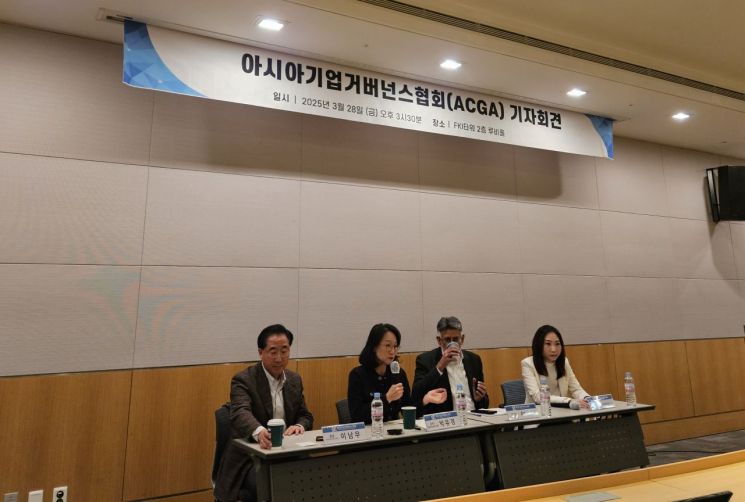 The Asian Corporate Governance Association (ACGA) held a press conference on the 28th in Yeouido, Yeongdeungpo-gu, Seoul, urging for amendments to the Commercial Act. From the left: Namwoo Lee, Chairman of the Korea Corporate Governance Forum; Yukyung Park, Head of Emerging Markets at the Dutch Pension Fund; Amar Gill, Secretary General of ACGA; Stephanie Lin, Head of ACGA Korea Research.
The Asian Corporate Governance Association (ACGA), which brings together major overseas institutional investors, has urged the passage of the amendment to South Korea's Commercial Act. They pointed out that if the governance and shareholder value of Korean companies, which are significantly lagging behind their industrial capabilities, are not improved, foreign investors will turn away, and the market could become isolated from the global stage.
On the 28th, ACGA held a press conference in Yeouido, Yeongdeungpo-gu, Seoul, to express this position. Amar Gill, Secretary General of ACGA, stated, "While the sales and operating profits of Korean companies have grown significantly over the past decade, the perspective of overseas investors has actually regressed. In the past, there was an expectation that Korea could enter the advanced markets, but now there is skepticism about whether Korean companies and their controlling shareholders truly represent the interests of all shareholders."
This was a direct criticism of the 'control premium' that only represents the interests of the largest domestic shareholders and the board of directors that acts as a rubber stamp. Amar Gill emphasized that for the Korean market to return to its original trajectory, the amendment to the Commercial Act must be passed, and the government’s ongoing corporate value enhancement (Value-Up) program incentives should be expanded. He noted that the fact that Value-Up has become a key topic is a tremendous driving force, and the government should provide momentum to ensure this is not lost.
He also suggested that the board of directors must fulfill its proper role. Amar Gill said, "In Korean companies, only the IR team communicates with investors, but the board of directors, which represents investors' rights, must actively listen to investors' voices, understand market issues and concerns, and oversee management. There also needs to be a system to educate directors on these matters," he urged.
Strange Korean Shareholders' Meetings That Block Questions and Avoid Answers
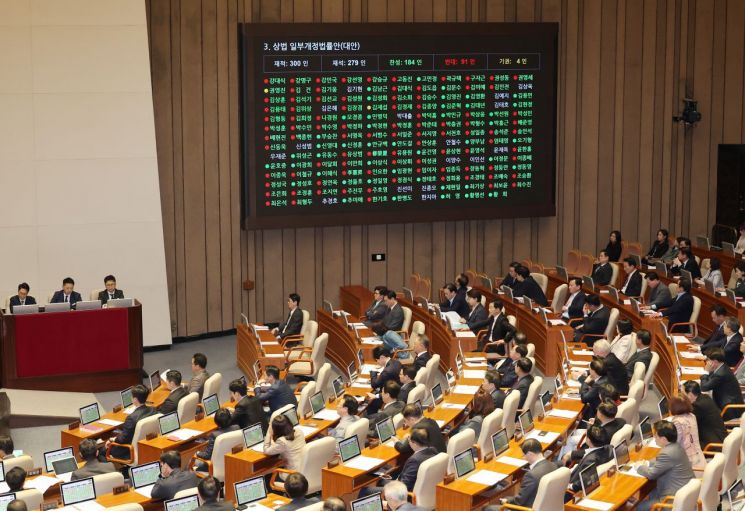
Park Yoo-kyung, Head of Emerging Markets (EM) at a Dutch pension fund managing assets worth 980 trillion won, revealed that she was 'shocked' after attending domestic corporate shareholders' meetings. Even at major domestic conglomerates' general meetings, the meeting halls were filled with company employees rather than investors, and proper questions and answers did not take place. Park said, "When I asked at a shareholders' meeting why a company that is relatively proactive in shareholder returns opposed the amendment to the Commercial Act, they did not respond. Domestic institutional investors also did not ask related questions. Although there are limitations as a trustee, I believe they must fulfill their responsibilities as shareholders," she criticized.
Amar Gill also found Korean corporate shareholders' meetings peculiar. He said, "Foreign investors from other continents were guided to separate locations outside the meeting hall under the pretext of providing simultaneous interpretation, effectively blocking any opportunity to ask questions. It is also common for the chairman of the board to be the company CEO, which raises doubts about whether the board can represent shareholders' voices and monitor management," he pointed out.
Park said, "The business community is somewhat concerned that the ambiguous interests of shareholders conflict with the company's interests and that various legal risks are involved. However, no one explains whether only shareholders' interests are ambiguous while the company's interests are clear, or what exactly these various legal risks are." She added, "For the Korean market, which stands at a crossroads, to develop, the amendment to the Commercial Act must instill the DNA that directors should consider shareholders."
© The Asia Business Daily(www.asiae.co.kr). All rights reserved.













