Emergency Countermeasure Meeting Held to Address Wildfire Damage
in the Gyeongsang Region and Beyond
Government-funded research institutes discussed plans for technical support, including the development of practical and comprehensive technologies for on-site response to wildfires in the Gyeongsang region.
The National Science and Technology Council (NST) held an "Emergency Countermeasure Meeting for Wildfire Damage Response in the Gyeongsang Region and Others" on the 27th at the Sejong National Research Complex.
The meeting was attended by the NST Chairman and Headquarters Director, as well as heads of 23 affiliated research institutes, focusing on ▲current wildfire damage status and response plans of the institutions ▲research status related to wildfires and disasters ▲support measures for recovery in affected areas.
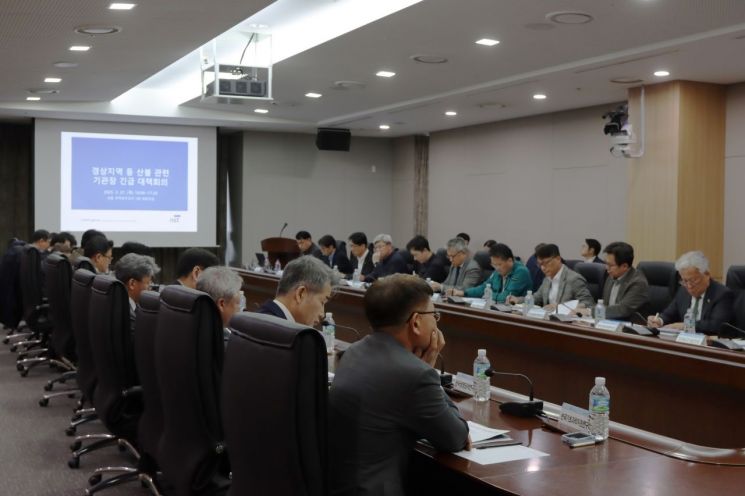 The National Science and Technology Council (NST) held an "Emergency Countermeasure Meeting for Wildfire Damage Response in the Gyeongsang Region and Others" on the 27th at the Sejong National Research Complex. Attending the meeting were Kim Young-sik, Chairman and Head of NST, along with the heads of 23 affiliated research institutes. Photo by NST
Kim Young-sik, Chairman of NST, expressed, "We extend our deepest condolences to the victims and bereaved families affected by the large-scale wildfires," adding, "The science and technology community will develop practical and comprehensive technologies that can be implemented on-site for wildfire suppression, thereby making a tangible contribution to disaster response and recovery."
Lee Pyung-gu, Director of the Korea Institute of Geoscience and Mineral Resources, stated, "The risk of landslides has increased following the wildfires," and added, "We plan to provide predictive data on landslide risk areas by comprehensively analyzing long-term forecast data from the Korea Meteorological Administration, Korea Forest Service, and local governments."
They also shared expected future effects of ongoing research at the affiliated institutes, including ▲gas hydrate fire extinguishing agents and fire suppression technologies for hard-to-access fires ▲preliminary research on fire visual enhancement systems for rapid response at fire disaster sites ▲development of infrared image analysis and lightweight technologies for invisible disaster sites.
NST plans to integrate technologies from each institution to develop synergistic disaster response technologies and to promote both material and human support for the rapid recovery and stable daily life restoration of wildfire-affected areas and residents.
© The Asia Business Daily(www.asiae.co.kr). All rights reserved.

![Clutching a Stolen Dior Bag, Saying "I Hate Being Poor but Real"... The Grotesque Con of a "Human Knockoff" [Slate]](https://cwcontent.asiae.co.kr/asiaresize/183/2026021902243444107_1771435474.jpg)















