Unprecedented: Same Release Date
Confidence in Targeting the Domestic Market
TCL Sells at Low Prices Online
Our Products Cost Nearly Twice as Much
Chinese TV Shipments Surpass Korea
Domestic Companies Seek Differentiation with AI Features
Chinese home appliance company TCL unveiled a new TV model coinciding with LG Electronics' TV new product launch date. While March and April are typically when companies introduce new TV models, it is extremely rare for them to set the release date on the same day. This has led to interpretations that TCL is showing confidence in targeting the domestic TV market, which is the stronghold of LG Electronics and Samsung Electronics. Our companies also appear to be entering an all-out battle to defend their home turf.
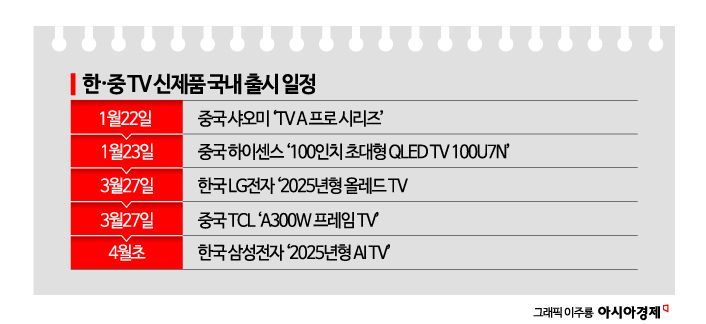
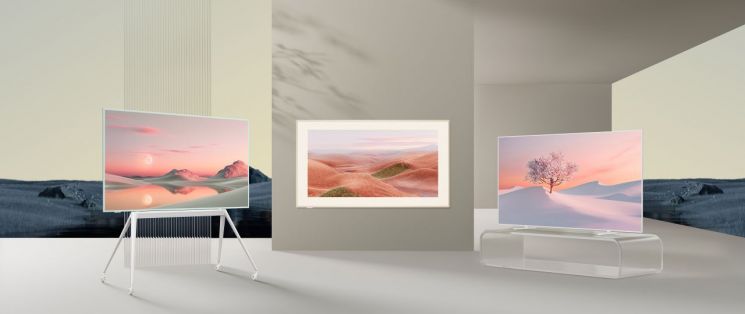
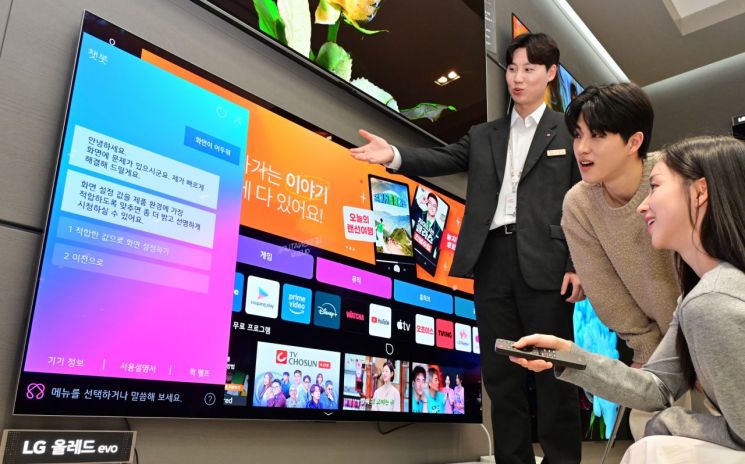
According to the home appliance industry on the 28th, TCL launched the 'A300W Frame TV' in Korea on the 27th, the previous day. Coincidentally, on the same day, LG Electronics began selling its '2025 OLED TV' at major domestic stores such as the Gangseo and Daechi flagship stores.
Industry insiders suggest that TCL may have strategically chosen the same release date. An industry official said, "Creating a competitive showdown with rivals to increase attention is a sales strategy typical of Chinese companies," adding, "While LG Electronics is expanding offline sales, TCL's move to start low-priced sales online is also notable." TCL is currently selling the new product on Coupang.
The biggest weapon of Chinese products is price. On Coupang, TCL's 'A300W Frame TV' 65-inch model is priced between 1.31 million and 1.51 million KRW, and the 75-inch model is around 1.71 million KRW. Considering that subscribing to a similar-sized LG '2025 OLED TV' new model for five years would cost over 3 million KRW in total, TCL is effectively selling at nearly half the price of our products.
The low-price strategy is showing some effect. As consumer satisfaction with Chinese products purchased and used directly increases, word of mouth about their cost-effectiveness is spreading. There is analysis that the position of domestic products in the local market is somewhat shaken.
According to recent data from market research firm Omdia, based on last year's shipment volume, the combined market share of Chinese companies TCL, Hisense, and Xiaomi was 31.3%, surpassing Samsung Electronics and LG Electronics' combined share of 28.4%. This is the first time Chinese TV shipments have overtaken those of Korea.
Chinese pursuit is fierce even in the premium market. According to Counterpoint Research, as of the fourth quarter of last year, Samsung Electronics' share of the premium TV market was 29%, down 12 percentage points from the previous year, while TCL and Hisense increased their shares to 20% and 16%, respectively. Although the market share of Chinese TVs in Korea is still small, the potential for growth is significant.
The confidence of Chinese TVs is not limited to price alone. They are narrowing the technology gap by continuously releasing new products equipped with advanced technologies such as Mini LED. Hisense introduced the 100-inch QLED TV '100U7N' in Korea in January, and Xiaomi is expanding its market share with the high-performance 'A Pro Series.' TCL has also launched a premium TV in Korea featuring nano-coating reflection reduction technology and integrated Dolby Atmos speakers, targeting the large and high-end market.
Domestic companies are attempting technological differentiation through artificial intelligence features, but it is evaluated that defending the home market is not easy against the offensive of Chinese products that combine price and performance. Shin Moo-yeop, Deputy Director of the New Trade Strategy Office at the Truth Martial Arts International Trade and Commerce Research Institute, said, "Chinese companies are employing a new strategy of selling home appliances such as TVs both online and offline in our market while providing after-sales service (AS). They are increasing cost-effectiveness tailored to domestic consumers who value AS, and with improved technology and durability, our companies need strategies to respond to this changed competitive landscape."
Additionally, a KOTRA official in charge of China stated, "Our companies must secure market competitiveness through continuous quality and technological innovation, building differentiated images and customer services suited to the Korean market, and expanding the use of digital marketing."
© The Asia Business Daily(www.asiae.co.kr). All rights reserved.



















