Korea: "Significant Impact on Automobiles Due to U.S. Tariffs"
Sohn Kyung-shik Requests "Careful Deliberation on Commercial Act Amendment"
On the 27th, the heads of six economic organizations met with Acting President and Prime Minister Han Duck-soo to request that he consider exercising the right to request reconsideration (veto power) on the amendment to the Commercial Act, which was passed by the National Assembly plenary session led by the opposition party.
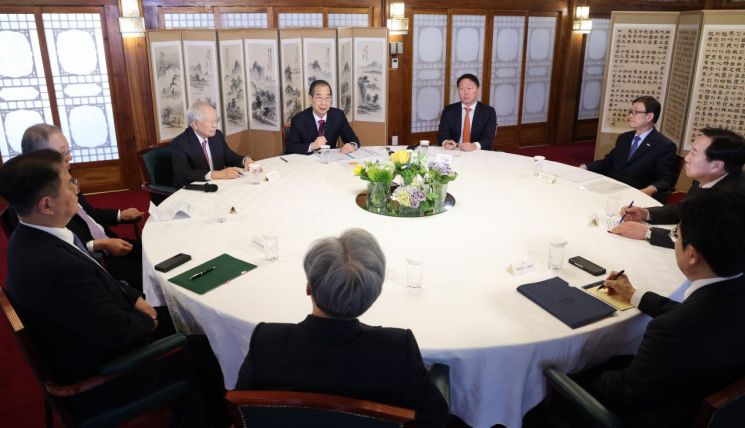 Acting President and Prime Minister Han Duck-soo is presiding over a meeting with six economic organizations held at the Prime Minister's official residence in Jongno-gu, Seoul, on the 27th. Photo by Yonhap News
According to the Prime Minister's Office, Acting President Han held a roundtable meeting with the heads of the six economic organizations at the Prime Minister's official residence in Seoul at 2 p.m. that day to discuss issues including the U.S. tariff imposition and the amendment to the Commercial Act.
The roundtable was attended by Sohn Kyung-shik, Chairman of the Korea Employers Federation; Yoon Jin-sik, Chairman of the Korea International Trade Association; Kim Ki-moon, Chairman of the Korea Federation of Small and Medium Business; Ryu Jin, Chairman of the Korea Economic Association; Choi Jin-sik, Chairman of the Korea Association of Mid-sized Enterprises; and Choi Tae-won, Chairman of the Korea Chamber of Commerce and Industry.
Acting President Han stated, "Today, the U.S. government decided to impose a 25% tariff on automobiles produced abroad, raising concerns that our core industry, the automobile sector, could be significantly affected."
He continued, "In this trade war situation, we will prioritize protecting our companies by preparing response strategies together with businesses and focusing on customized corporate support. Additionally, to minimize damage to our companies, the government and private sector will utilize all available networks to communicate with the U.S. government," he emphasized.
Acting President Han added, "Just as the government and private sector have overcome various crises in our country by working together, if the public and private sectors unite as one team and exert full effort, we can overcome the current crisis," urging economic organizations to take the lead and lend their support.
Chairman Sohn Kyung-shik requested Acting President Han, "The recently passed amendment to the Commercial Act increases managerial uncertainty and could suppress investment and innovation. We ask for more cautious deliberation."
Chairman Ryu Jin emphasized, "As the U.S. is strengthening protectionism, close cooperation between the public and private sectors is urgently needed. Regarding the amendment to the Commercial Act, it could cause very serious side effects to our economy and companies, so we ask for careful review."
The amendment to the Commercial Act adds shareholders to the duty of loyalty for directors and requires directors to protect the interests of all shareholders when performing their duties. The business community has opposed this bill, arguing that its enforcement could lead to frequent management instability due to shareholders filing excessive lawsuits.
Since the amendment to the Commercial Act was submitted to the government on the 21st, Acting President Han must either promulgate the bill or exercise veto power by the 5th of next month. Although he has not yet expressed a clear stance, he voiced concerns during the National Assembly's government questioning session in September last year.
Chairman Choi Tae-won said, "Responding to the realized U.S. trade pressure is an urgent task. We proposed a cooperative plan between Korea and the U.S. to strategically create synergy at the private sector level and opened the door for economic cooperation discussions between the two countries. The government also needs to develop response measures and actively engage in diplomatic negotiations with the U.S. through official channels."
Chairman Choi Jin-sik requested, "Please create an environment where companies and workers can leap forward together by promoting corporate activities through lowering inheritance and gift tax rates to OECD levels and enhancing labor flexibility, and by increasing disposable income for workers through raising income tax brackets."
© The Asia Business Daily(www.asiae.co.kr). All rights reserved.

















