Songpa-gu Ranks First in House Price Growth for 2025
Turns Downward on Weekly Basis for the First Time This Year
Negative Factors Reflected Ahead of Land Transaction Permit Zone Reimplementation
All Three Gangnam Districts See Slower Growth... Seoul's Upward Trend Stalls
Apartment sale prices in Songpa-gu, Seoul, have turned downward on a weekly basis for the first time this year. This appears to reflect a preemptive adjustment trend ahead of the reimplementation of the land transaction permit zone.
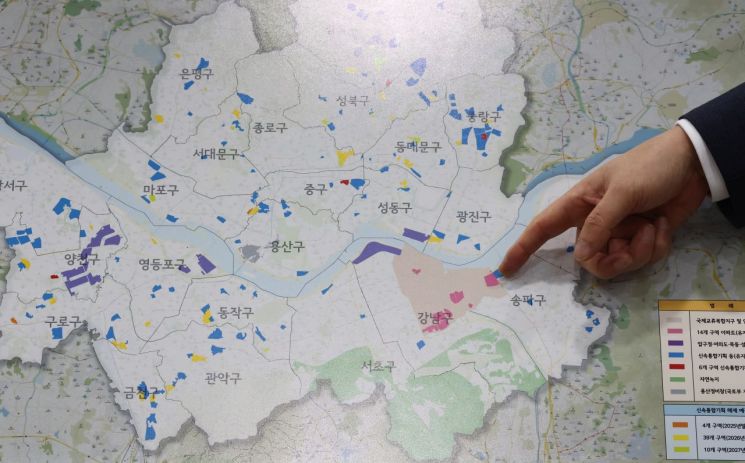 Jonamjun, Head of the Urban Space Headquarters of Seoul City, is conducting a briefing on the results of the review for the lifting of the Seoul City Land Transaction Permission System at Seoul City Hall on the 12th. Photo by Yonhap News
According to the nationwide weekly apartment price trend for the fourth week of March (as of the 24th) announced by the Korea Real Estate Board on the 27th, Seoul recorded a 0.11% increase, less than half of last week's 0.25%. Although the upward trend continued for five consecutive weeks, the rate of increase slowed. The rise in Gangnam-gu (0.36%) and Seocho-gu (0.28%) decreased, and Yongsan-gu also slowed from 0.34% to 0.18%. Notably, Songpa-gu, one of the Gangnam 3 districts, turned negative (-0.03%) for the first time this year.
Across Seoul, areas with price increases still predominated, but the growth rates in major areas such as Gaepo and Apgujeong-dong in Gangnam-gu, and Banpo and Jamwon-dong in Seocho-gu, were lower than the previous week. In particular, Songpa-gu saw prices adjust downward in the Jamsil and Sincheon-dong areas, turning into a decline. Songpa was a region with a large increase, with a cumulative rise of 3.61% nationwide this year.
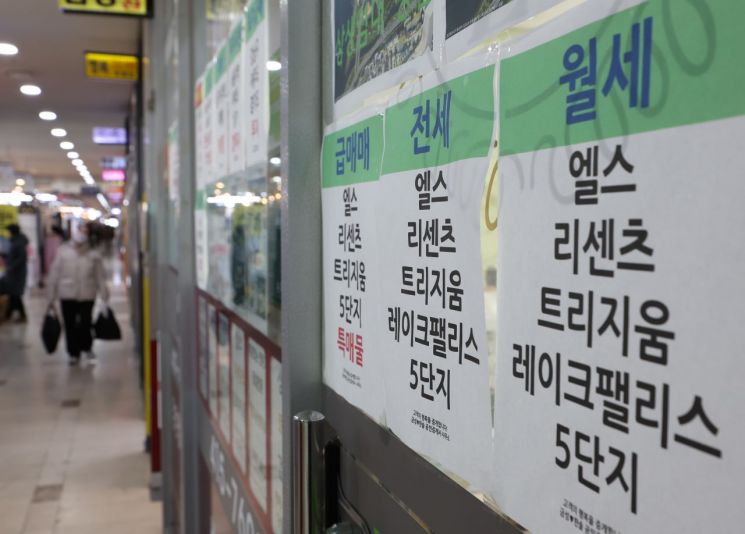
The reference date for this week's price trend is the 24th. This is the day when Seoul designated and implemented the land transaction permit zones covering four districts: Gangnam, Seocho, Songpa, and Yongsan. It can be seen as reflecting price changes just before the regulation took effect. In the case of Songpa, which has been considered the epicenter of rising house prices this year, negative factors appear to have been preemptively reflected as the regulation implementation approached. The Real Estate Board stated, “Although some buying demand continues in preferred complexes such as reconstruction areas, the increase in listings and cautious sentiment have combined to slow the upward trend.”
Meanwhile, nationwide apartment sale prices turned downward by 0.01%, halting the upward trend. The metropolitan area rose by 0.03%, while provincial areas fell by 0.04%, continuing regional polarization. By city and province, Jeonbuk (0.02%) and Ulsan (0.01%) saw increases, Gyeonggi (0.00%) was flat, and Daegu (-0.13%), Incheon (-0.07%), Jeju (-0.06%), Gwangju (-0.06%), Gyeongnam (-0.05%), and Daejeon (-0.05%) experienced declines.
© The Asia Business Daily(www.asiae.co.kr). All rights reserved.