EU Chief: "Seeking Solutions Through Negotiations"
Canadian Prime Minister Criticizes "Very Direct Attack"
Korean Ministry of Industry Holds Emergency Public-Private Countermeasure Meeting
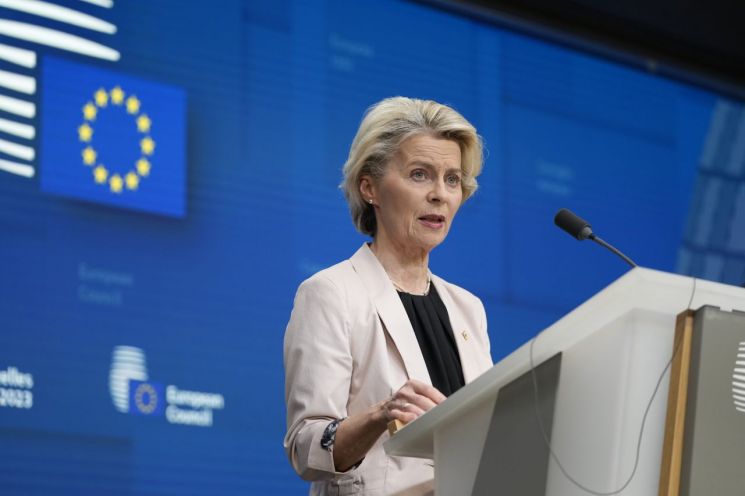 Ursula von der Leyen, President of the European Commission. After U.S. President Donald Trump announced a 25% tariff on automobiles on the 26th (local time), leaders from Europe, Canada, and other countries expressed regret and hinted at 'retaliatory tariffs.' /AP Photo·Yonhap News
After U.S. President Donald Trump's announcement on the 26th (local time) of a 25% tariff on automobiles, leaders from Europe, Canada, and other countries expressed regret and hinted at 'retaliatory tariffs.' Japan, South Korea, Mexico, and others, which had previously expressed concerns at the government level, also faced difficulties and began urgently preparing countermeasures.
According to U.S. news agencies including Reuters, Ursula von der Leyen, President of the European Union (EU) Commission, issued a statement that afternoon saying, "We deeply regret the decision by the United States to impose tariffs on European automobile exports."
She pointed out that "the automotive industry is a driving force that creates innovation, competitiveness, and high-quality jobs through deeply integrated supply chains on both sides of the Atlantic," and added, "We will evaluate this announcement along with other measures the U.S. is considering." This is interpreted as meaning that the EU will review the comprehensive response direction after seeing the details of the reciprocal tariffs the U.S. plans to announce on April 2.
However, President von der Leyen stated, "While protecting our economic interests, the EU will continue to seek solutions through negotiations," leaving the possibility of talks open. It is observed that she is being cautious in her official remarks as negotiations with the U.S. are currently underway.
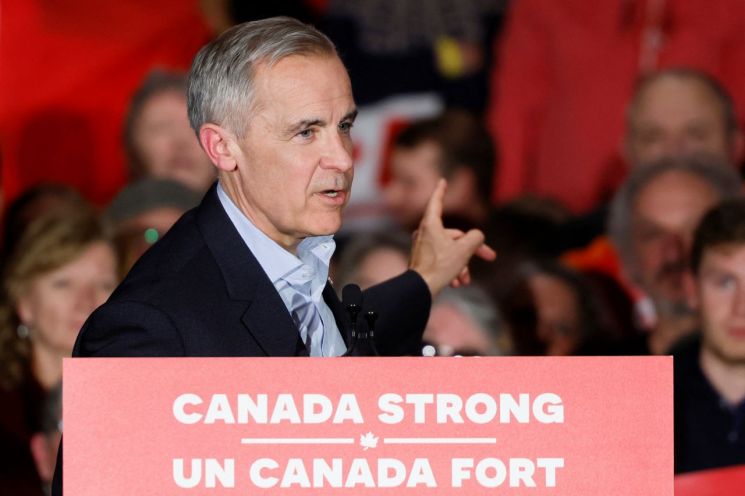 Mark Carney, Prime Minister of Canada, is speaking on the 26th in Kitchener, Ontario, Canada, regarding President Trump's announcement of a 25% tariff on imported automobiles. / Reuters · Yonhap News
Canada, which recently entered into a full-scale 'trade war' with the U.S., responded more aggressively. Canadian Prime Minister Mark Carney declared, "We will protect our workers," showing a strong determination to respond. He described the U.S. automobile tariff announcement as a "very direct attack" on the Canadian economy.
However, Prime Minister Carney stated that before imposing retaliatory tariffs, the details of the executive order signed by President Trump must be reviewed. Ahead of an early general election next month, Carney plans to briefly leave the campaign trail on the 27th to hold an emergency meeting with the 'Special Cabinet Committee on Canada-U.S. Relations,' which handles Canada's diplomatic affairs with the U.S.
Efforts by various countries to obtain exemptions from the automobile tariffs through behind-the-scenes negotiations with the U.S. also fell through. The Washington Post (WP) noted, "Canada and Mexico hoped for tariff exemptions, but their efforts were insufficient."
Japan's government spokesperson, Chief Cabinet Secretary Yoshimasa Hayashi, indicated ongoing responses during a press conference two days earlier on the 25th, after President Trump announced the planned automobile tariffs, stating that the Japanese government had requested exclusion from the U.S. tariff policy. In Japan's case, the Japan Automobile Manufacturers Association (JAMA) and others actively competed in lobbying for tariff exemptions. The South Korean government is also considering responses, with the Ministry of Trade, Industry and Energy announcing on the same day that it will hold an emergency public-private joint countermeasure meeting to respond to Trump's automobile tariffs.
© The Asia Business Daily(www.asiae.co.kr). All rights reserved.
![Clutching a Stolen Dior Bag, Saying "I Hate Being Poor but Real"... The Grotesque Con of a "Human Knockoff" [Slate]](https://cwcontent.asiae.co.kr/asiaresize/183/2026021902243444107_1771435474.jpg)

















