Tariffs on Foreign Cars to Be Imposed Starting April 2
Second Item-Specific Tariff After Steel and Aluminum on the 12th
Korean Companies, as a Top 3 U.S. Car Importer, Face Direct Impact
Trump: "Reciprocal Tariffs Will Apply to All Countries... We Will Be Generous"
Hints at Possible Tariff Reduction on China to Facilitate TikTok Sale
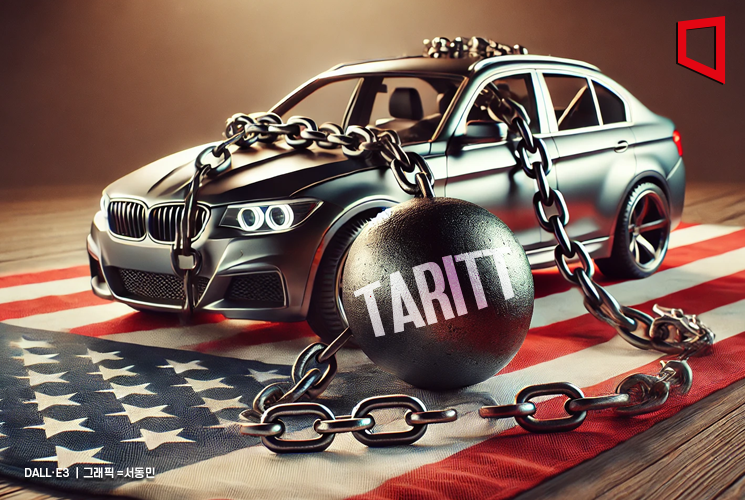
U.S. President Donald Trump announced on the 26th (local time) that starting April 2nd, a permanent 25% tariff will be imposed on foreign-made automobiles imported into the United States. This is the second item-specific tariff measure following the steel and aluminum tariffs, and the high tariff rate will apply not only to finished vehicles but also to key components. As the tariff front triggered by Trump expands comprehensively, Korean companies, which are among the top three automobile exporters to the U.S. and whose vehicles are the number one export item to the U.S., are expected to be directly hit by this measure.
President Trump also said that the reciprocal tariffs to be announced next week will be imposed at a very lenient level for all countries, signaling that the tariff bombardment will continue. He also mentioned that tariffs on China could be lowered to facilitate the sale of TikTok's U.S. business rights.
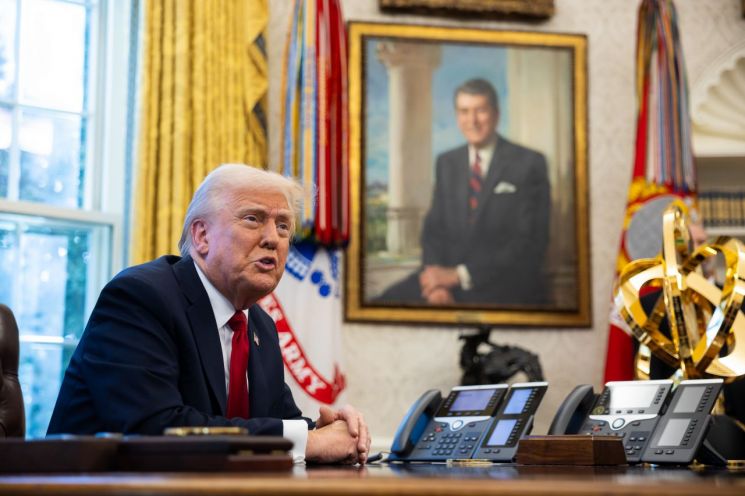
Trump: "Permanent 25% Tariff on Foreign Cars Starting April 2"
President Trump held a press conference at the Oval Office in the White House and signed an executive order stating, "What we will do is impose a 25% tariff on all cars not produced in the United States." Until now, the U.S. had imposed tariffs of 2.5% on passenger cars and small trucks, and 25% on pickup trucks, but this measure will unify the tariff rate on all imported cars to 25%.
He said, "We will impose tariffs on countries that operate businesses in our country, steal our jobs and wealth, and have taken a lot from us over the years," adding, "Vehicles produced in the United States will have no tariffs at all."
President Trump explained that the automobile tariffs will take effect on April 2, the day reciprocal tariffs are announced, and tariffs will be collected starting the next day. The proclamation states that tariffs will be imposed from midnight on April 3, Eastern Time. The White House also announced that the 25% tariff will apply not only to finished vehicles but also to major automobile parts including engines, transmissions, powertrains, and electrical components. Tariffs on key components are expected to take effect before May 3.
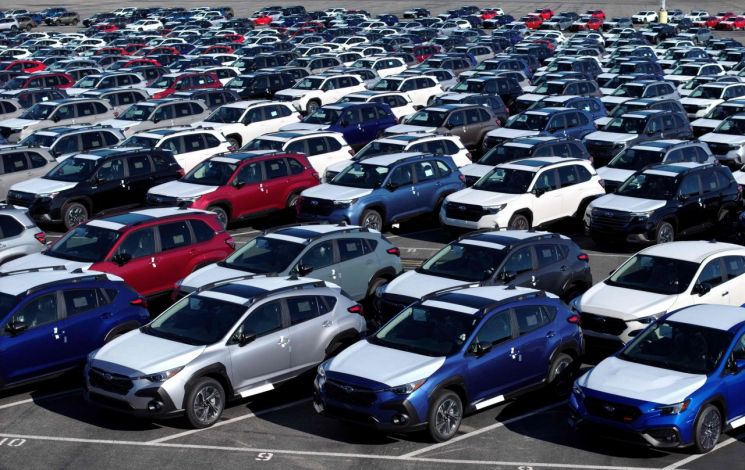
President Trump also described this measure as "permanent" and expressed no interest in negotiations regarding tariff exemptions. It appears he made it clear that automobile tariffs are not for negotiation and exemptions will not be granted. Will Sharp, White House Document Secretary, also explained, "The new tariff measure will generate more than $100 billion in new annual (tax) revenue." This suggests that automobile tariffs will be used as a multifaceted tool for resolving U.S. trade imbalances, revitalizing manufacturing, and increasing tax revenue.
This automobile tariff increase had been anticipated even before President Trump's inauguration. During his first term, Trump considered raising tariffs on steel and automobiles. At that time, only steel tariffs were raised to 25%, and automobile tariffs were left untouched until the end of his term. Afterwards, his aides criticized that automobile tariffs should have been raised then. For this reason, domestic and international trade experts had predicted that Trump would raise automobile tariffs to 25% during his second term, and he announced the increase based on Section 232 of the Trade Expansion Act, which was used for the steel tariff hike in his first term. Section 232 allows the president to restrict imports through tariffs or other measures if deemed a threat to national security.
'Number One Export Item to the U.S., Automobiles' Korean Companies Expected to Take Direct Hit
Korean and other major automobile-exporting countries to the U.S. are expected to suffer direct damage from this automobile tariff measure. According to statistics from the International Trade Administration (ITA) under the U.S. Department of Commerce, the U.S. imported $36.6 billion worth of automobiles from Korea in 2024, ranking third after Mexico ($78.5 billion) and Japan ($39.7 billion). Automobiles also account for the largest share of Korea's exports to the U.S. According to the Korea International Trade Association, Korea's exports to the U.S. in 2024 reached a record high of $127.786 billion, with automobile exports amounting to $34.744 billion, representing 27.1%, the largest share.
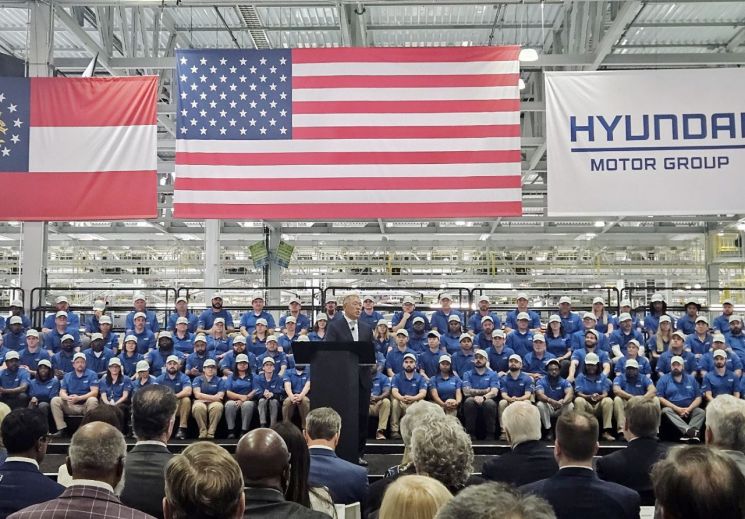
The domestic automobile industry, facing an urgent crisis, is forced to adjust its global production portfolio. The hardest hit is Korea GM. Korea GM, whose export ratio to the U.S. is absolute, is even facing the possibility of withdrawal due to this tariff decision. Korea GM has been responsible for exporting about 500,000 small sport utility vehicles (SUVs) annually to the U.S. It had price competitiveness due to low labor costs, production innovation, and tariff-free benefits under the Korea-U.S. Free Trade Agreement (FTA), but the high tariff will eliminate this price competitiveness. It is predicted that the American company General Motors (GM) will increase domestic production. Hyundai Motor Group announced plans to increase the production capacity of its third U.S. plant, Hyundai Motor Group Meta Plant America (HMGMA), from 300,000 to 500,000 units. Earlier, on the 24th, it also announced a new investment plan of $21 billion over the next four years at the White House. However, concerns have been raised that increased U.S. production will naturally lower the operating rate of domestic plants, leading to economic slowdown due to reduced exports and even job losses.
Bloomberg News analyzed, "Such tariffs significantly expand the president's trade battles and are likely to put many of the largest automakers in major U.S. trading partners, including Japan, Germany, and Korea, in a difficult position," adding, "It also risks disrupting the management of North American automakers that rely on highly integrated supply chains across the U.S., Mexico, and Canada."
Trump: "Reciprocal Tariffs for All Countries"... Suggests Possible Tariff Reduction on China to Facilitate TikTok Sale
President Trump reaffirmed the plan to impose reciprocal tariffs to be announced on April 2. He stated that reciprocal tariffs will be imposed on "all countries," adding, "We will be very generous, and in many cases, the rates will be lower than what other countries have imposed on the U.S. for decades." Although he said on the 24th that exemptions could be granted to several countries, he reversed his stance two days later, saying the tariffs will apply to all countries. Regarding plans to impose tariffs on other items such as semiconductors and pharmaceuticals, he said, "Not on that day (April 2), but tariffs will be imposed on pharmaceuticals and lumber," signaling that additional item-specific tariffs will continue and the tariff front will widen further.
President Trump also indicated that tariffs on China could be lowered if China cooperates in the sale of TikTok's U.S. business rights. He said, "I think China will probably play an approving role regarding TikTok (in relation to the sale of U.S. business rights)," adding, "If that happens, we might give a slight tariff reduction or something else."
© The Asia Business Daily(www.asiae.co.kr). All rights reserved.

![Clutching a Stolen Dior Bag, Saying "I Hate Being Poor but Real"... The Grotesque Con of a "Human Knockoff" [Slate]](https://cwcontent.asiae.co.kr/asiaresize/183/2026021902243444107_1771435474.jpg)

















