Amid growing concerns over an economic downturn triggered by the so-called 'Trump tariffs,' domestic securities analysts have concluded that it will be difficult for U.S. President Donald Trump to maintain a hardline tariff policy, and that four buffers to absorb the economic shock are already in place. It is expected that even if only one of these buffers takes effect, the stock market will once again be reassured.
On the 27th, NH Investment & Securities researcher Jo Yeon-ju stated in the report titled "The U.S. is in Detox" that "the uncertainty surrounding Trump's tariff policy will peak in April."
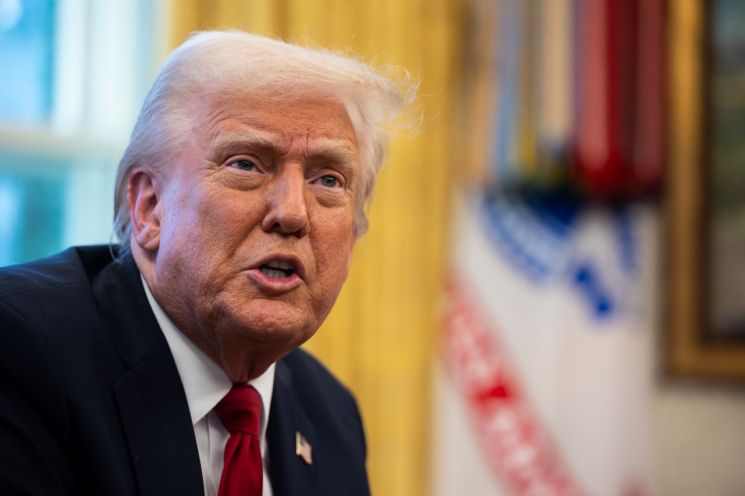
First, Researcher Jo pointed out that recent declines in the stock market and economic sentiment indicators were due to market concerns over Trump's tariff policy, but he also noted, "It is difficult for the policy to be implemented in an extreme manner. The reason it is hard to sustain a hardline tariff policy is that the multiplier effect of this policy on the U.S. economy is not significant." He added, "Trump hopes to expand domestic investment and revive manufacturing through high tariffs, but the U.S. economy is more focused on services (50%) than manufacturing (10%)."
However, if President Trump insists on a hardline tariff policy to revive manufacturing, it is expected that "it could cause a significant shock to the U.S. economy." Researcher Jo cited past radical policies that led to U.S. recessions, such as the Smoot-Hawley Tariff Act under President Herbert Hoover in 1930, the abandonment of the gold standard by President Richard Nixon in 1971, and the interest rate hikes initiated by Federal Reserve Chairman Paul Volcker in 1979. He predicted, "If Trump's tariffs are excessively implemented, it will be difficult to avoid a recession, so a gradual implementation is more likely." He further emphasized that in past situations, the factor that helped avoid recession was a rapid policy shift, citing examples such as the Fed's monetary policy shift during the 1998 Asian financial crisis and large-scale tax cuts following the 2002 dot-com bubble burst.
Ultimately, to avoid sliding into a recession, it is argued that for President Trump, "vitamin supply during the detox period is essential." Earlier, President Trump likened the recent declines in the stock market and economic sentiment indicators due to tariff policies to a 'detox period,' a process of removing toxins accumulated in the body. Accordingly, Researcher Jo compared the stimulus policies to vitamins that absorb the economic shock caused by the tariff policy.
In particular, Researcher Jo identified four buffers prepared by the Trump administration to prepare for economic slowdown: ▲ the Fed's interest rate cut stance ▲ improvement in consumer sentiment through falling crude oil prices (Drill Baby Drill policy) ▲ expansion of fiscal policies such as tax cuts ▲ increase in real income due to deregulation. Among these, the tax cut policy, which has previously shown a strong effect in stimulating U.S. consumption, is expected to be announced at least before the summer recess in July.
Researcher Jo said, "Even if only one of the four buffers prepared by the U.S. government to prevent economic shocks takes effect, the stock market will be reassured again," and added, "Considering that there are several domestic demand stimulus cards available and the 'Trump volatility' that allows policy changes at any time, May could rather be a phase of opportunity."
He also noted, "Since Trump's election, the stock market performances of the U.S. and China have diverged significantly, but Trump, who is sensitive to stock indices, will not allow this trend to continue," and diagnosed, "If the price-to-earnings ratio (PER), which acted as the first support level after 2023, falls below 20 times, it will be a buying opportunity."
Meanwhile, on the afternoon of the 26th (local time), President Trump signed an executive order imposing a 25% tariff on foreign automobiles and confirmed that the reciprocal tariffs scheduled for April 2 will apply to all countries, including Korea. On the same day, the three major indices of the New York Stock Exchange also closed down amid tariff concerns.
© The Asia Business Daily(www.asiae.co.kr). All rights reserved.












